
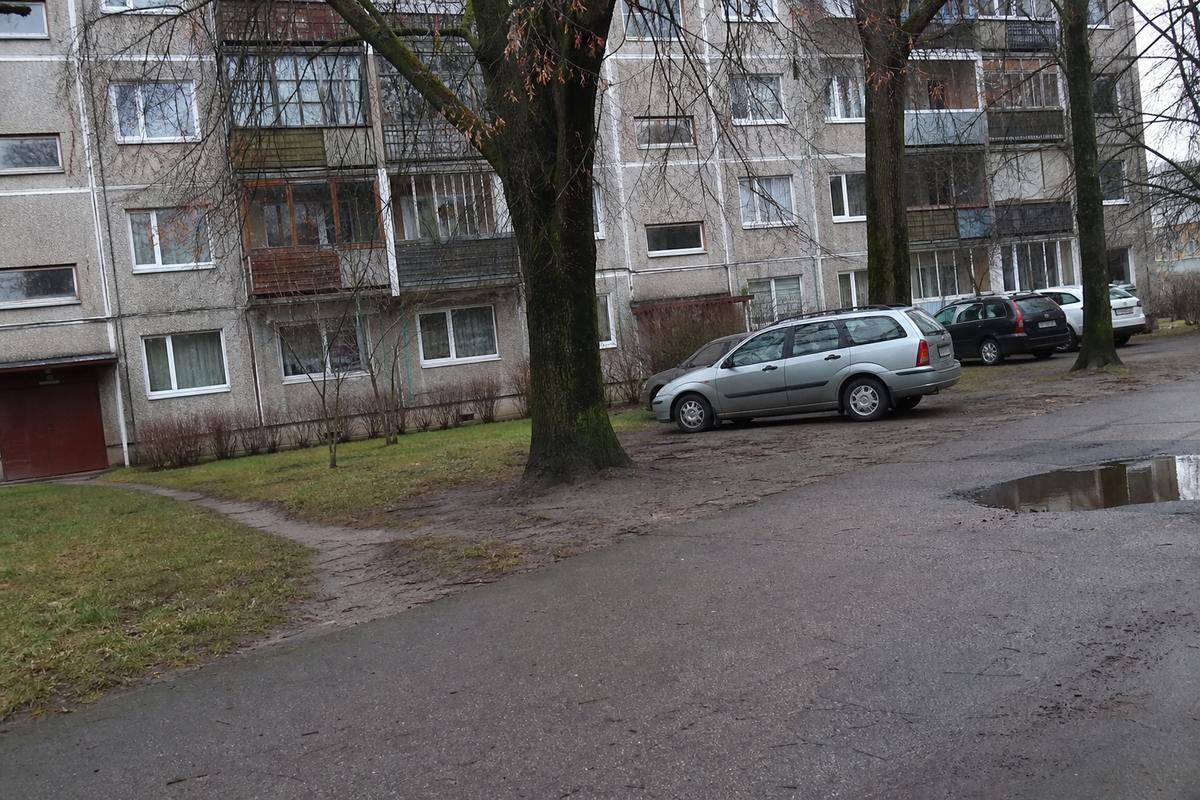
Rīga is not one market but several. A tree in a villa garden in Mežaparks, a tree in the courtyard of a five-storey block in Purvciems and a tree in an inner courtyard in Vecrīga call for three completely different methods — the access, the drop zone, the approvals and the question of who orders the work at all are all different. So we do not promise one price per tree; we first establish where the particular tree grows.
Where we are called out most often in Rīga
The city's fabric is very uneven — a dense historic centre, extensive Soviet-era apartment districts, areas of detached houses on the outskirts, office and port sites. In practice that means four distinct working scenarios:
- Inner courtyards of apartment blocks. Ķengarags, Purvciems, Imanta, Zolitūde, Pļavnieki. Poplars and maples planted when the buildings went up are now close to roofs and balconies. The courtyard is full of cars, and the tree can almost never be felled whole — we dismantle it in sections, lowering every piece on a rope. We have written separately about who may order work like this and how it is approved: tree removal in apartment block courtyards.
- The centre and Vecrīga. Inner courtyards entered through a gateway, with restricted parking but roofs, gutters and historic façades overhead. Here the positioning of machinery has to be agreed in advance, and often the only solution is climbing the tree with rope access.
- Areas of detached houses. Mežaparks, Bieriņi, Berģi, Šampēteris, Jaunciems, Vecāķi. Old pines and oaks that grew before the house did. Here it is more often a question not of removal but of crown care and assessing the tree's condition.
- Commercial premises and grounds. The surroundings of offices, shops, warehouses and production sites, where the work often has to be done outside business hours so as not to obstruct access and customers.
What access changes in Rīga
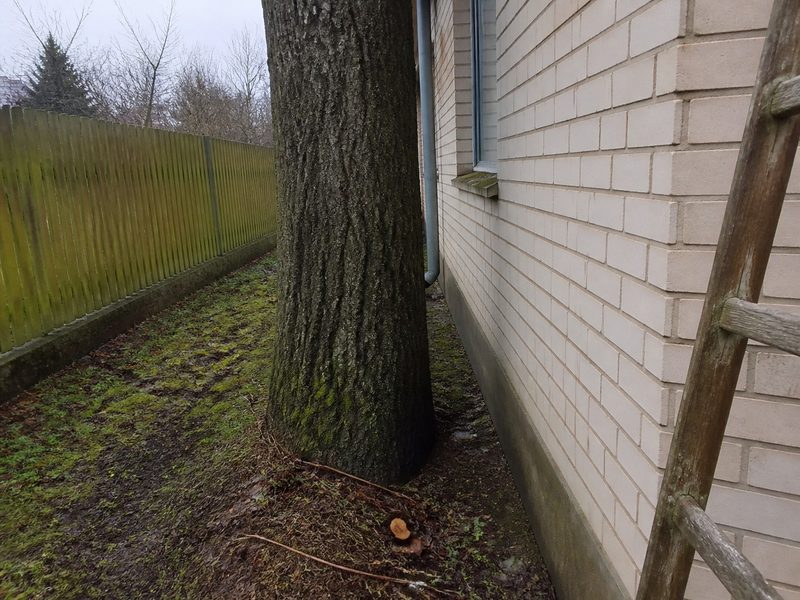
In Rīga the planning of a visit and of the work is changed by things that are no problem in a small town. Daugava crossings and congestion on the bridges can add half an hour; the parking regime in the centre means the chipper and trailer need a space agreed beforehand; inner courtyards often have an archway our machinery simply will not fit through.
So in your enquiry it helps us greatly to have a photo showing not only the tree but also the route to the tree. If there is no vehicle access at all, that is no obstacle — we work where machinery cannot reach, carrying the material out by hand. But we need to know beforehand, as it changes both the size of the team and the price.
Typical problems with Rīga's trees
City trees have ailments that country trees do not. The commonest we see in Rīga is compacted and overloaded soil — paving, parking and heavy machinery over the root zone. The tree does not die from it at once; it happens gradually, over years, and the first sign is a thinner crown and deadwood in the top. What can be done about it is described under root and soil care.
The second frequent situation — roots lifting paving or pressing on foundations, and shade falling into a flat or a garden. The third — old poplars and maples left after storms with branches broken but not fallen above a footpath.
Permits in Rīga
Felling a tree outside a forest in Rīga requires a permit from the local authority in most cases, including in a private garden, and the procedure differs from the surrounding municipalities. For dead trees and trees in a dangerous condition the requirements are different from those for a healthy tree someone wants removed because of shade.
We handle the permit for you. First we check whether one is needed for the particular tree at all — quite often it turns out not to be. If the tree is a heritage or protected tree, we say so at once, because then the conversation is about care rather than felling. In more detail: tree felling permits.
Which trees grow in Rīga and what that means in practice
Rīga's planting has come in several waves, and the species often tells you what work will be needed. In courtyards and along the streets the common lime and the maple dominate — they usually do not need felling, but the deadwood has to be taken out regularly and the crown thinned, because in a dense crown the lower branches die and break precisely above pavements and parking spaces.
A great deal of poplar was planted in the Soviet-era districts. It grows fast, but the inside of the trunk tends to rot sooner than can be seen from outside, so before any decision we look at the base of the trunk, the cavities and the bracket fungi. Birch in older gardens often starts dying back from the top. Ash trees across Rīga show ash dieback, and they become brittle quickly — a dead ash beside a pavement or a playground has to be dealt with, not deferred.
In Mežaparks, Bukulti and the other pine neighbourhoods we work more carefully: pines tolerate root damage and soil compaction badly, so we position machinery further off and work more with ropes. If you are not sure what is growing in your courtyard and how dangerous it is, we start with a tree health assessment.
How the work divides across the seasons in Rīga
In Rīga the season changes not only the state of the tree but how realistic it is to reach it at all. In scheduling we take account of both the tree's biology and the daily life of the courtyard.
- Winter and early spring. The best time for larger cutting jobs: the trees are bare, the structure of the crown is legible, the ground is frozen and the lawn suffers less. In courtyards it is usually easier in winter to agree on freeing up parking briefly.
- Spring and summer. During the bird nesting season we check the crown before starting — if there is an occupied nest in the tree, we postpone the work or do only the part that does not affect the nest. In summer it is easy to see which branches have not come into leaf, so it is a convenient moment for deadwood removal and for dealing with shade problems.
- Autumn and the storm season. After westerly winds the trees that come down in Rīga are usually the ones that were already rotten at the base. We look at leaning and fallen trees ahead of the queue, and in emergencies we normally come out the same day.
If the work needs a permit from the local authority, reckon on the approval taking time — planned felling in Rīga is worth applying for in the autumn so the work can be done in winter. We have written in more detail about when to prune what under when to prune trees.
What we do in Rīga
Our full range of services is available in Rīga. The most frequently requested:
- Dangerous tree removal — Dead, rotten, leaning and damaged trees. We assess first, then cut.
- Emergency tree removal — Fallen and broken trees after a storm — we come out the same day.
- Tree crown care — Crown shaping, thinning and deadwood removal.
- Stump grinding — Stump grinding without digging — the lawn stays almost untouched.
- Tree health assessment — Is the tree dangerous? We survey it and tell you what to do.
- Branch and timber removal — Removal of branches and timber, including where someone else did the cutting.
The full list with descriptions is in the services section.
How the work happens
- We get back to you within 5 minutes. Fill in the form and attach photos showing the tree at full height, its base and the route to it.
- Assessment. We reply with an approximate price and method. If access is difficult, we come out to look before the work.
- A permit, if one is needed. We check whether the particular tree requires one, and handle the paperwork for you.
- The work. We agree a time, cordon off the area and arrive with everything needed.
- Clearing up. We chip or collect the branches and take them away. We don't leave wood chip behind.
What the price depends on in Rīga
There is no flat rate per tree — two trees of the same height in Rīga can call for entirely different work, because one grows in an open garden and the other between five-storey blocks. The price is set by the height and girth of the tree, the species, the condition, the distance to buildings and cables, whether there is a drop zone at all, whether climbing or machinery is needed, and how much material has to be taken away.
In Rīga the price is further affected by access and space for machinery: a job in an inner courtyard where all the material has to be carried out through an archway takes longer than the same tree at a detached house with clear access. We have set out the full list with explanations on the prices page.