
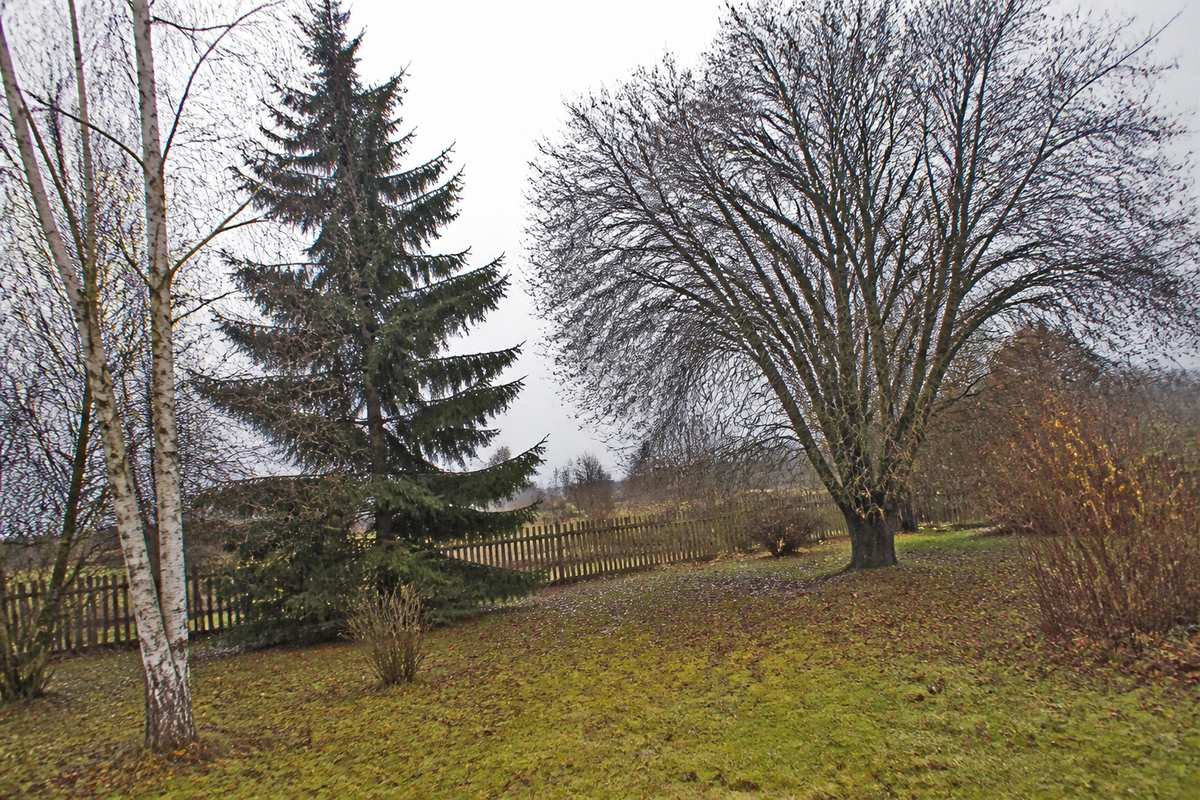
The contrast in Jugla is pronounced: on one side Brīvības gatve and the apartment estates, on the other Lake Jugla, the forests and streets of private houses that reach into the woodland. In terms of trees it is a neighbourhood where city trees and forest trees meet on the same plot.
When the forest comes right up to the house
Where houses have been built at the forest edge or on a plot cleared out of woodland, the remaining trees are left exposed. A spruce or pine that has held against the wind all its life together with the stand around it now takes the load alone — and it is precisely these trees that blow over most often in the first years after building.
Spruce is the riskiest here: its roots are shallow, and in the wetter ground near the lake it holds less well than it looks. The answer is usually not to clear a strip but to inspect the edge trees and remove the few that genuinely threaten the buildings — the starting point is a tree health assessment.
Bark beetle in the spruces
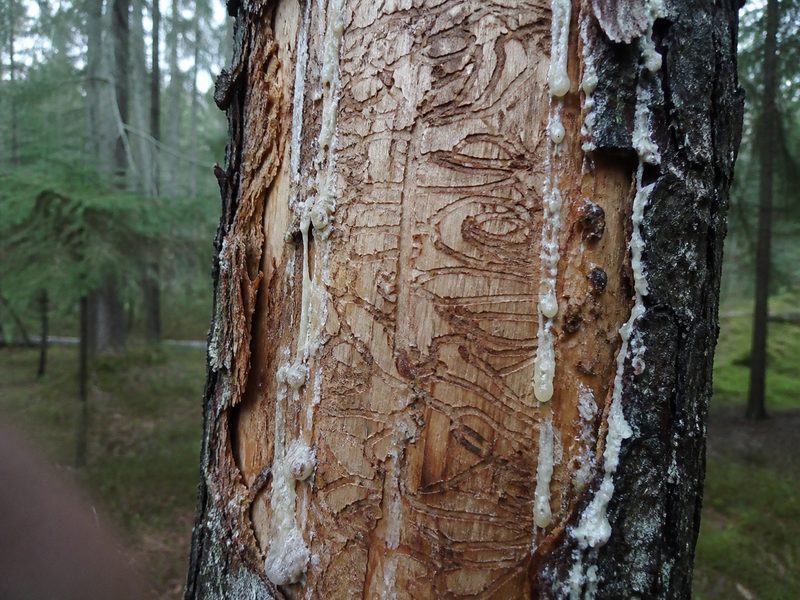
In recent years the spruce bark beetle has been one of the commonest reasons we are called out to neighbourhoods beside forest. The signs are specific: brown dust at the base of the trunk and in the cracks of the bark, pieces of bark coming away, and a crown turning red-brown from the top downwards.
If the bark is already peeling the tree is finished, and then timing is what matters most. A dead spruce quickly becomes brittle: the wood loses its strength, and climbing such a tree is no longer safe. The longer you wait, the more the job needs machinery and the more it costs — dead and dying tree removal.
Courtyards and the lake side
In the apartment part of Jugla the situation is as on other estates: trees the same age as the buildings, dead branches over the paths, poplars at the gable ends. The work is ordered by the managing agent, and the commonest task is deadwood removal.
Nearer the lake and in the lower-lying parts the soil is wetter, and the birch, aspen and black alder growing there are more brittle. After stormy seasons these are the first trees to go over, so after strong winds it is worth walking the property here and looking at the bases of the trunks.
Where your plot ends and the forest or municipal land begins
In Jugla the boundary of many private houses runs right along the forest edge, and that raises a practical question: who is liable for a tree that falls from the forest onto a house, a fence or a car. The short answer is that liability usually follows ownership of the land the tree grows on, not the side it happens to fall on. So before any work we establish the boundary — from the land boundary plan, not from the fence line, which in Jugla has often been shifted or is older than the survey.
If the dangerous tree grows on your side, we can fell it and, where necessary, obtain the felling permit. If the tree grows on forest or municipal land, the correct route is a written application to the land manager — we can describe the tree's condition and the risk of damage, so that the application is more than a free-form letter. We have gathered more on how liability is divided between owners in the section who is liable for a fallen tree.
The old gardens in the private-house part of Jugla
Some of the private gardens in Jugla were planted several decades ago and have now passed into the hands of new owners. The picture is typically the same: apple and pear trees left unpruned for years and grown into wide, congested crowns with dead wood in the middle; a row of thujas that has turned from a fence into a wall; and self-seeded bird cherry or maple that has come up between everything else.
It is not right to recover a garden like that in one go. If half the crown is taken off an old apple tree at once, it answers with a mass of vertical shoots and looks worse the following year than it did before. We usually work season by season:
- in the first year — the dead and crossing branches, cutting out the self-seeded growth, opening the ground up;
- in the second — restoring the shape of the crown and evening out the shoots that have grown away;
- thereafter — regular maintenance fruit tree pruning at the end of winter.
We haul the cut branches away or chip them on site, so the garden is not left full of heaps after the work. Which trees in such a garden are worth keeping at all we settle during the inspection.
What we do in Jugla
All of our services are available in Jugla. The most requested in this neighbourhood:
- Dangerous tree removal — Dead, rotten, leaning and damaged trees. We assess first, then cut.
- Emergency tree removal — Fallen and broken trees after a storm — we come out the same day.
- Tree crown care — Crown shaping, thinning and deadwood removal.
- Stump grinding — Stump grinding without digging — the lawn is left almost untouched.
- Tree health assessment — Is the tree dangerous? We inspect it and tell you what to do.
- Branch and timber removal — Branch and timber removal, including where someone else did the cutting.
The full list with descriptions is in the services section.
How the work is done
- We get back to you within 5 min. Fill in the form and attach photos showing the tree at full height, its base and the route up to it. That is often enough for a rough quote.
- Assessment. We come back with an approximate price and method. If access in Jugla is difficult, we come out to look before the work.
- Permit, if one is needed. We check whether the particular tree needs one in Rīga and file it on your behalf.
- The work. We agree a time, cordon off the working area and arrive with everything needed.
- Clearing up. We chip or collect the branches and take them away. We do not leave wood chip behind. If you want the firewood, we cut it to length and stack it where you ask.
What the price depends on in Jugla
There is no flat rate per tree. In Jugla the price is set by the tree's height and girth, its species and condition — for a dead spruce that is decisive — the distance to buildings, the drop zone, whether machinery is needed and the volume to be hauled away.
In Jugla the price is influenced by how far the tree grows from the access road — on plots at the forest edge the material often has to be carried out, and that takes longer than the cutting itself. We have put the full list with explanations on the prices page.