
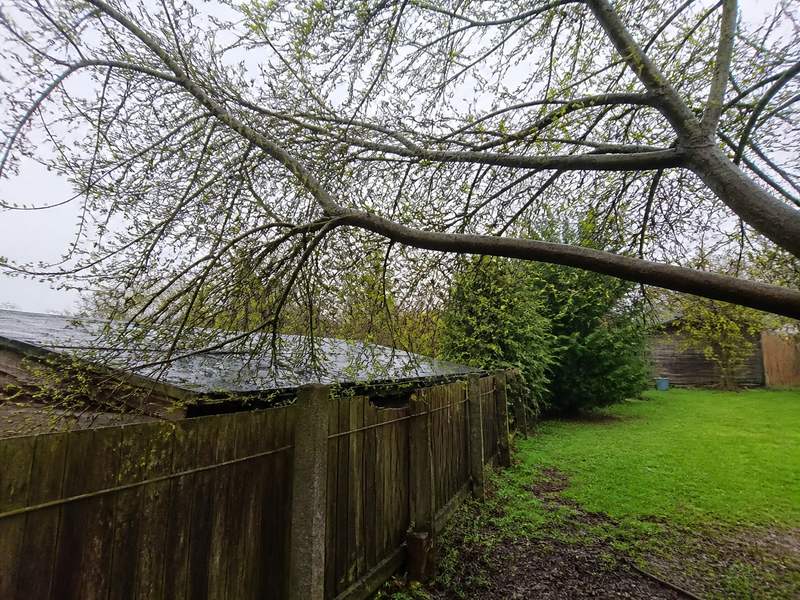
First — what is and is not a legal answer here
We are arborists, not lawyers. What follows describes how situations like these usually work out in practice and what the tree side of it actually is: whether a branch really poses a risk, whether roots really damage foundations, whether shade can be reduced without taking the tree down. The specific answer always depends on the circumstances — where the boundary runs, how the tree grows, what the status of the property is and whether we are talking about an inconvenience or a real hazard. If the dispute is serious and the sums are large, go to a lawyer, not to the internet.
One thing, though, is almost always true: a conversation with your neighbour costs less and moves faster than any other route. Most tree disputes that end up with solicitors could have been settled with one inspection and one agreement about who pays.
Branches hanging over the boundary
This is the commonest case. A neighbour's branches reach over the fence, block the light, rub against the roof or drop fruit on your side.
The general principle is simple and surprises many people: a tree belongs to whoever owns the land its trunk grows on, even if half the crown is on your side. That means you cannot simply walk onto your neighbour's land, and you cannot cut your neighbour's tree as you see fit. Overhanging branches are a matter to take to the neighbour first, not to the saw.
In practice it goes like this: you talk, you agree that the branches will be pruned, and you agree who organises it and who pays. Often a neighbour does nothing simply because it has not occurred to them, or because they are afraid of the cost — not because they want an argument.
If a branch is cut in the wrong place — too close to the trunk, or leaving a long stub — the wound does not heal, and decay starts there. A few years later your neighbour's tree has a damaged trunk, and on your side a cluster of even weaker branches has grown out of the same spot. The cut has to be made in the right place, at the base of the branch, preserving the branch collar. That is a technical matter, and it is one of the reasons why "I'll just quickly cut it myself" often turns out to be the more expensive solution.
Roots crossing the boundary
Roots cause more serious damage than branches, only more slowly and out of sight. The typical cases: lifted paving or a path, a cracked driveway, roots in a sewer or drainage pipe, damp in the cellar.
Here it is important to distinguish two things. A root that has lifted a paving slab is real, measurable damage. A root simply growing in your ground is not damage — tree roots travel a long way, and on a large tree the root zone is much wider than the crown. Practical solutions often do not call for removing the tree at all: a path can be rebuilt with a root barrier, and individual roots can in certain circumstances be severed, provided it is done at the right distance from the trunk and with a considered understanding of how much the tree will tolerate.
Before you start digging or demanding action from your neighbour, it is worth understanding what roots actually do — more on that under tree roots damaging foundations. It often turns out that the cracks in the foundations came from somewhere else, and the tree was simply the most convenient suspect.
Shade
This is the section where we have to be honest, even if the answer is not the one you would like to hear. Shade in itself is usually the weakest argument of them all. A tree that casts shade is behaving like a tree. It has no defect. It damages nothing. In Latvia, where the sun is in short supply nine months of the year, the complaint is entirely understandable, but that does not turn it into an obligation on your neighbour.
What can realistically be achieved is a compromise, not removal. The crown can be thinned so that light passes through it. The lower branches can be removed to lift the crown — that often gives the most light with the least change to the tree. The crown can be shortened on one side. All of this is a job in its own right, and we do it: pruning for more light. An offer of "we'll pay for the thinning" sounds quite different to a neighbour from "cut your tree down", which is why it is accepted far more often.
There is another side to this worth saying out loud: a tree cannot be thinned indefinitely. If too much is taken out, it responds with vigorous, weak regrowth, and after three years the shade is back — only the tree is now in worse condition. Reducing shade is repeat work, not a one-off.
Leaves, fruit, needles and resin
Leaves in the gutters, fallen plums on the lawn, needles on the roof, drops of resin on a car parked under a pine. Here too the answer is usually the same as for shade: a tree that sheds leaves is doing what trees do, and that does not normally create an obligation on your neighbour to act. Fallen fruit is a separate topic in law, and in practice it is almost always settled by a conversation rather than a demand.
That does not mean it is not worth asking. Many neighbours will happily agree to lift the crown above your roof or thin the branch that showers everything onto your parking space — it costs them nothing. Asking and demanding are two different things here, and the first works better.
A neighbour's tree that really could fall on your house
This is an entirely different case, and it must not be confused with the ones above. If a neighbour's tree is dead, rotten at the base, has a large crack in the trunk or has recently begun to lean towards your building, this is no longer about inconvenience. It is about a hazard, and that is the strongest position you can be in.
Photograph the tree — the whole height, the base of the trunk, the lean, any fungi or cracks, and what lies in the fall zone. Then notify the owner in writing and keep proof that the notification was sent. This changes the situation more than anything else, because afterwards the owner can no longer say they did not know.
Why this matters so much is explained separately under who is liable for a fallen tree. In short: liability is usually tied to what the owner knew or could have known. If the tree comes down after they have been warned in writing, their position is quite different from the case where nobody said anything.
If you and your neighbour cannot agree on whether the tree is dangerous at all — and that is what people argue about most — it is worth commissioning an independent tree health assessment. An arborist's report takes "it seems to me" out of the conversation on both sides. Sometimes it shows that the tree really does have to go. Quite often it shows that the tree is stable and the problem is smaller than it looked. Both outcomes are useful.
A tree growing right on the boundary
A tree whose trunk stands on the boundary line is a special case. In practice such trees are treated as the joint property of both owners, and that means neither side can act alone. That applies both to removal and to serious pruning. If one side fells a shared tree without the other's consent, it usually ends badly.
If the boundary is unclear, or the trunk has grown up right along the fence line, start by establishing where the boundary actually runs. The boundary plan matters more here than the fence — fences have a habit of standing somewhere other than the boundary.
What to do in practice
Talk first
In person, calmly, with a specific request. "The branch is rubbing the roof covering" is negotiable. "Your tree is a problem" is not.
Offer a solution, not just a complaint
If you propose a specific job and split the cost, the answer is "yes" far more often. Many disputes are really disputes about money, not about the tree.
Then put it in writing
If the conversation produces nothing, write the same thing down and keep a copy. A written notice only has value if you can prove it was sent.
If the dispute is about the tree's condition — commission an assessment
An independent arborist's report is the quickest way to end an argument about whether a tree is dangerous. Ideally both sides commission it together.
Only then the legal route
If there is real damage or a real hazard and your neighbour does not respond, that is where a lawyer belongs. With all the material gathered beforehand, it goes faster.
What the costs depend on
If work does have to be done in the end, the price is set by the same things as any other tree job: the height and species of the tree, how much of the crown has to be touched, whether we climb the tree or use a platform, how close buildings and fences are, what the vehicle access is like and how much brushwood has to be taken away. In a boundary case one more factor comes in — whether we work from one side or need access from both. We have set out the list of factors with explanations on the prices page. If a permit is needed, we arrange it for you.
And finally, a practical point. Once the tree question is settled, you will still be neighbours. That is worth keeping in mind when you write the second letter. The tree will stand for another fifty years, and arguing that long is not worth it.