When machinery is the right answer
- The tree is decayed or dead. Climbing a tree whose timber cannot be trusted is simply not acceptable. More on this: rotten tree removal.
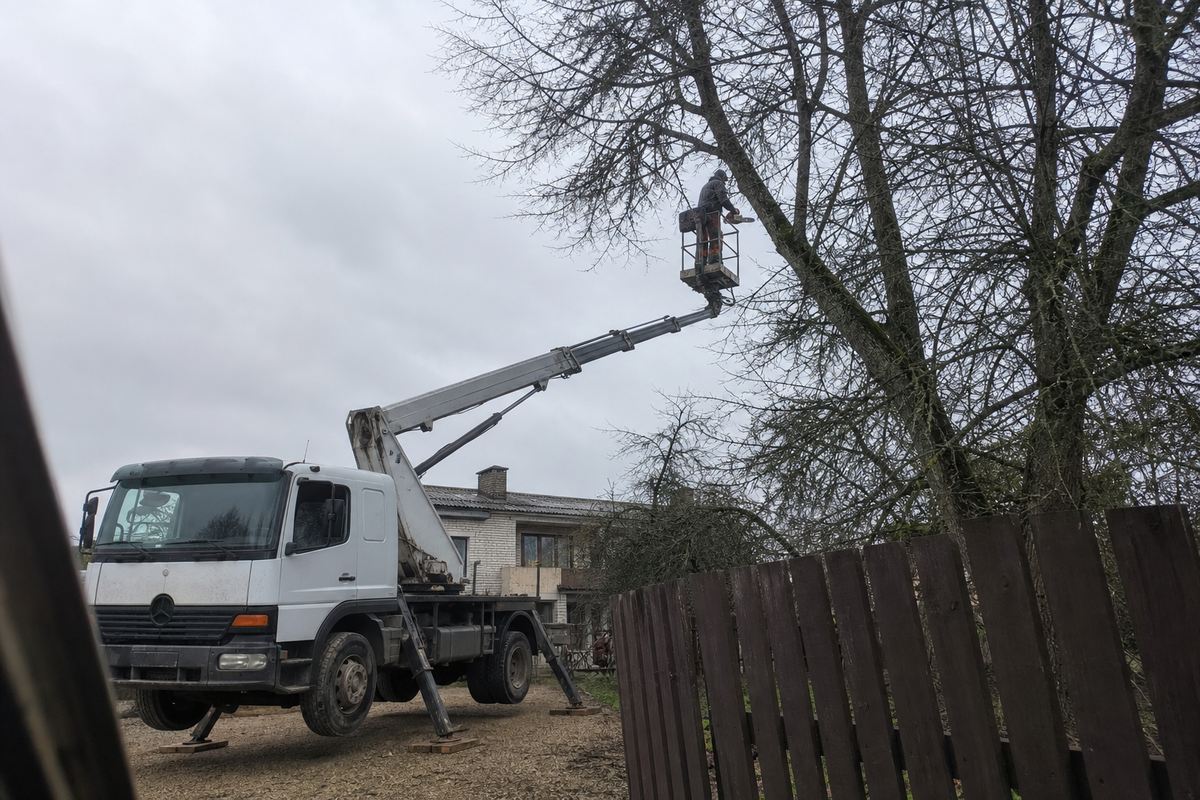
- A very wide crown. Where branches reach a long way out to the sides, they can be reached far more quickly from a basket.
- The job has to be done quickly. A MEWP is often faster than climbing, provided the access is good.
- Heavy sections have to be lifted over an obstacle. With a crane a length of trunk can be lifted and carried over a roof or a fence, rather than lowered down the side of the building.
- The tree is beside a road or a car park. There a platform can usually be set up without any difficulty.
The working position is planned before the machine arrives
You cannot bring a platform in and only then start thinking about where to put it. So before we order one we walk right round the tree and decide where the machine will stand — and it is often not where you would assume at first glance.
The position has to be chosen so that as much of the crown as possible can be reached from one set-up, because every reposition means lowering the outriggers, driving across and levelling up again — and that takes time each time. At the same time you have to consider where the lowered pieces will land, because they must not fall on the machine itself or on the route it has to drive out along. And you have to look up: there must be nothing above the standing position — branches or cables — that would restrict the boom in the direction it needs to work.
In practice that means we know before the job starts how many times the machine will be repositioned and in what order the crown will be taken. If that isn't worked out in advance, you end up unable to reach the last few branches, and then half the job has to be done by climbing after all.
What actually limits the reach
People usually assume that the only question about a platform is how high it goes. In practice height is less often the problem than what sits between the machine and the tree.
The basket doesn't travel straight up — it moves through an arc. The further the basket has to stretch sideways, the less weight it will carry and the harder it is to steer precisely. If the machine cannot get close to the tree because there is a greenhouse, a fence, a terrace or a neighbour's boundary in the way, then all the available reach is spent on the horizontal distance and there is none left higher up. Obstacles on the way up hinder it just as much — branches of another tree, eaves, cornices or service cables the boom has to bend around.
So when we assess a job we measure not the height of the tree but the distance from where the machine can stand to the tree, and we look at what lies between them. Two trees of identical height can be completely different jobs on this count.
When a platform isn't the right answer
A machine that reaches the top of the tree isn't always the thing that does the job best. There are several cases where climbing is the better choice:
- A dense crown. The basket can be placed at the edge of a crown but not inside it. If the branches to be removed are in the middle of the crown, an arborist on ropes can reach them and a basket cannot.
- Crown care rather than removal. When the tree is staying and each cut has to be made in exactly the right place on every branch, doing that from a basket means dozens of repositions. Climbing is both quicker and more precise here — see crown care.
- Lawns and planting to be protected. If the garden is such that machinery tracks are out of the question, bringing a machine in causes more damage than it prevents.
- No room for the outriggers. A narrow driveway isn't enough on its own — the outriggers need space all around the machine, and that is wider than the machine itself.
So we choose the method to suit the particular site. Often the right answer is both: a platform for the upper part, where the timber is weaker, and climbing for the lower part inside the crown.
What a platform needs in order to work
A MEWP needs vehicle access and somewhere to set up. Before the job we check:
- whether the driveway is wide enough and the gates open far enough;
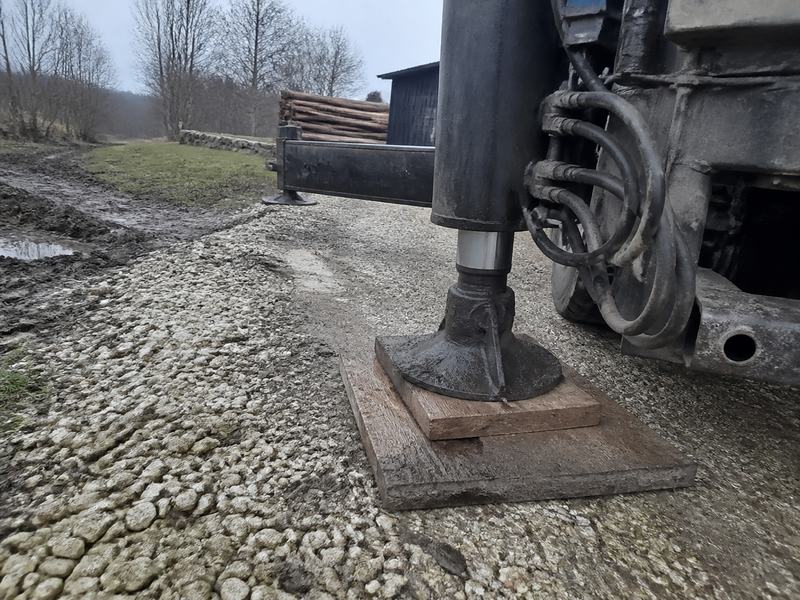
- whether the ground will carry the weight of the machine — on soft ground we put boards under the outriggers so the lawn isn't damaged;
- whether there are low cables or branches along the route;
- whether anything above the standing position restricts the movement of the basket.
If there is no vehicle access at all, machinery doesn't help — then we work with rope access or look at the options where there is no access.
How the material is handled from the basket
The fact that the arborist is working from a basket doesn't change the main rule: nothing falls freely if there is something below it that can be damaged. The basket only changes where the work is done from.
In practice there are three ways of working from a basket. If there is clear ground under the tree — lawn or a path with nothing on it — the smaller branches can be dropped, and the ground team carries them straight to the chipper. If there is a roof, a fence or planting below, every piece is attached to a rope before the cut and lowered exactly as it would be when climbing. And for heavy trunk sections, where a crane is on the job, the piece is secured, cut and lifted over the obstacle — rather than lowered down the wall.
One important side point: working in a basket, there are no branches around you to brace against, so during the cut the limb has to be held or tied off so that it doesn't fall onto the basket itself. That is one of the reasons we work in fairly small sections from a platform too, rather than larger ones than we would use when climbing.
The ground team's work stays the same — pieces are cut to length, brash is chipped, and we take the wood chip and the branches away.
Lawns and paving
Heavy machinery on wet ground leaves ruts. That cannot be avoided entirely, but it can be reduced: we work with boards under the outriggers, choose a route over the firmest surface and, where possible, plan the work for dry or frozen conditions. In winter, when the ground is hard, this work is far kinder to a lawn — one of the reasons winter jobs often work out better.
It is worth understanding where the damage actually comes from, because there are two separate issues. The first is the outriggers. Each one concentrates the entire weight of the machine into a small area, and there the ground simply presses in. So we always put boards or plates under the outriggers to spread the load over a larger area. On block paving that matters just as much as on a lawn: a point load makes paving blocks settle, and that is harder to put right than a lawn.
The second is the route. The wheels only damage the ground at the surface, but they do it along the whole way, and on wet ground they leave ruts where the turf has been torn. This is reduced by choosing the shortest and firmest route and driving in once and out once, rather than manoeuvring about on the lawn.
What this means for you: we tell you the planned route and standing position before the work, and if it crosses somewhere that matters to you, we talk it through. Sometimes the better solution is to put the machine further away and accept less reach rather than drive through the garden. Underground services — manhole covers, drainage, heating mains, irrigation systems — are worth mentioning straight away, because we don't put outriggers over them.
Price
Using machinery changes the price, so we always explain why we are recommending it in your particular case. Often a platform makes the job quicker, and the total comes to no more than a long job done by climbing. The price is also affected by how long the machine is needed on site.
This is worth explaining properly, because it runs counter to what most people assume. A job that takes a full day and a team of several people by climbing is often finished by midday with a platform. Climbing, the arborist moves himself through the tree one branch at a time, and a large part of the day goes on moving about and resetting anchors. From a basket, repositioning takes a few seconds on a joystick. If the access is good and the crown is reachable, the time saved is enough to offset the cost of the machine.
So we recommend a platform not because it costs more, but because on that particular site it is either safer or finishes the job sooner. If the bill does come out higher, we say so too, and explain what you get for it. We have set out all the factors that affect the price on the prices page.