
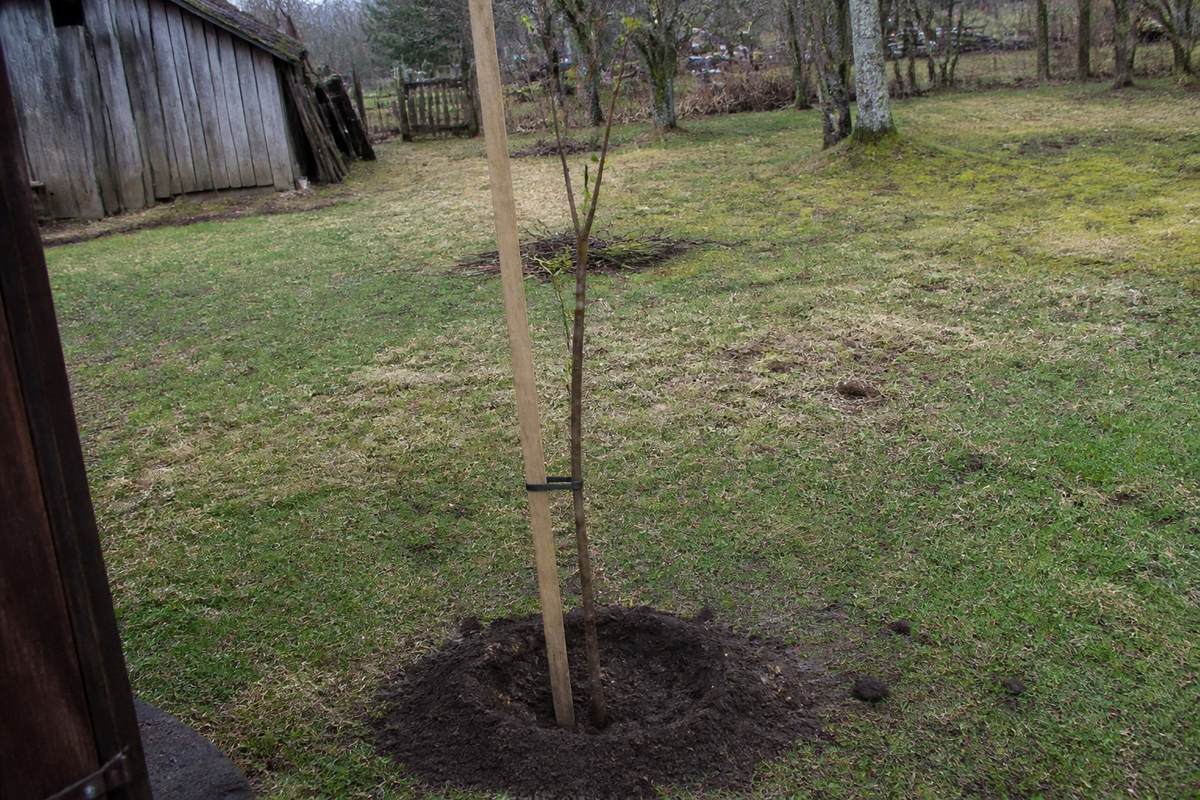
The most important decision is made before planting
A large part of our work is taking trees down. A considerable proportion of those trees are not diseased or dangerous in themselves — they are simply standing in the wrong place, because somebody twenty years ago planted a half-metre sapling without picturing what it would be full grown.
The classic case: a spruce or a maple planted two metres from the corner of the house as a pretty little tree. Twenty years later it is a fifteen-metre tree shading half the house, dropping cones into the gutters and touching the foundations with its roots, and it cannot be pruned in any way that leaves it still a tree. Then we are called out, and we take it down for many times the cost of the sapling. The only place this problem can be solved is on planting day.
How a tree is chosen for a spot
We start not with what you like but with how much room there is. Then we look for a species that fits that space.
- Mature size. The key figure. How tall and how wide the tree will be in 20, 30 and 50 years — not in five.
- Distance from buildings and services. The crown has to be able to develop without reaching over the roof or into cables. Nothing tall is planted under an overhead line — sooner or later a tree like that comes into conflict with the cables, and from then on it can only be disfigured.
- The boundary with a neighbour. A tree by the boundary will in time cast shade and branches on the other side, and that is one of the commonest causes of dispute — there is a separate page on it: neighbours' trees and liability. When planting near a boundary, allow for the width of a mature crown, not the width of the sapling.
- Root behaviour. Some species — poplars, willows, some maples — send out aggressive, shallow roots that seek moisture and lift paving and tarmac. They aren't planted near paths, terraces or drain runs.
- Soil and moisture. Heavy clay, dry sand and a spot where water stands in spring all call for different species. In a place where water stands, most trees simply die after a couple of years.
- Light. On the north side of a wall or under large trees, a light-demanding tree becomes drawn and weak.
- What the tree will ask of you. Some trees drop a great deal of fruit, seed or leaf litter. Over a parking space or a terrace that means work every year.
If you want a particular species, we'll tell you honestly whether it will survive in your spot and whether it will still fit there in years to come. Where a species isn't suitable, we suggest the nearest one that is — we've set out the characteristics of the species separately.
How we plant
A wide pit, not a deep one
We dig the pit considerably wider than the root ball but no deeper than it. The sides need to be loosened so the roots can move outwards — that is where they grow.
The right depth
The point where the trunk flares into the roots stays at ground level. Planting too deep is one of the commonest mistakes: the base of the trunk stays wet, the bark starts to rot, and the tree weakens slowly over years for no obvious reason.
Straighten the roots
On pot-grown stock the roots are often wound round the root ball. We free them — otherwise they carry on growing in a circle and eventually strangle the tree itself.
Backfill with native soil
We backfill the pit with the soil that came out of it, improved only as far as necessary. A pocket of rich peat in clay will hold water, and the roots will never leave it.
A stake only where one is needed
A stake isn't compulsory. We use one in windy positions and for large stock, fixed low so the top of the trunk can still move — that is what makes a trunk strong. The ties must never cut into the bark.
Mulch, but not against the trunk
A layer of mulch around the tree holds moisture and keeps back the grass that competes with a young tree for water. It isn't drawn up against the trunk itself — there it holds moisture against the bark.
A stake and tie are needed for one to two years, not for ever. A tie left in place grows into the trunk within a few years, severs the tree's conducting tissue and creates the point at which the tree later breaks — we see it regularly. If there is a tree in your garden still wearing the tie it was planted with, it needs cutting off now.
The first two summers decide everything
A tree doesn't die of a badly dug pit. It dies because nobody waters it through its first dry summer. A young tree has been through the loss of its roots and cannot yet reach deeper moisture, so watering through the first two seasons — three on lime-rich ground — is the one thing that genuinely decides survival. Water infrequently and heavily — less often, but enough that the water reaches the roots, rather than a little every day, which only encourages surface roots. In a dry summer that means once a week, even when it has rained.
In its first years a young tree hardly needs pruning at all. We take off only damaged branches or ones rubbing against each other. Shaping the crown starts later, once the tree is established — see the section on tree crown care. We recommend feeding only where the soil genuinely calls for it; a young tree more often needs water than nutrients.
When to plant in Latvia
There are two windows. Autumn — from leaf fall until the ground freezes — is the best time for broadleaved trees: the soil is still warm, the roots go on growing, and in spring the tree starts with an established root system and a full summer ahead. Early spring — before bud break — is the other opportunity and the better option for anything tender in winter. A container-grown tree can technically be planted right through the season, but a tree planted in July depends on your watering can all summer, so midsummer is not a time we would choose ourselves.
What the price depends on
The price of planting is set by the size of the stock, the number of trees, the state of the ground and the vehicle access. Planting one large tree with a heavy root ball is a different job from planting ten small ones; heavy clay or stony ground takes longer, and where machinery cannot reach, everything is done by hand. We usually combine species selection and the site visit with the rest of the work. The factors that make up the price are described on the prices page.