
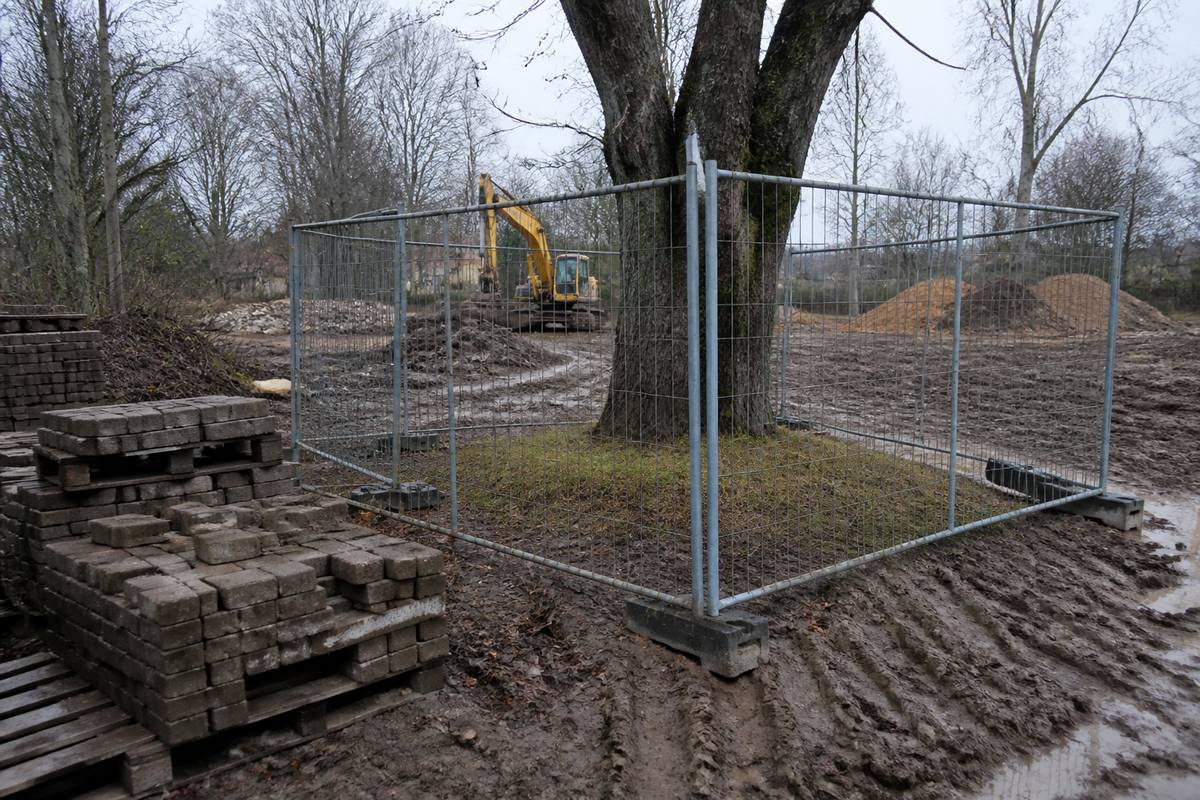
Why this problem is noticed too late
If a branch is broken off during building work, you see it at once. If the roots are severed, you see nothing at all. The tree stays green, the leaves are where they should be, and everyone concludes that all is well.
In fact a slow process has begun. The tree has lost part of what it takes up water with, but the crown is still the same size. For one season it holds out on its stored reserves. The following summer, if the weather turns dry, the reserves are gone. The typical picture:
- first season — the tree looks normal, or the leaves are a little smaller;
- second season — the crown is noticeably thinner, autumn colour comes early, dead branches appear at the top;
- second to third season — the top of the crown dies back, the tree throws shoots on the trunk, fungi start to appear at the base;
- third season and beyond — the tree has to be removed, and often it is already dangerous, because the roots have decayed and the anchorage is gone.
A severed root cannot be put back. After building work we can slow the decline — decompact the soil, mulch, reduce the weight of the crown — but we cannot return the tree to its former condition. That is why everything on this page is about what needs to be done before the machinery arrives on site.
Three ways building work kills a tree
1. Severing the roots
Service trenches, foundation pits, drainage, fence posts, the sub-base for new paving. Because a tree's roots are shallow and wide-spreading — often twice as wide as the crown — a trench that looks safely far from the trunk can sever a large part of the root system. The worst case is a trench running along one side of a tree: in a single pass it cuts off the entire root system on that side, and that means not only starvation but lost stability.
2. Compaction
An excavator does not have to dig to do damage — it is enough for it to drive. A heavy machine over wet ground compacts it so that the air pores collapse and the roots suffocate. Stacking materials does exactly the same: a heap of sand, pallets of block paving, a skip, or a concrete mixing point under the tree. This damage is completely invisible — the ground simply becomes hard.
3. Changing the ground level
This is the one people take to be harmless. Tipping twenty centimetres of soil over the root zone to level a garden sounds innocent enough — but it buries the very top layer in which the tree breathes. The roots beneath the new soil are left without air. Removing soil does harm just as surely: the most active part of the root system goes with it.
What real protection looks like
We set the protection zone
The zone is not set by eye. It is calculated for the individual tree — trunk diameter, species, age, and where the roots actually grow. For an old, wide tree the zone is far larger than people expect, and it almost always extends beyond the spread of the crown.
We fence the zone off BEFORE work starts
Fencing put up after the machinery has already been on site is decoration. The barrier must be solid and visible, and installed before the first vehicle arrives. A rigid barrier works, because you cannot drive across it “just for a moment”.
We take the zone out of the site logistics
There must be no stockpiles, skips, plant parking, concrete mixing, refuelling or washout points within the protection zone. We agree the haul routes and stacking areas before they establish themselves by default.
We dig around the roots, not through them
Where a trench genuinely cannot be rerouted, we use careful methods: hand digging, exposing the soil with an air spade so the roots stay visible and untorn, or routing the services around the root zone. The major roots are retained; if anything has to be cut, it is cut cleanly rather than ripped out with a bucket.
We put the soil right afterwards
Once the building work is finished we survey the root zone and, where needed, decompact and mulch it. More on this: root and soil care.
Who this page is for
Two people. The first is the homeowner facing an extension, new paving, drainage or a service connection in the garden — with one old tree they would rather not lose. The second is the contractor, designer or client with trees to be retained on site who needs them still alive when the work is finished. For businesses we often combine this work with the rest of the tree care across the site.
If the tree is protected or a heritage tree, the position is stricter and work around it may be restricted regardless of your plans — see heritage and protected trees. If some of the trees do have to be removed, we handle the permits for you.
If the work has already been done
If the digging is behind you and the tree looks worse for it, it is still worth having it inspected. Two things matter. The first is whether the tree can still be helped. The second, and often the more urgent, is whether the tree is still standing safely. A tree with the major roots severed on one side can look perfectly healthy and still be a risk of falling. We check that in a health assessment, and if the tree has already begun to lean, see also leaning trees.
What the price depends on
The price is set by the number of trees to be protected, the size of the protection zones, the length of fencing, how much of the excavation has to be done carefully by hand or with an air spade, the duration of the project, and whether supervision is needed while the work is under way. Compared with removing and replacing one large tree, protection is almost always cheaper — and the tree stays. How we calculate a quote is set out on our prices page.