
What makes Ķengarags distinctive is its shape: the neighbourhood stretches along the river, pressed between the Daugava, Maskavas iela and the railway. On one side there is water and the promenade, on the other an arterial road. In terms of trees that means two different sets of conditions within one neighbourhood.
The shore belt and wet ground
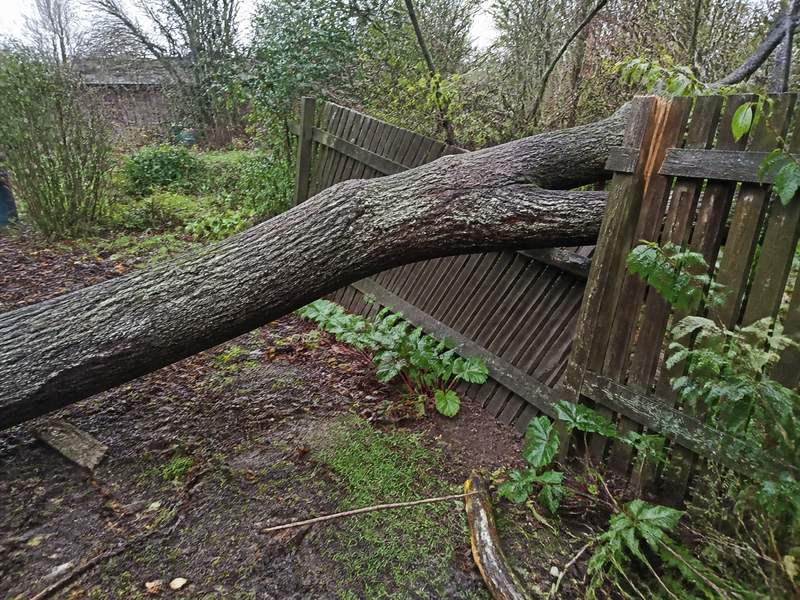
Closer to the Daugava the soil is wetter, and the trees growing there — willow, aspen, grey alder, birch — grow fast but are brittle. After storms these are the first to break and go over.
In wet ground the roots also hold less firmly: a tree can lean over not because it is diseased but because the ground no longer holds it. If you notice a tree has begun to lean and cracks are visible in the ground at its base, or the turf has lifted, that is an urgent sign. How to tell an established lean from a new one: leaning trees.
Courtyards between the estates
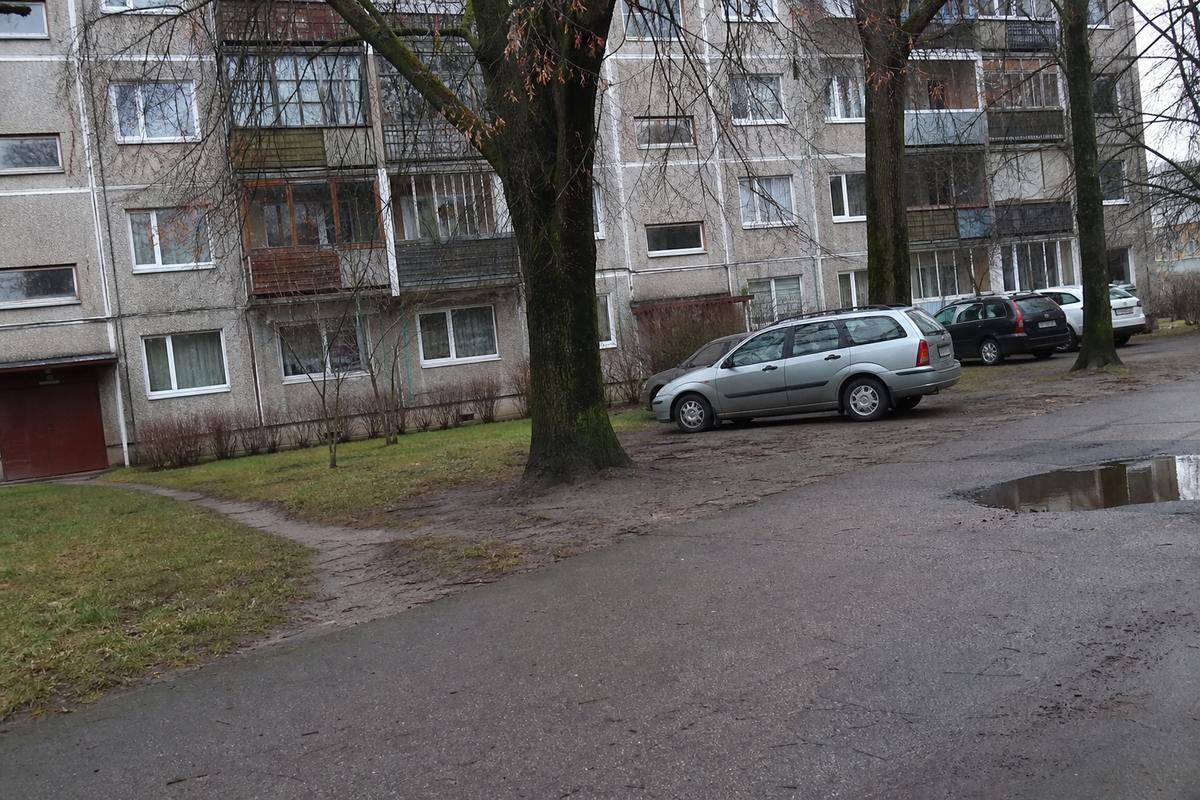
In the apartment part of Ķengarags the situation is as on other Soviet-era estates: the trees were planted at the same time as the buildings and are now at full size. The commonest enquiries are dead branches over a path or parking space, branches over the roof and old poplars at the gable ends.
In most cases the answer is deadwood removal or crown reduction, not taking the tree down. The work is ordered by the managing agent or the body of owners — we prepare the quote and the description.
A long neighbourhood, an exact address
Ķengarags stretches for several kilometres, so the address "Ķengarags" does not yet tell us how far we are driving or with what kit. An exact street helps a great deal in your enquiry.
Because the neighbourhood is linear and crossed by the railway and the arterial road, getting from one end to the other can take longer than it looks on a map. We therefore try to group planned work by section — if the job is not urgent, say so and we will offer a better-value time.
Wind off the river: why trees at the shore edge are loaded differently
The building in Ķengarags runs along the Daugava, and between the promenade and the first row of houses there is nothing to stop the wind. A tree growing in an open spot by the water is pushed from one side all its life and builds its trunk and roots accordingly — thicker on one side, thinner on the other. A tree in a courtyard between nine-storey blocks grows in shelter and never develops that anchorage.
The trouble starts when that sheltered situation suddenly changes: a neighbouring tree is felled, a shed is demolished, a belt of shrubs is cleared. The remaining tree suddenly takes a load it has never prepared for, and the first strong storm can break it or tear it out roots and all.
What we look at when we inspect:
- whether the tree has recently been left standing alone in an open spot after neighbouring trees were cleared;
- whether the crown is one-sided and the heavy end points at a building or a footpath;
- whether the ground at the base of the trunk on the windward side has lifted or cracked.
In some cases crown thinning is enough to reduce the sail area. If the tree has already leaned, we look at solutions for leaning trees.
The poplars of Ķengarags: rotten inside, green outside
The poplars planted along with the estate are today close to the limit of their age. What makes them dangerous is that from the outside the tree looks perfectly healthy — green crown, smooth bark — while the middle of the trunk has already become brittle and hollow. Poplar is a fast-growing tree with soft timber, and it rots from the inside outwards, not the other way round.
So we do not judge poplars by their foliage. We pay attention to other signs:
- bracket fungi or fungal fruiting bodies at the root collar and on the lower trunk — see what bracket fungi on a tree mean;
- old, untreated cut wounds with the bark sunken around them;
- thick dead branches in the upper crown while the rest of the tree is still green;
- cavities in the trunk where water collects.
A tree like this must not be felled in one piece, because an internally decayed trunk does not hold at the hinge and breaks unpredictably. Beside a building, a path or a parking space we work in sections, lowering each piece with ropes. If you are unsure about the tree's condition, we start with a tree health assessment.
What we do in Ķengarags
All of our services are available in Ķengarags. The most requested in this neighbourhood:
- Dangerous tree removal — Dead, rotten, leaning and damaged trees. We assess first, then cut.
- Emergency tree removal — Fallen and broken trees after a storm — we come out the same day.
- Tree crown care — Crown shaping, thinning and deadwood removal.
- Stump grinding — Stump grinding without digging — the lawn is left almost untouched.
- Tree health assessment — Is the tree dangerous? We inspect it and tell you what to do.
- Branch and timber removal — Branch and timber removal, including where someone else did the cutting.
The full list with descriptions is in the services section.
How the work is done
- We get back to you within 5 min. Fill in the form and attach photos showing the tree at full height, its base and the route up to it. That is often enough for a rough quote.
- Assessment. We come back with an approximate price and method. If access in Ķengarags is difficult, we come out to look before the work.
- Permit, if one is needed. We check whether the particular tree needs one in Rīga and file it on your behalf.
- The work. We agree a time, cordon off the working area and arrive with everything needed.
- Clearing up. We chip or collect the branches and take them away. We do not leave wood chip behind. If you want the firewood, we cut it to length and stack it where you ask.
What the price depends on in Ķengarags
There is no flat rate per tree. In Ķengarags our quote takes in the tree's height and girth, its species and condition, any rot in the trunk, the distance to buildings, the drop zone, whether climbing or machinery is needed and the volume to be hauled away.
In Ķengarags the price is influenced by how close machinery can be brought to the tree and by how far along this long neighbourhood we have to travel — in a tight courtyard getting the material out takes longer than the cutting itself. We have put the full list with explanations on the prices page.