
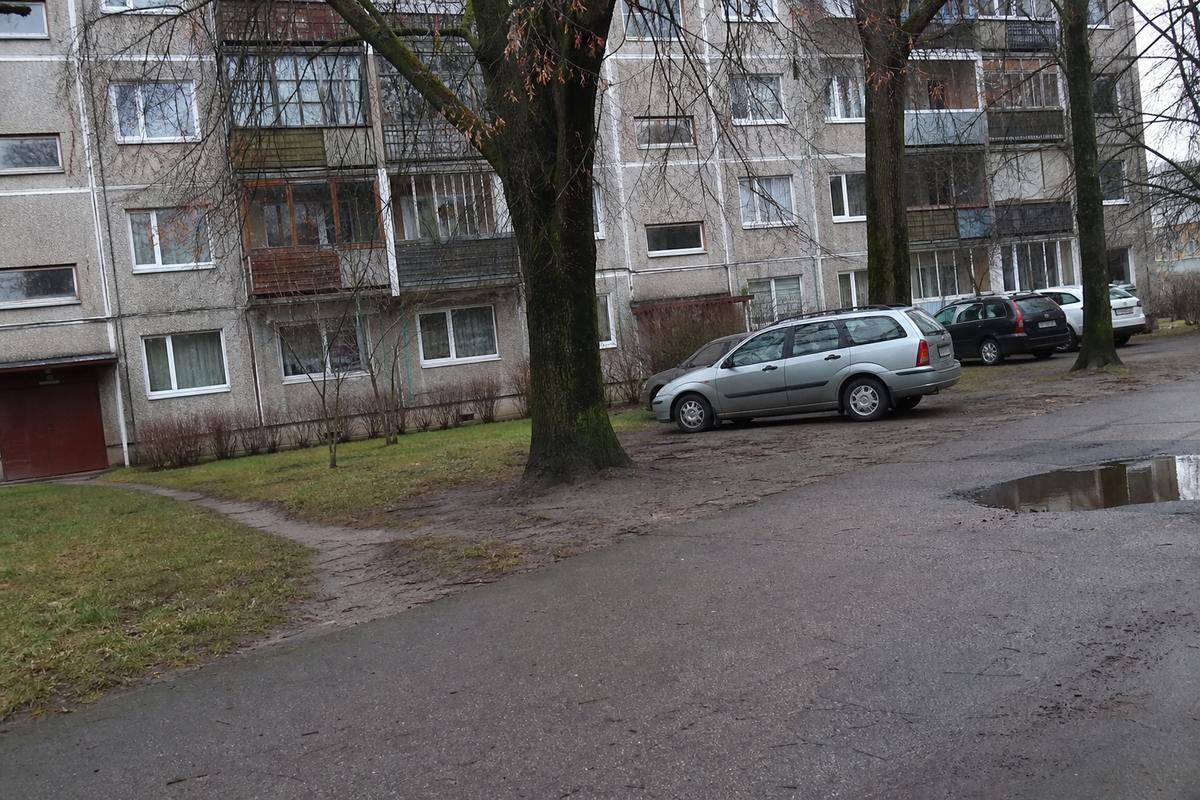
The housing estates of Pļavnieki were built as a single scheme, and the planting followed at the same time. The result is that the neighbourhood's trees are largely one generation of trees — they all grew large together, and now they all want attention together.
One generation of trees
When every tree in a neighbourhood is the same age, the problems arrive in waves too. In Pļavnieki we see it in practice: one courtyard will have several maples with dead tops at once, or several poplars with branches that have partly torn out.
It is also the reason we advise against reacting to each tree separately here, and in favour of surveying the whole courtyard in one go. The result is a list ordered by urgency: what has to be done now, what can wait for next season, and what merely needs watching. For a managing agent that is cheaper and easier to plan than separate call-outs — more on this under tree care contracts.
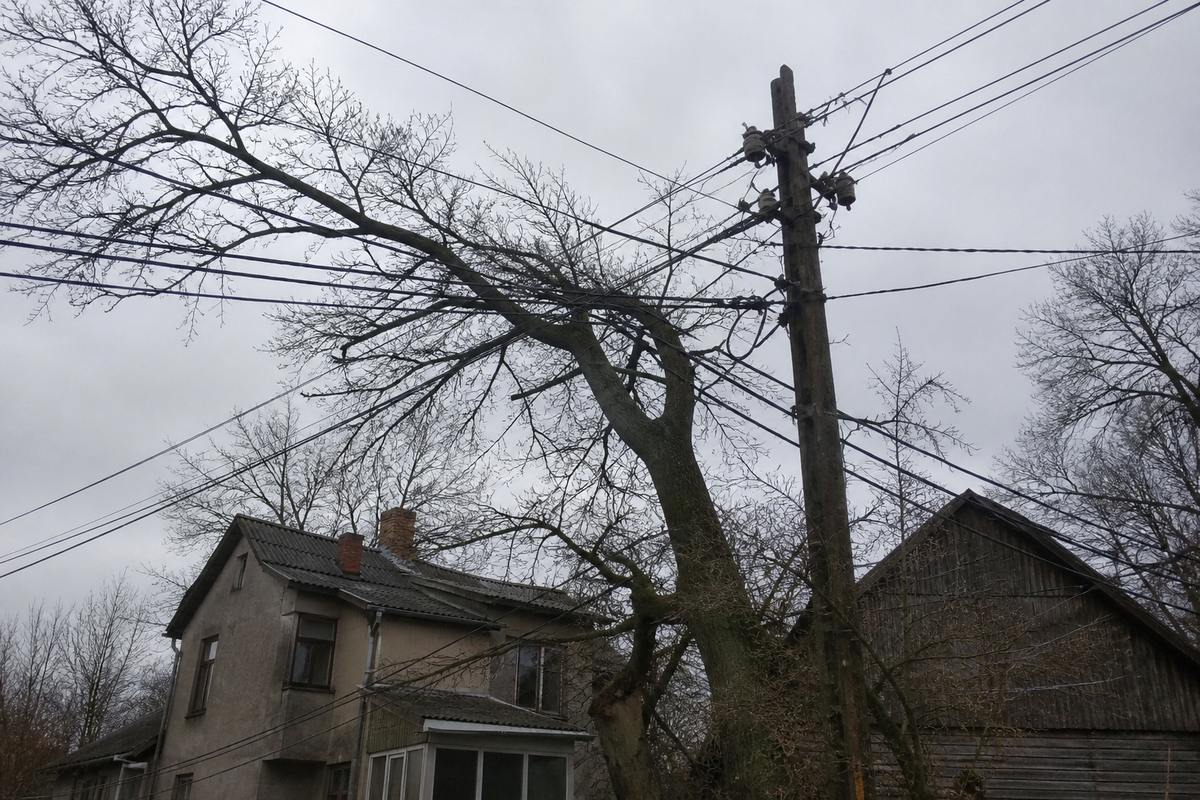
Cables, paths and parking bays
In courtyards trees often grow close to overhead lines, lighting columns and buried services. Knowing the limits matters here: some work near power lines may only be carried out by the network operator, and we say plainly when that is the case — tree removal near power lines.
The rest is usually deadwood removal over paths and parking bays. That is the typical courtyard job: the dead branches come off, the living crown stays, the tree carries on growing.
Access inside the blocks
In the inner courtyards of Pļavnieki, access and parking are the main practical constraint. The courtyard is full of cars, playgrounds and paths cross the drop zone, and there is often simply nowhere to put a large machine.
In practice that means sectional dismantling and an agreement beforehand that some of the parking bays will be cleared for a while. We cordon off the work zone, and afterwards we chip the branches and take them away.
What to photograph and write down so the matter actually starts moving
In Pļavnieki most enquiries begin with a text message to the managing agent along the lines of "there's a dangerous tree by the building". That is not enough to make a decision on, and it is not enough for us to name a cost either. If you live towards Deglava iela or Lubānas iela and you want the question not to be left hanging, we suggest attaching the following to your enquiry:
- At least three photos — one from a distance showing the whole outline of the tree and the wall of the building, one of the base of the trunk with the ground around it, and one close-up of the problem itself (a crack, the dead branches, fungal growths).
- The house number and block, and a note of which side the tree grows on — from the street, from the courtyard, or between the building and the garages.
- What is underneath the tree — a parking bay, a footpath, a playground, a district heating main, an overhead line.
- The approximate girth of the trunk at about one and a half metres, measured with a piece of string if that is all you have.
With a set like that we can usually already tell you whether this is a matter of deadwood removal or something more serious, and sketch out a price range that matches our price list. If the photos show something unclear, then we come and look — but at least we know what we are looking for.
Self-seeded scrub along gable ends, fences and garages
Around the edges of the Pļavnieki blocks there are strips that nobody counts as their garden: the gaps between gable ends and rows of garages, the footings of fences, the far corners of car parks. Over the years maples, ash-leaved maples, poplars and willow suckers seed themselves there. For the first few years they bother nobody, so nobody orders them cut. The problem shows up later, and always as something else: the garage door no longer opens fully, the fence starts to lean, you cannot see what is coming round the corner for the scrub, and it is dark under the ground-floor window even in summer.
This is the sort of work it pays to sort out at the same time as everything else — while we are already in the courtyard with the machinery and the chipper. We cut the self-seeded growth down to ground level, grind out the stumps where needed so they do not sucker again, and take the lot away. The result is a strip that can be kept in order from then on with a mower rather than a saw. The other jobs we can pick up on the same visit are gathered in the services section.
What we do in Pļavnieki
Every one of our services is available in Pļavnieki. The ones most often requested in this neighbourhood:
- Dangerous tree removal — Dead, rotten, leaning and damaged trees. We assess first, then we cut.
- Emergency tree removal — Fallen and broken trees after a storm — we come out the same day.
- Tree crown care — Crown shaping, thinning and deadwood removal.
- Stump grinding — Stump grinding without digging — the lawn is left almost untouched.
- Tree health assessment — Is the tree dangerous? We survey it and tell you what to do.
- Branch and timber removal — Branch and timber removal, even if someone else did the cutting.
The full list with descriptions is in the services section.
How the work happens
- We get back to you within 5 min. Fill in the form and attach photos showing the whole tree, its base and the route up to it. That is often enough for a ballpark quote.
- Assessment. We reply with an approximate price and a method. If access in Pļavnieki is awkward, we come out and look before the job.
- Permit, if one is needed. We check whether this particular tree in Rīga requires one, and we file it on your behalf.
- The work. We agree a time, cordon off the work zone and arrive with everything needed.
- Clearing up. We chip or collect the branches and take them away. We do not leave wood chip behind. If you want firewood, we cut it to length and stack it where you tell us.
What the price depends on in Pļavnieki
There is no flat rate per tree. In Pļavnieki the price is set by the tree's height and girth, its species and condition, how close it is to cables and paths, the absence of a drop zone inside the block, the amount of rope work and the volume of material to be taken away.
In Pļavnieki, several trees done in one courtyard work out noticeably cheaper per tree than separate call-outs — which is why we usually advise managing agents to start with a survey of the whole courtyard. We have set out the full list with explanations on the prices page.