What is happening to ash trees
Since the early 2000s Latvia's ash trees have been ravaged by a fungal disease commonly known as ash dieback, caused by Hymenoscyphus fraxineus. It affects ash in woodland, in gardens and in avenues alike. The result is visible everywhere: year after year the same trees grow thinner until eventually they stand dead. This is not something an individual owner has brought on through poor care — it is happening across the country and across most of Europe.
In practical terms this means two things. First, if an ash in your yard is dying back, this is most likely the reason, not something local. Second, expecting the tree to recover fully on its own is not realistic, even though individual seasons may look better than others.
The signs and the order they appear in
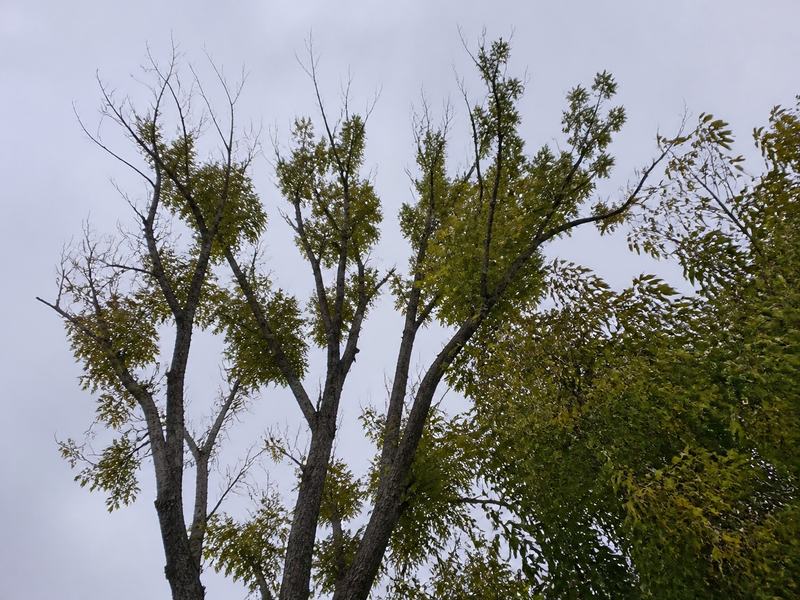
- Dieback starts at the top of the crown and works downwards. First the fine tips right at the top go dead, then thicker branches. Seen from the road, the upper part of the tree's silhouette goes bare while the lower part is still in leaf.
- Dark, diamond-shaped lesions. Where a branch joins the trunk or a thicker limb, the bark turns dark and sunken with a distinct margin around it. This is one of the most characteristic signs.
- A thin crown and small leaves. There are fewer leaves, they are smaller, and they are concentrated in tufts.
- Epicormic shoots on the trunk. Dense clusters of new shoots appear on the trunk and on the underside of thick branches. This is not recovery — it is the tree trying to compensate for the crown it has lost.
- Branches breaking without wind. At a later stage the dead branches begin to fall of their own accord, even in still weather.
- Decay at the base. Weakened ash trees are frequently joined by root and butt decay. That often settles the matter faster than the crown does — and it is the part you cannot see at all from the road.
There is no treatment — and it is only honest to say so
There is no product, injection or spray that will halt ash dieback. Anyone offering one is selling not a solution but hope. We do treat trees where treatment genuinely helps — as described here — and ash dieback is not on that list.
What can be done is specific and useful:
Establish how far it has gone
We assess how much of the crown no longer comes into leaf, how much deadwood has accumulated and whether there is decay at the base. Everything else follows from that.
Assess what is around it
A dead ash in the middle of a wood is not a problem. The same tree beside a house, along a path, over a car or next to a playground is quite another question.
Decide: lighten, monitor or remove
At an early stage it is often enough to take out the deadwood and reduce the weight of the crown. At a later stage the question is only the timing and method of removal.
Follow it every season
An ash's condition changes quickly. A tree that could be left last year may be in a different category this year. Looking at it once is not enough.
Safety — why a diseased ash is a special case
The wood of a dying ash becomes brittle faster than that of many other species. A branch or a stem can snap off with no load and no wind, on a completely still day. Do not stand under a tree like that, and do not let children play there.
This has consequences for the working method too. It is often unsafe to climb a dying ash — the wood will not take the loads you would expect of it, and anchor points cannot be trusted. So we work on diseased ash from a MEWP (mobile elevating work platform) rather than by rope access, or dismantle them in sections from outside. That changes both the planning and the price of the work, and we tell you about it in advance.
If a dying ash stands close to a house, a roof or a parking space, time is not a neutral factor. Every season makes the wood more brittle and the job more difficult. A tree that can be removed this year on a calmly scheduled visit may, after two winters, become an emergency job.
How quickly it happens
Ash trees do not all follow the same course. Some die within three or four seasons; others linger for ten years with a thin but living crown. It goes faster in young and medium-girth ash, and in those growing in wet ground or in shade. An old, stout ash growing in full sun often holds on longer.
In practice this means the decision does not have to be made in a day, but nor can it be put off indefinitely. We recommend having an ash with visible signs looked at once a year — the best time is in full leaf, in June or July, when it is immediately apparent which part of the crown no longer comes into leaf. In winter, without leaves, a dying ash is harder to tell from a healthy one.
One more thing worth knowing: it is characteristic of ash that the leaves are small and the crown thin in summer, but the following spring a new canopy appears from the epicormic shoots and the tree looks improved. This is not recovery. It is the same compensation, and meanwhile the decay at the base carries on regardless of what is happening above.
Not every ash has to be removed
Research shows that a small proportion of ash have a natural tolerance of the disease. These trees stand green while those around them die back. If your ash has looked normal for years while the neighbours' ash trees are faring badly, it may well be one of these. It would be a shame to fell such a tree — they are the most valuable ash trees left in Latvia.
So our advice on an ash is never automatic. An ash with only a few dead tips we look at and schedule for a check the following season. An ash that has lost most of its crown, or that has decay at the base and stands beside a building, we will recommend removing, and we will tell you why. For a fuller explanation of the signs, see the tree health assessment page.
Permits and price
Felling ash outside forest land normally requires a local authority permit, though the procedure tends to differ for dead and dangerous trees. We arrange the permit for you — more under tree felling permits. The cost is set by the height and condition of the tree, how close it grows to buildings and cables, whether machinery is needed and how much timber has to be taken away. The factors are gathered on the prices page. We take the brushwood and timber away; if you want to keep the firewood, we cut it to length and stack it on site.