Birch
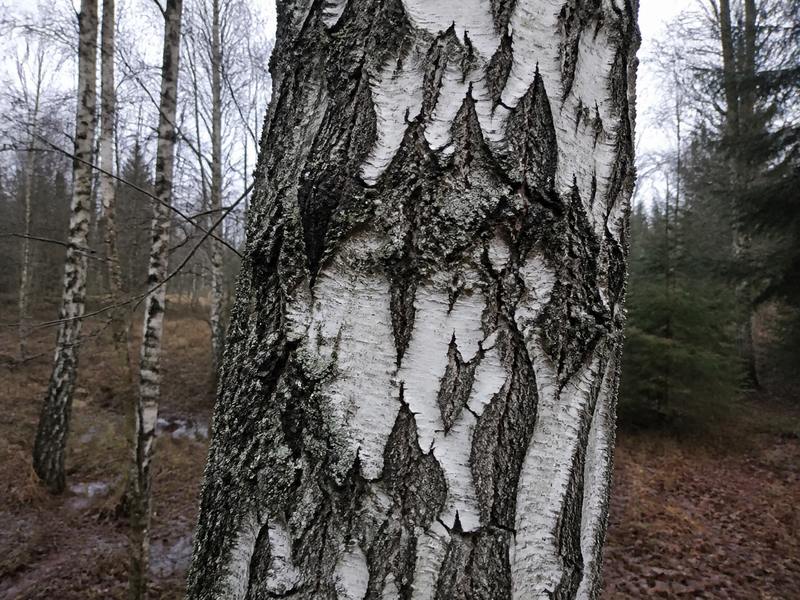
The commonest tree in Latvian gardens and also one of the most troublesome when it grows close to a house. A birch's root system is wide and shallow, so it competes hard for water with everything around it. The crown is large in relation to the trunk, and on older birches the top often begins to die back.
The key point: birch must not be pruned in spring. During the sap flow it loses a great deal of sap from the cuts, and that weakens the tree. We work on birch in the second half of summer or in autumn.
Pine
Pine has a deep taproot, so it is usually wind-firm. The problem is a different one: pine has no ability to produce new branches from the trunk. If part of a pine's crown is cut away, nothing will grow back in its place — the tree will stay disfigured for the rest of its life. The lower dead branches can be taken off a pine, but the crown cannot be shaped.
In Jūrmala and the coastal districts pine is the dominant species, and old tall pines beside houses are a typical job.
Spruce
Shallow roots and a dense crown — the combination that gives spruce the poorest wind-firmness of all our common species. Spruces frequently go over complete with the root plate. The second problem is the bark beetle: it colonises weakened spruces, after which the tree dies within a few months.
Poplar
Grows very fast and gets very large, but the timber is brittle. Poplar branches break in the wind, and old poplars in urban settings are one of the most frequent causes of emergency call-outs. Poplars tend to have extensive decay at the base even when the tree looks sound. If you have a large old poplar near a building in your garden, it is worth having it surveyed rather than waiting.
Ash
Latvia's ash trees are widely affected by ash dieback — a fungal disease that has killed a large proportion of them. A diseased ash dies back from the top downwards, and the timber turns brittle. Assessing it in good time matters here: at an early stage the tree can sometimes be saved; at a later one it is already dangerous.
Oak
Strong, heavy timber and a long life. With oak the main issue in removal isn't the technique but the legal question: large oaks often reach the dimensions of a heritage tree and are then specially protected — they may not be felled without separate consent. Before planning any work on a large oak, the measurements need checking.
Lime
Tolerates pruning well and regrows after being cut back — which is why limes in Latvia have traditionally been trained and shaped. That doesn't mean a lime can be cut about however you like: a lime cut back crudely throws out a dense thicket of weak shoots. A shaped lime crown needs maintaining regularly, not restoring once a decade.
Maple, willow, thuja
Maple, like birch, loses a lot of sap under pressure in spring — work on it in summer or autumn. Willow grows fast, its timber is soft and brittle and the branches break often; a willow crown needs regular maintenance. Thuja is a special case, because it is usually a hedge rather than a tree — covered separately under thuja and hedge trimming.
What species means for the price
Species affects the work in several ways: how heavy and hard the timber is, how wide the crown is, whether the tree may be worked on in that season at all, and whether it has any special legal status. An oak of the same height as a birch takes longer, because the timber is heavier and the sections have to be lowered smaller. For the full list of factors, see the prices page.
It doesn't matter. Send photos — the tree at full height, a close-up of the bark, and a leaf or a needle — and we'll tell you the species and what specifically matters for it.