
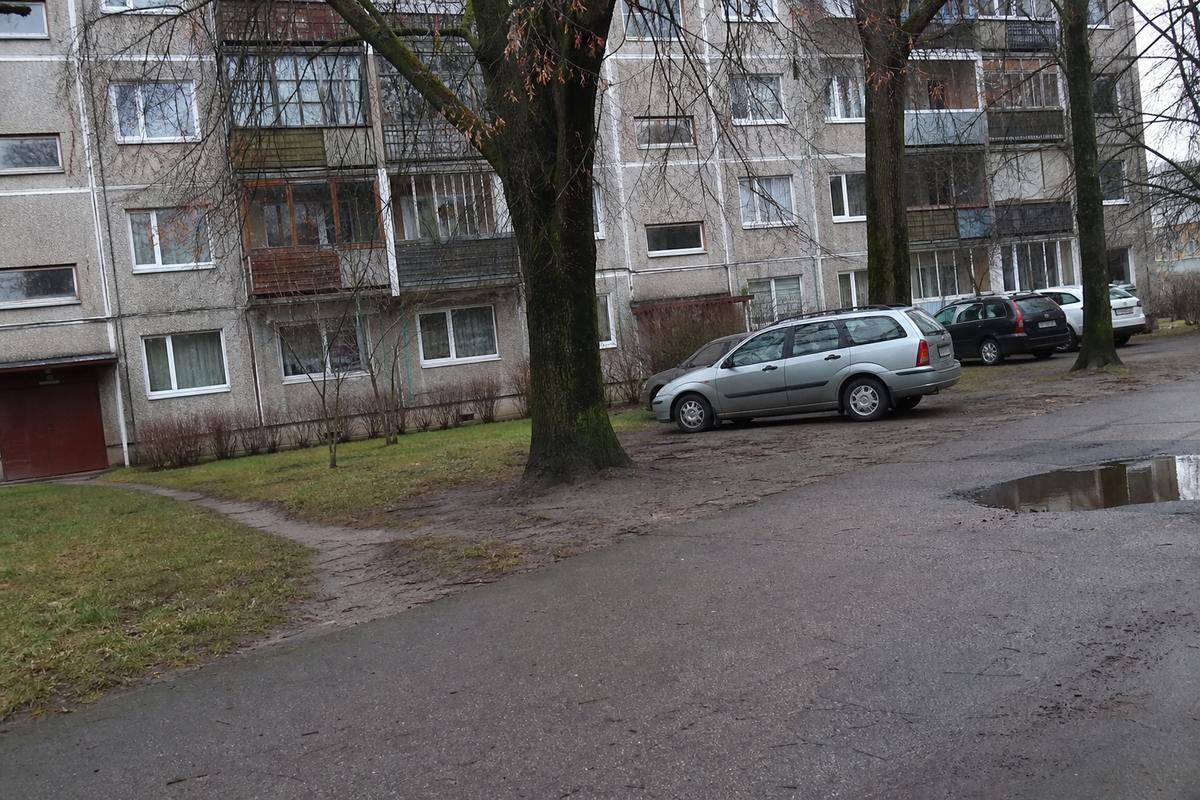
Within a single neighbourhood, Imanta holds Soviet-era housing estates with wide inner courtyards, streets of detached houses with private gardens, and new-build developments. In practice that means the first question we ask is not about the tree but about where it grows and who owns the land.
Two neighbourhoods in one
On the apartment estates the trees are the same age as the buildings and have now reached full size. The work is ordered by the managing agent or by the body of flat owners, and the commonest task is deadwood removal over paths and parking spaces, not taking the tree down.
In the detached-house areas the client is the owner, and the questions are different: shade in the garden, branches over the neighbour's fence, fruit trees, hedges. Here the decision can be taken at once and the work done without lengthy approvals.
So it helps to say straight away in your enquiry which of these situations is yours — it saves one exchange of messages and lets us name a quote sooner.
The wide inner courtyards
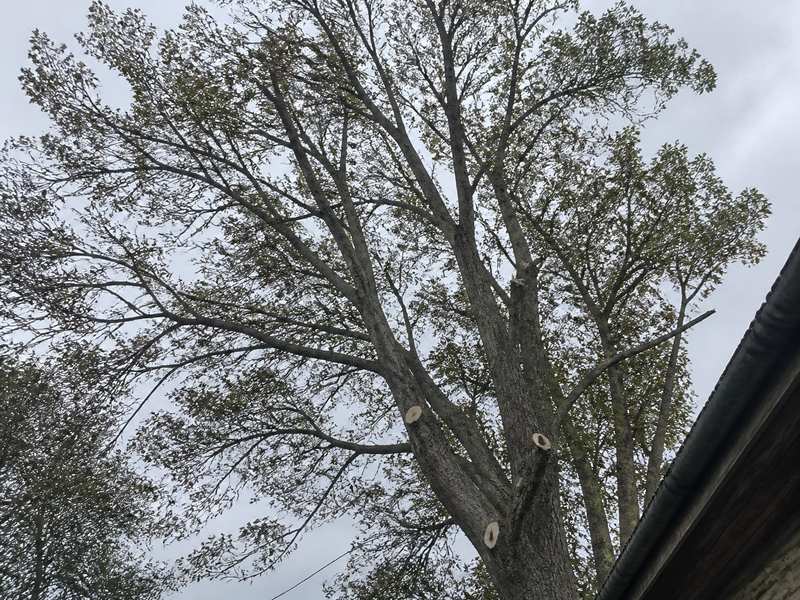
The inner courtyards of Imanta are more generous than on many other estates, and that sometimes means good news: if there is enough clear space around the tree, it can be felled whole, and that is the quickest and cheapest option.
So when we assess a job we always look first at whether there is a drop zone at all. Sectional dismantling is not a better method — it is the method for cases where there is no other. If there is room in Imanta, we say so and offer the cheaper solution.
The railway and the routes
The railway crosses Imanta, and Kurzemes prospekts and Jūrmalas gatve are busy arterial roads. In practice that means getting from one part of the neighbourhood to another can take longer than it looks, and that access to a particular courtyard needs to be known in advance.
An exact address therefore helps in your enquiry, along with a photo showing the route to the tree — from that we decide what kit to bring and whether it will get through at all.
The pines left standing between the houses when Imanta was built in the forest
The estates of Imanta were raised on the site of a pine forest, and some of the pines were left standing between the new buildings. Decades on they look nothing like pines grown in woodland. The crown is high up, the trunk long and bare, the side branches broken off or dead, and the tree spent years growing alongside others — once the surrounding trees are felled or building work goes in, it stands alone in the wind, even though its root system formed in shelter.
What we see in practice on the pines of Imanta:
- dead branches in the upper crown — they come down by themselves, and from twenty metres that is dangerous; the answer is usually deadwood removal, not felling the tree;
- resin bleeding and bracket fungi on the lower trunk — a sign that the wood inside is already damaged;
- root damage after trenching, the building of parking spaces, or asphalting close to the trunk.
An old pine is not worth felling merely for being tall. Often a tree health assessment and tidying the crown is enough — but if the base of the trunk is soft, we will say so plainly.
The detached-house streets of Imanta: hedges, thujas and apple trees
Between the apartment estates Imanta also has older streets of detached houses on fairly narrow plots. There the owner orders the work themselves, and deciding is far simpler than in a courtyard with many neighbours — on their own land the owner decides about tree care alone. A local authority permit is needed to fell a tree, not to care for a crown, and hedges, thujas and fruit trees usually fall outside it altogether.
The commonest jobs in these streets:
- thuja trimming, when the row along the fence has grown above the roofline and gone bare at the bottom;
- apple and pear pruning in old gardens where nothing has been done for years;
- crown thinning, when a tree shades the windows or the neighbour's greenhouse.
In narrow courtyards a tree often cannot be felled whole — we take it down in sections from a rope or by climbing, and haul the branches away, because there is nowhere to put them. If the tree grows right on the boundary, it is worth reading beforehand how responsibility is shared with a neighbour.
What we do in Imanta
All of our services are available in Imanta. The most requested in this neighbourhood:
- Dangerous tree removal — Dead, rotten, leaning and damaged trees. We assess first, then cut.
- Emergency tree removal — Fallen and broken trees after a storm — we come out the same day.
- Tree crown care — Crown shaping, thinning and deadwood removal.
- Stump grinding — Stump grinding without digging — the lawn is left almost untouched.
- Tree health assessment — Is the tree dangerous? We inspect it and tell you what to do.
- Branch and timber removal — Branch and timber removal, including where someone else did the cutting.
The full list with descriptions is in the services section.
How the work is done
- We get back to you within 5 min. Fill in the form and attach photos showing the tree at full height, its base and the route up to it. That is often enough for a rough quote.
- Assessment. We come back with an approximate price and method. If access in Imanta is difficult, we come out to look before the work.
- Permit, if one is needed. We check whether the particular tree needs one in Rīga and file it on your behalf.
- The work. We agree a time, cordon off the working area and arrive with everything needed.
- Clearing up. We chip or collect the branches and take them away. We do not leave wood chip behind. If you want the firewood, we cut it to length and stack it where you ask.
What the price depends on in Imanta
There is no flat rate per tree. In Imanta the quote is made up of the tree's height and girth, its species and condition, whether there is a drop zone in the inner courtyard, the distance to buildings and cables, whether climbing is needed and the volume of material to be hauled away.
In Imanta the price is often brought down by good vehicle access and a clear drop zone — in the wider inner courtyards a tree can frequently be felled whole, and that costs less than lowering it in sections. We have put the full list with explanations on the prices page.