What it is and what it isn't
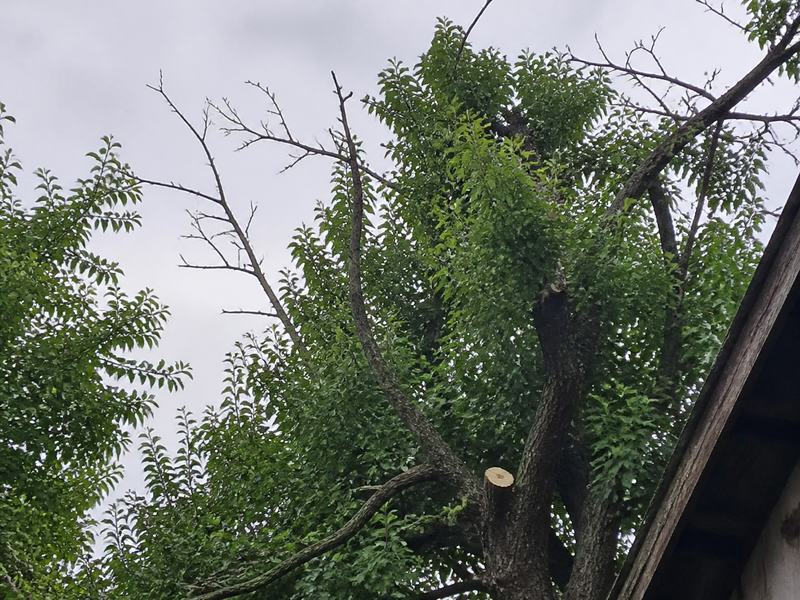
Deadwood removal means taking out of the crown the branches that are no longer alive. Nothing else is touched: the tree's height, spread, shape and quantity of leaves stay just as they were. That is what distinguishes this job from thinning, where live branches are taken out as well.
It is the smallest intervention that can be made to a tree. It costs the tree effectively nothing — a dead branch produces no food, so removing it is no loss. That is also why there is no limit on how much dead wood can be taken out at one time: all of it can go.
Why deadwood is a problem of its own
A live branch flexes in the wind. Dead wood does not — it is brittle and breaks suddenly, without warning and without any noise beforehand. That is why dead branches come down even on days with almost no wind: it is enough that the wood has finally let go.
The second factor is weight. A large dead oak or maple branch is heavy and hard. It has no leaves or fine twigs to slow its fall, so it comes down straight and at full force. Deadwood damages roofs, greenhouses and cars, and injures people, on a regular basis.
If a branch has broken but is still held in the crown or caught up in other branches, do not go underneath it — not even briefly, not even to fetch something. There is no way to predict when it will let go. If a branch like that is over a path, a doorway or a parking space, it is emergency work, and we try to come out the same day.
Where it matters most
A dead branch in a forest is not a problem. The same branch in a city garden is. We look first at the places where somebody is regularly underneath the tree:
- paths and the entrance to the house;
- parking spaces and the drive;
- terraces, summerhouses, garden furniture, the barbecue;
- play areas, trampolines, sandpits;
- greenhouses and glass roofs;
- a neighbour's garden and the public pavement — responsibility here usually lies with the owner of the tree, and there is more on that in our section on who is liable for a fallen tree.
Often it is all that's needed
A large proportion of the trees we're called out to as dangerous turn out to be healthy trees with dead wood in the crown. An old oak or lime will often let its lower and inner branches die back simply because they no longer get enough light — that is normal tree life, not disease. Once the dead wood is out, the risk is gone and the tree stays. This is a case where the smallest job delivers the most.
When it isn't enough: if branches are dying right across the top of the crown, if more dies back each year than the year before, or if there are bracket fungi at the base of the trunk, then the problem is not in the branches. What is needed first is a tree health assessment, because the tree may be dying back for an underlying reason — root damage, decay or disease.
How we do it
We climb the tree on ropes. We don't use spikes on a living tree — they damage the bark. Dead branches are always taken with particular care, because they can break the moment they are touched, so we choose our anchor points in live wood. For wide or tall crowns we use a MEWP (mobile elevating work platform).
We cut branches in the right place — back to the branch collar, not flush with the trunk and not leaving a projecting stub. A correct cut in that position grows over; an incorrect one stays open. We chip the brash and take it away.
It can be done at any time of year
Unlike most pruning work, taking out dead wood is not tied to a season. No live wood is cut, so there is no sap flow, no risk of disease entry and no need to wait for the dormant period. In summer it is actually easier to tell a dead branch from a live one — the live one has leaves. The only constraint is the bird nesting season: if there is an occupied nest in the crown, we postpone the work or work in another part of the tree. More on the seasons — when to prune trees.
What the price depends on
The height of the tree, how much dead wood there is and where in the crown it sits, whether we have to climb or can work from a platform, vehicle access, and the volume of brash to be taken away. This is usually one of the cheaper crown jobs, because the work is targeted and doesn't involve going through the whole canopy. If we have to climb high or bring in a platform, the price goes up. We explain the factors on the prices page.