
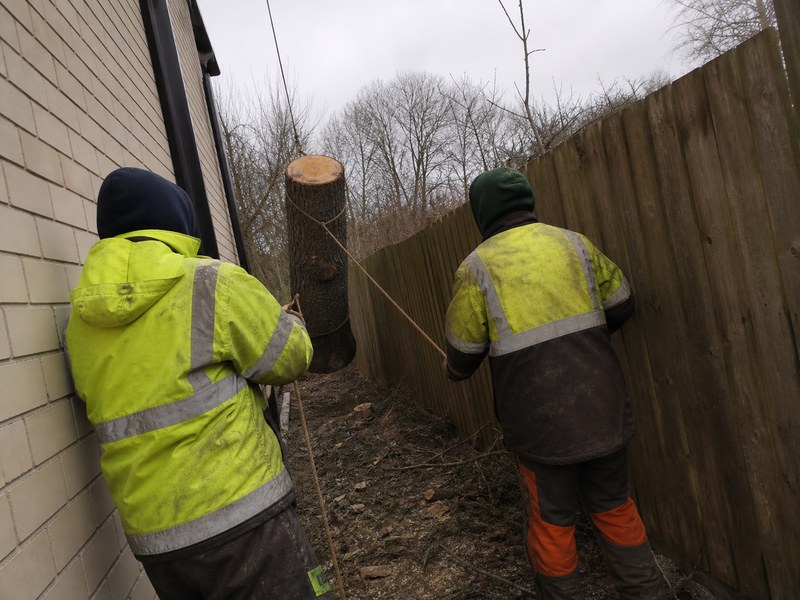
What is different here
In an open garden there is always some direction in which a tree can be dropped. In an inner courtyard there isn't — every side has a wall, a fence or a neighbour's property. So the job isn't “fell the tree” but “take the tree out piece by piece from a confined space”.
On top of that come things that simply don't exist in a garden:
- windows at every level, including right beside the work area;
- parking spaces with cars that have to be moved or covered;
- doorways that have to be closed off or cordoned during the work;
- neighbours and residents walking through the work area;
- often — no room for machinery.
A courtyard tree and a garden tree are not the same thing
In a garden a tree grows in a space with light and wind from every side, and it usually grows up balanced. In an inner courtyard a tree has spent its whole life reaching upwards for light between walls. In practice that means a long, spindly trunk, a crown that starts high up, and often a lean towards whichever side the courtyard is open. There are fewer branches that could serve as anchors, and they are thinner than on a garden tree of the same height.
What the tree conceals is different too. In an inner courtyard the ground around the tree has been compacted, paved over and dug up for services for decades, so the root system is often partly severed. That isn't visible from above, but it changes how much the tree will take when weight starts coming off it. And finally — in a garden the things around the tree are yours; in a courtyard they belong to several people, and every one of them matters to somebody.
What the pre-work survey establishes
In a tight courtyard the survey isn't a formality — without it the job simply cannot be planned. On site we establish four things.
- Where the landing zone will be. That is the area we lower pieces onto and where they get cut up. It has to be in one place, and it is usually the single most important decision on the whole job.
- Where we will stack the material. The brash and timber have to go somewhere before they are carted away. If that isn't worked out in advance, material piles up where it shouldn't.
- Which entrance stays open. At least one stairwell or doorway has to remain accessible all day. We tell you which in advance, so residents know which way to go.
- Where the vehicle will stand. Often that isn't in the courtyard but out on the street, and then the distance the material has to be carried is what determines the length of the job.
How we work
The method is sectional dismantling, but with extra emphasis on controlling the area. Before the work we cordon off the zone, agree which entrances will be closed and for how long, and discuss whether cars need moving. On the day it affects everyone living around the courtyard, so it is better agreed in advance than sorted out while the work is going on.
When several owners are involved
In an inner courtyard the tree is often positioned so that the work touches more than one property — the landing zone is on one side, the vehicle on another, and the branches reach over a third owner's fence. Then the order of things matters. First we establish who owns the tree and who owns the ground beneath the work area. Then we agree access with everyone involved, and only after that do we fix the day of work. If one party hasn't agreed, we don't start and we don't expect to resolve it on site — that usually ends with the job being abandoned halfway through.
In practice that means it is worth saying in your enquiry straight away how many owners are involved. One house's garden with one owner, and a boundary between two houses with a shared driveway, are two completely different jobs, even if the tree is the same.
Why work goes more slowly in an enclosed space
In an open space the arborist cuts a branch and it goes down. In a courtyard, after every piece you have to check where it landed, free the rope and clear the landing zone before the next one comes. The pieces are smaller, so there are more of them. The angle of the lower is often not vertical, because directly under the branch there is a wall or a canopy, and then the piece has to be steered sideways. Each of these things takes a little time on its own, but multiplied by the number of pieces, the same tree in a courtyard takes several times longer than in a garden.
That is also why we don't promise the work will be quick. It is more honest to say in advance that it will take a day than to promise a couple of hours and leave the courtyard half finished.
What residents experience on the day
In practice it looks like this. In the morning we cordon off the zone and cover over what is beneath the tree. Most of the day passes with noise that comes in bursts — the saw runs for a minute, then there is quiet while the piece is lowered and cut up. The chipper is the loudest stage, and that is usually in the afternoon. The courtyard is partly occupied all day but not completely closed: you can't walk through the cordoned zone, you can walk around it.
By the end of the work the material has been taken away and the place swept. We take the wood chip and brash with us rather than leaving a pile in the courtyard — in a courtyard a pile like that would sit in front of everybody, and that isn't acceptable.
Apartment blocks
Where it is the courtyard of an apartment block, in addition to the technical side there is the question of who commissions the work and how residents are informed. We have written about that separately: tree removal in apartment block courtyards.
Price
Here what you pay for is the conditions, not the tree. The price is affected by how tight the space is, how small the sections have to be, whether machinery is needed and whether it can be positioned, how the material is carried out, and whether the work has to be agreed with several owners. For the full list of factors, see the prices page.