
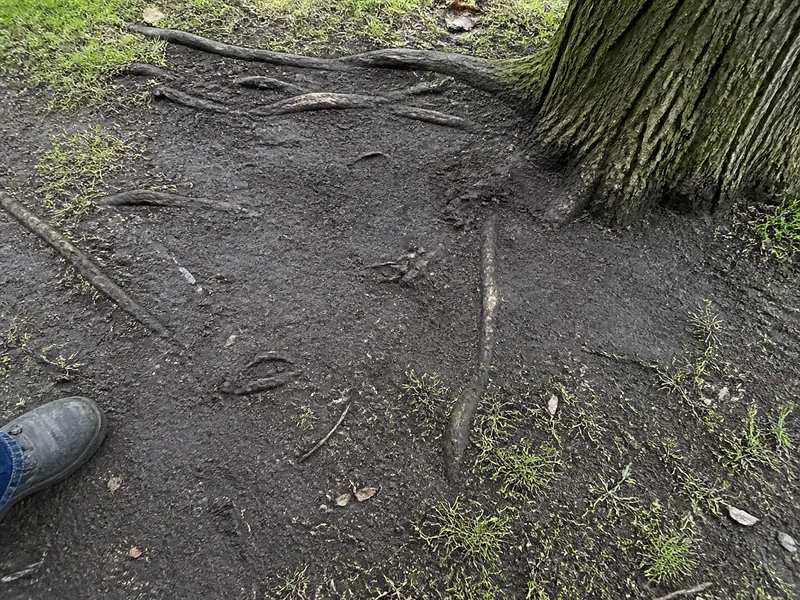
Roots are not where people think they are
Almost everyone pictures a tree's roots as a mirror image of the crown — a deep taproot going down as far as the tree is tall. The reality is very nearly the opposite. Most of a tree's active, feeding roots sit in the upper layer of the soil, and they spread far wider than the crown — often twice as far as the branches reach.
In practice this means a tree's roots form a flat, wide disc directly beneath the lawn, the path or the parking space. This single fact explains almost every root problem we see:
- the roots are where people walk, drive and stack things — not safely out of reach underground;
- a trench dug ten metres from the trunk can still sever a large share of the roots;
- block paving or tarmac over the root zone cuts off air and water exactly where the tree takes them up;
- soil tipped over the root zone buries the very layer the tree depends on.
Soil compaction — the main killer of urban trees
A root is not just a pipe for water. A root has to breathe. In healthy soil there are pores between the particles, filled with air, and that is where roots work. When soil is trodden down, those pores collapse. The ground becomes as hard as a road, and the roots slowly suffocate.
Compaction is caused by:
- foot traffic — paths, play areas, animal runs, the courtyards of apartment blocks;
- parking under the tree — one car, put in the same spot every day, does real damage over a few years;
- heavy machinery — even a single pass by a fully laden lorry over wet ground compacts it for years;
- building work — stacking materials, skips, mixing concrete in the root zone;
- sealing the surface — block paving, tarmac, concrete slabs.
A tree does not die within a week. The roots suffocate slowly, and the tree responds in the only way it knows — by reducing its crown. So between the moment the ground was damaged and the moment the tree looks ill, three to ten years can pass. By then nobody connects the two events any more, and the tree is written off as “diseased”.
Signs that the problem is in the roots
Root problems look different from trunk decay or pests. Look for a slow, even decline:
- the crown is thinning — you can see more sky through it than before;
- the leaves are smaller than is normal for the species, and there are fewer of them;
- dieback starts at the top of the crown — the tree retreats from its furthest points, because it can no longer supply them;
- autumn colour comes too early and the leaves fall before those of other trees of the same species;
- the length of the new shoots gets shorter year on year;
- a mass of small, tightly bunched shoots appears on the trunk or branches — the tree's response to stress.
These same signs can point to another problem, so before any work is carried out you need a tree health assessment. There is no point in caring for the soil if the trunk has already decayed.
What we do with the root zone
We survey the soil and the root zone
We look at how hard the ground is, how far the root zone extends, what goes on across it, whether the surface has been sealed and whether the ground level has been changed. Often that conversation alone reveals the cause — a trench dug years ago, or new paving.
We decompact the soil
Compacted ground cannot simply be dug over — a spade or a rotavator would sever the very roots we are trying to save. We use an air spade: compressed air is injected into the ground and loosens it from within. The air travels around the roots rather than through them — the soil is opened up and the roots are left untouched.
We improve the soil
Organic matter can be worked into the loosened ground so the pores do not collapse again the following year. Without that, decompaction is only a temporary fix.
We mulch the root zone
We cover the root zone with a suitable mulch, which we bring with us. Mulch holds moisture, evens out temperature, does not obstruct air exchange and — most importantly — protects the soil from being compacted all over again.
We agree what changes above ground
If people carry on driving or parking over the root zone, all the work is merely a postponement. We say plainly what has to change — paths moved, parking relocated, edging installed.
We supply the mulch ourselves. The branches and wood chip produced by tree work we take away rather than leaving them in your garden — a purpose-suited material is used for mulching.
Fertilisation — when it helps and when it does not
Fertilisation is the form of root care that is sold the most and helps the least. Fertiliser helps in one case only: when a tree is genuinely short of a particular nutrient. If a tree is suffering from compacted soil, severed roots or drought, fertiliser does nothing — the nutrients are already in the ground, it is just that the roots cannot reach them.
Worse — fertiliser can do harm. Nitrogen pushes a tree into new shoots and leaves, and a tree under stress has no resources with which to sustain them. The result is a weaker tree, not a stronger one. So we establish the cause first and only then talk about fertilisation.
Fertilisation is justified for young trees still establishing, for trees in very poor or disturbed urban ground, and for trees recovering from damage. For a mature tree in ordinary garden soil it is usually not needed at all.
If building work is still only planned
The cheapest root care is the kind you never need. If excavation, paving, an extension or new services are coming on your property, the root zone can be protected in advance — and that costs many times less than treating or removing the tree afterwards. We cover it separately: root protection during construction.
What the price depends on
The price is set by the area of the root zone that has to be treated, the condition of the soil and how hard it is, the method chosen — decompaction with an air spade is more labour-intensive than mulching — the volume of mulch, whether soil analysis is needed, the number of trees, and access for the equipment. Root care is often a process lasting several years rather than a single visit: soil is restored gradually. How we put a quote together is described on our prices page.
If you are not sure whether your tree's problem is in the roots, send photos with your enquiry showing the tree at full height, the base of the trunk, and what is going on at ground level around it — paving, a path, a parking space. That alone tells us a great deal.