
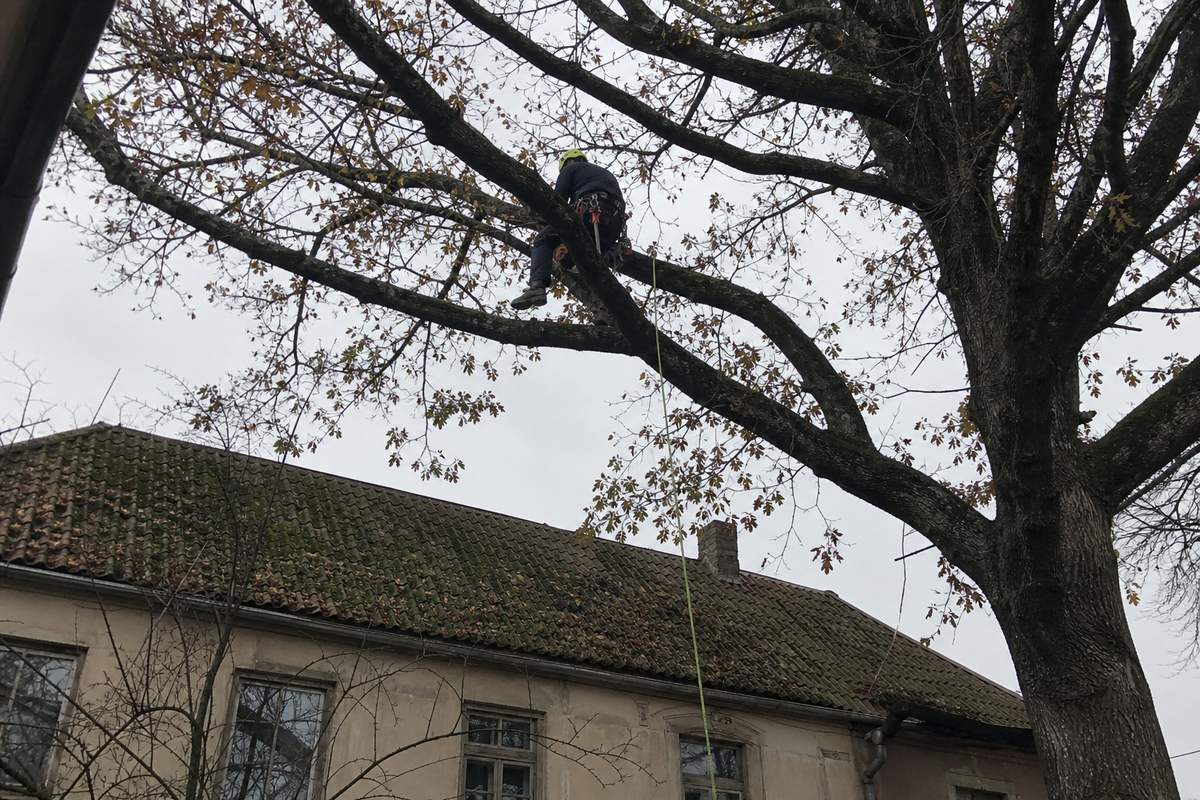
Why trees over a roof are a job of their own
There is no room for error here. Below the work area are the roof covering, the gutters, chimneys, windows and sometimes solar panels — all things a single badly dropped branch can damage. On top of that, sawdust and fine brash mustn't land on the roof in any quantity either, because they block the gutters.
What exactly is at risk
It is worth understanding that a roof isn't one surface. It is several different things with completely different tolerances, and some of them cost more than everything else put together.
- The roof covering. Clay and concrete tiles crack under a relatively light blow, and a cracked tile starts letting water in not immediately but months later. Slate cracks, and the crack isn't visible from the ground. Sheet metal and bitumen shingles take a knock better, but they are left with dents where water then sits.
- Gutters and the rainwater system. The most vulnerable part, because it projects out beyond the wall and sits exactly where a branch travelling down the side of the building wants to strike. A gutter bracket bends easily, and after that the whole run no longer holds its fall.
- The ridge and ridge capping. The ridge is the highest point of the roof and therefore the first thing a falling piece hits. It is also one of the most expensive places to repair.
- Chimney flashing and abutments. The metalwork around the chimney, the flashings to rooflights, ventilation outlets — everywhere the roof covering meets something else there is a weatherproof detail that a knock will shift. These are the joints that then let water in and whose cause is hard to trace.
- Rooflights. Glass is glass. A rooflight is also closer to horizontal than a wall window, so it takes the full force of a fall rather than a glancing one.
- Solar panels. These are increasingly common, and they are everything at once: glass, a frame, fixings through the roof covering, and electrical wiring. If there are panels on the roof, say so in your enquiry straight away — it changes the plan of work, not merely the level of care.
The point of that list is simple: there is nowhere on a roof where a piece may “just be set down”. So over a roof we don't send pieces towards the roof at all.
Why small sections matter more here than anywhere else
In a lowering system, weight determines everything. A piece twice as heavy means twice the force in the rope, twice the deflection at the anchor and far less chance of stopping the piece if it starts to spin. Elsewhere in the garden that only means a piece lands a couple of metres off target. Over a roof, two metres of inaccuracy is the difference between empty lawn and the ridge.
So over a roof we cut deliberately smaller sections than would technically be possible. That means more cuts, more lowers and a longer job for the same quantity of branches. It is a conscious trade-off — time can be added, a broken ridge cannot be undone.
How the anchor point is chosen
This is the essence of the whole job, so it is worth explaining. A cut branch hanging on a rope does not drop straight down — it swings like a pendulum about the point the rope is attached to. Where it swings to is determined not by where the branch grew, but by where the anchor is.
So we always set the anchor further from the building than the branch itself — usually on the opposite side of the trunk, or higher up on another branch away from the roof. Then, as the piece separates, it travels away from the roof and comes to rest hanging over clear ground rather than over the building. If there is no such anchor point in the tree — often because the tree grows too close to the wall and the whole crown is on one side — then climbing isn't the right answer and we work from a platform, where the branch is held from the basket and never travels over the roof at all.
How we work
We decide where to work from
Whether an arborist will climb the tree or we will use a platform. Over a roof a platform is often the easier option, because you don't have to brace against branches that sit above the building.
We set up the lowering system
The anchor point is chosen so the cut branch travels away from the roof rather than over it. That is the critical point of the whole method.
We cut in small sections
The smaller the piece, the less weight on the rope and the greater the control. Over a roof we work in deliberately small sections, even where that takes longer.
We check the gutters
After the work we check whether any brash or sawdust has been left in the gutters or on the roof, and clear it out.
Needles, leaves and fine debris in the gutters
Everyone notices the big pieces, but in practice the thing that does a roof the most harm is the small stuff. Every branch that is cut sheds needles, leaves, flakes of bark and sawdust, and all of it heads the way the water goes — that is, into the gutters.
Needles are the worst. Spruce and pine needles are small, they don't wash through, and in a gutter they mat together into a dense mass that holds water back. A blocked gutter overflows, water runs down the wall, and in winter ice forms there instead and pulls the brackets off the gutter. All of this happens six months after the job, when nobody connects it with the tree work any more.
So checking the gutters isn't a courtesy at the end of the job but part of the job. Afterwards we walk the gutter runs along the whole work area and take out whatever has got in. If the roof is steep or high and cannot be reached safely, we say so honestly rather than pretending we checked. And one more practical point: if the work is done in autumn while the tree is still shedding, it is worth scheduling the gutter clearance for after leaf fall has finished rather than before.
Branches over the roof — do they all have to go?
Not always. It is often enough to take off only the branches that touch the roof or sit directly above it and leave the rest of the crown. The tree stays, the shade stays, but the risk goes. If the tree is already old and the part of its crown over the house is damaged, then it is more honest to talk about removing the tree than about pruning it again every couple of years.
The choice between the two is usually reasonably clear if you look at the tree rather than only at the branches over the roof.
Only the branches over the roof is the right option when the tree is healthy, its crown is large and only part of it reaches over the building, and the tree will still be balanced afterwards. Then you get everything you needed — the roof is clear — without losing the tree. Two things to bear in mind: one side of the crown is being removed, so the tree will no longer be symmetrical, and after a few years the branches will start growing that way again, so it will need repeating every few years. This is maintenance rather than a one-off job, and it should be treated as such — more under crown care.
The whole tree is the right option when the house side of the tree is already damaged or dead, when removing everything over the roof would leave only half a crown, or when the tree grows so close to the wall that any new growth ends up on the roof. Likewise if the tree is dead or decayed at the base — then pruning the branches solves nothing, because the problem isn't in the branches. In cases like these, repeat pruning every couple of years costs more than a single removal and ends in removal anyway.
We'll tell you which applies in your case when we survey it. We don't push in either direction — felling a whole tree when three branches would have done is just as bad a piece of advice as the reverse.
What the price depends on
Here the price is set not by the quantity of branches but by how many vulnerable things sit beneath them. It is affected by the height of the tree and its distance from the wall, how small the sections have to be, whether climbing will do or a platform is needed, whether there are rooflights and panels under the work area, what the vehicle access is like and how much material has to be taken away. We have explained the factors on the prices page. The most useful photo for an assessment is one showing both the tree and the roof in a single frame.
If a branch has already fallen onto the roof or damaged it, that is emergency work — see a tree has fallen on the house, and photograph everything before anything is moved.