
Over the past few decades Mārupe has changed from farmland into a dense suburb, and you can see it in the trees. On one side of the street there is a new house with saplings only just planted; on the other, an old farmstead tree or the oak of a former homestead, now standing between four new houses. Those are two completely different jobs.
Old trees in new development
The most common job we come out to in Mārupe: on a plot that used to be a field or a farmstead, a new house has been built, and one large old tree has been left beside it — most often a birch, a maple or an ash. The tree's conditions have changed: service trenches have been dug around it, paving laid, soil piled up, and heavy machinery drives nearby.
The result shows a few seasons later — a thinner crown, dead tops, sometimes the tree simply starts to die back from above. If the house is still going up, it is worth protecting the root zone during the building work; if the damage is already done, we start with a tree health assessment and only then decide.
Narrow streets and hedges
In the new quarters the streets are narrow, pavements and planting have only just been built, and there is often no lawn beside the house yet. That changes how we plan machinery: in some places a large MEWP (mobile elevating work platform) simply will not set up, and the outriggers must not be placed on fresh paving or unconsolidated ground.
So in Mārupe we quite often work with rope access — lowering the tree in sections — even when there appears to be enough room around it. The other frequent job is thuja and hedge trimming: in the new neighbourhoods thujas have been planted almost everywhere, and after a few years they start turning into a hedge that has to be kept in shape.
Business premises and the airport surroundings
Mārupe is where warehouses, logistics sites, offices and aviation-sector companies are concentrated. On sites like these tree work usually means not one tree but an area: car park planting, the fence line, an overgrown edge of the plot, trees along the access road.
For businesses we offer both one-off jobs and a regular maintenance contract, where we survey the site to a schedule and spot problems while they are still cheap. More: commercial tree care.
Wet ground and drainage ditches
Around Mārupe there is a network of drainage ditches and, in places, lower-lying ground. For trees that means two things: after a wet season the soil in the root zone can be saturated and the tree stands less securely than it does in a dry spell, and heavy machinery must not be driven over the lawn at such times — it will leave deep ruts.
In practice we either wait for a drier period or use lighter equipment and carry the material out. If the job is not urgent, winter with frozen ground is often the technically best time in Mārupe.
Young planting in Mārupe gardens — mistakes that can still be put right
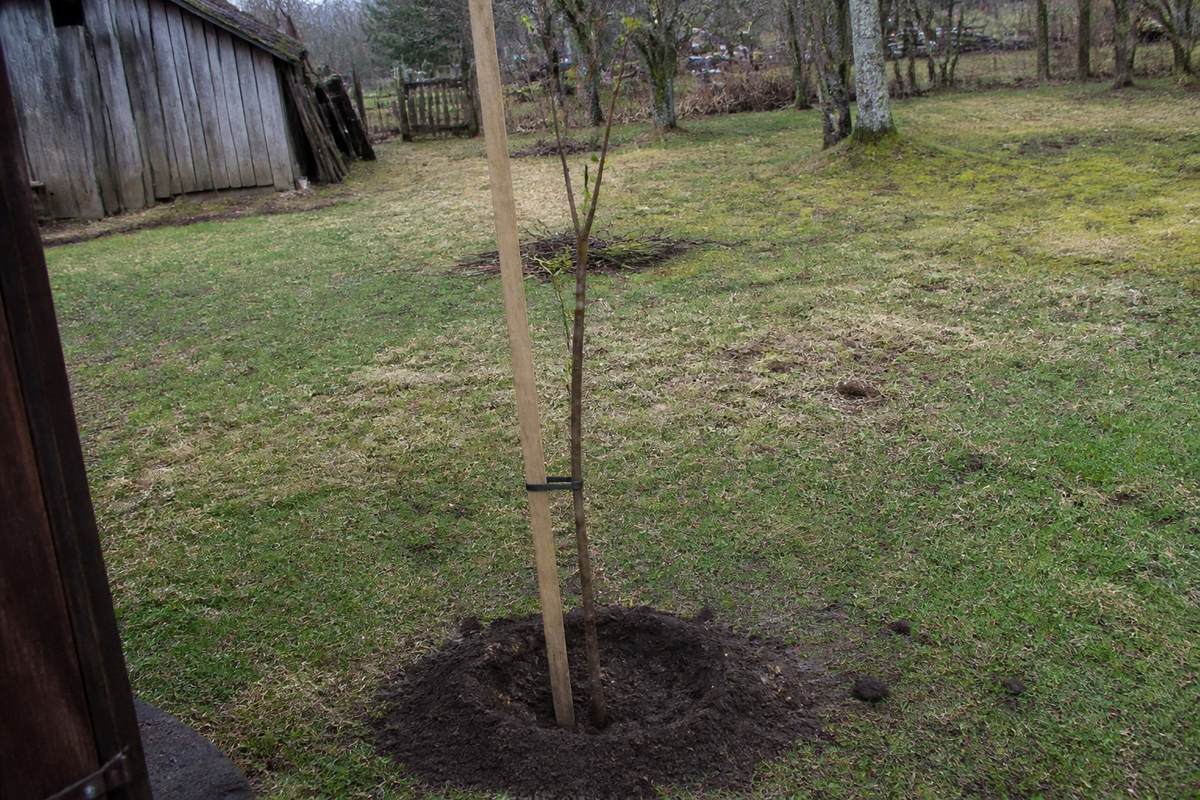
In Jaunmārupe and Skulte we have been in dozens of gardens where the trees were planted five to ten years ago and the problems are starting now. The reason is almost always the same: when the tree was planted it was a metre tall, and nobody thought about how wide it would be full-grown. A lime or a maple in a 1,200 square metre garden takes up almost the whole plot after twenty years.
The most common mistakes we see in Mārupe:
- a tree planted a metre and a half from the corner of the house or the terrace — roots running under the foundations, crown against the roof;
- a large broadleaf tree planted on the boundary with the neighbour, shading both gardens after ten years;
- a species chosen for a park rather than for a small plot;
- a tree planted too deep, or with the root ball left unopened, so it grows slowly and ails.
If the tree is not many years old and the trunk is not too thick, it can often be transplanted elsewhere in the same garden rather than cut down. For older trees the answer is usually crown thinning or shaping. We come out, look, and tell you honestly whether the tree is still worth saving.
Fast-growing screens for privacy — what they become after ten years
In the new Mārupe quarters the houses stand close together, and the first thought after moving in is to screen yourself from the neighbours and the street. Most often people choose thujas, poplars, willows or fast-growing spruce — they grow quickly and in the first years do exactly what is wanted. The problems start later.
What we have seen in Tīraine and Jaunmārupe:
- a row of thujas planted every 60 cm, grown together, bare at the bottom and no longer screening anything — but now a dense wall six metres high;
- poplars and willows that have reached 15 metres in ten years, with brittle wood and branches that break in the wind;
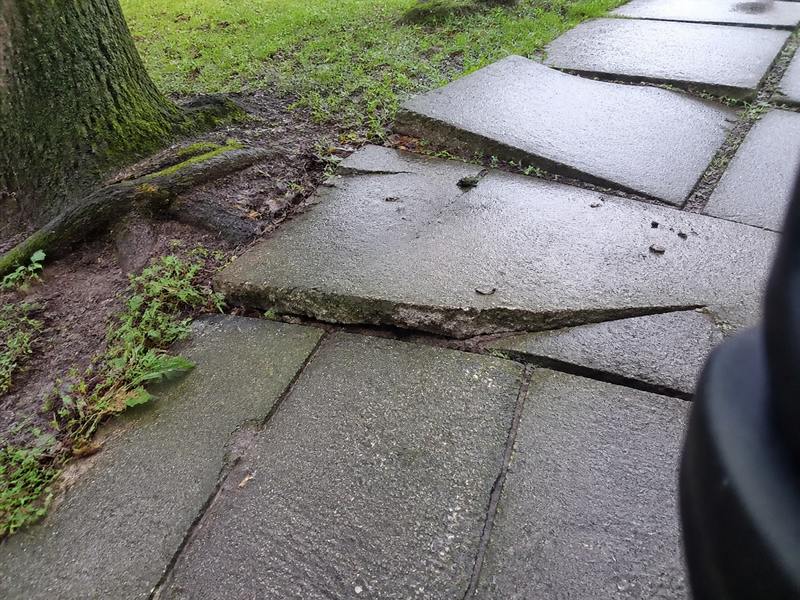
- roots that have grown into the drainage, the ditch edge or under the paving;
- a row of spruce completely bare on one side because it grows too close to the fence.
Thujas and hedges can be brought back into order with regular trimming — we write about that under thuja trimming. With poplars and willows the honest answer is usually different: the longer you leave it, the more expensive and difficult it becomes to take them out between houses later. We take the branches and chippings away ourselves, so nothing is left in the garden.
What we do in Mārupe
In Mārupe we offer our full range of services — from a single dangerous tree to clearing an entire site. The most frequently requested:
- Dangerous tree removal — Dead, rotten, leaning and damaged trees. We assess first, then cut.
- Emergency tree removal — Fallen and broken trees after a storm — we come out the same day.
- Tree crown care — Crown shaping, thinning and deadwood removal.
- Stump grinding — Stump grinding without digging — the lawn stays almost untouched.
- Tree health assessment — Is the tree dangerous? We survey it and tell you what to do.
- Branch and timber removal — Removal of branches and timber, including where someone else did the cutting.
The full list with descriptions is in the services section.
How the work happens
- We get back to you within 5 minutes. Fill in the form and attach photos showing the tree at full height, its base and its surroundings. That is often enough for a rough quote.
- Assessment. We reply with an approximate price and method. In more complicated cases we come out to Mārupe to look before the work.
- A permit, if one is needed. We check whether the Mārupe local authority requires one for that particular tree, and we handle the paperwork for you.
- The work. We agree a time, arrive with everything needed and cordon off the working area.
- Clearing up. We chip or collect the branches and take them away. We don't leave wood chip in the garden. If you want the firewood, we cut it to length and stack it where you ask.
What the price depends on in Mārupe
There is no flat rate per tree. In Mārupe our quote takes in the height and girth of the tree, its species and condition, the distance to buildings and cables, whether there is anywhere to fell it, whether climbing or machinery is needed, what access is like along the new quarter's streets, and how much material has to be taken away.
In Mārupe good access often brings the price down — if a chipper and trailer can be brought up to the tree, removing the material costs less than if it has to be carried out to the street. We have set out the full list with explanations on the prices page.