
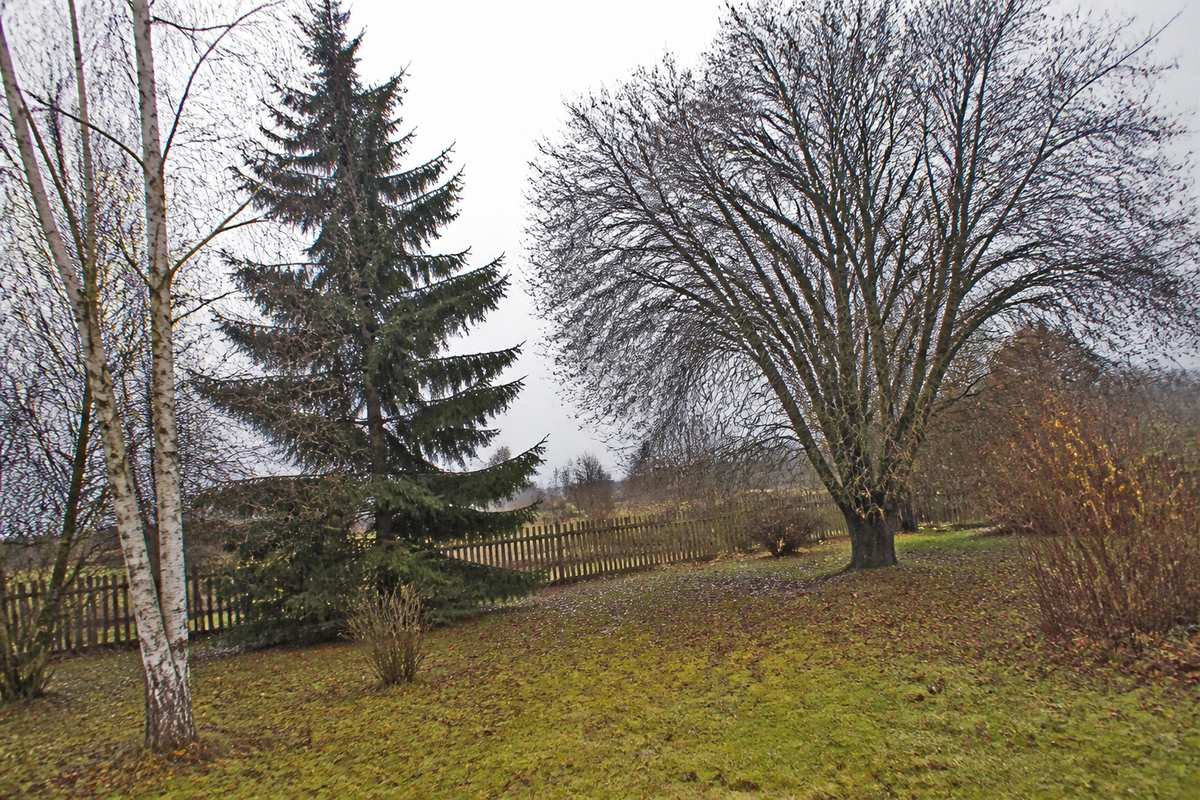
Jaunciema gatve is the neighbourhood's main and effectively only linear corridor, and arranged along it are housing, warehousing and wide areas of open country. The nearness of Ķīšezers, the forests and the lower-lying ground determine both how the trees grow and when machinery can get in at all.
Wet ground changes everything
Near the water and in the lower-lying parts the soil is wet, or at least saturated for part of the year. The black alder, birch, aspen and willow growing there grow fast but are brittle — after storms these are the first to break and go over.
More importantly: in wet ground the roots hold less firmly, and a tree can lean over even while completely healthy. The sign to watch for is the ground at the base of the trunk — if a crack has appeared there or the turf has lifted, the tree has begun to move. More on this: leaning trees.
Machinery and the season
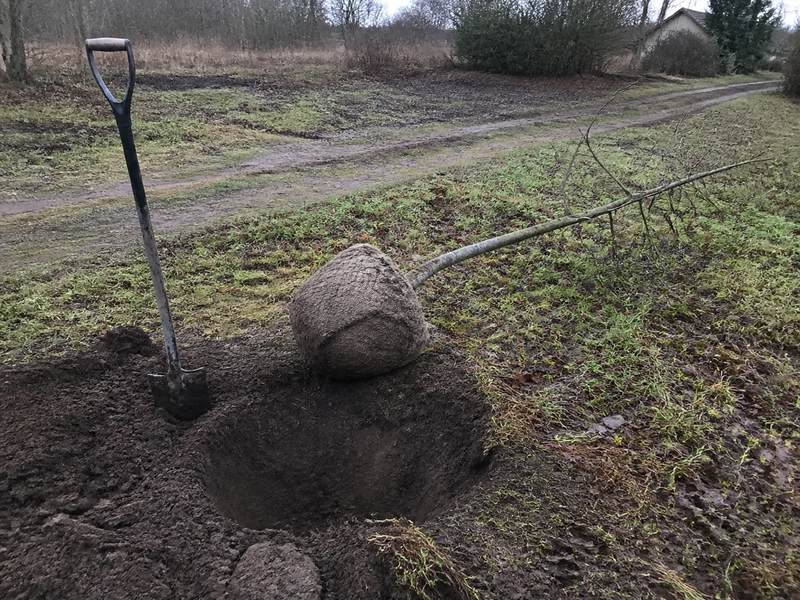
In the wet season heavy machinery does not go onto plots like these — it would leave deep ruts that then have to be made good. In practice we have two answers: either we work with rope access and carry the material out, or we plan the job for a drier period.
Winter, with the ground frozen, is often technically the best time in Jaunciems: machinery can get in without damaging the lawn, the structure of the tree is easier to read without leaves, and the garden is dormant. If the work is not an emergency, it is worth scheduling.
Plot edges and warehouse sites
Jaunciems has many properties with larger plots whose edges have not been managed for years: aspen and willow by the ditch, maple regrowth along the fence, branches over the drive. The typical job here is tidying an edge, not a single tree.
On industrial and warehouse sites the task is similar but with extra requirements: entry permits, safety rules and a time window in which the work does not disrupt operations. We agree that beforehand — commercial tree care. We chip the material and haul it away, and the stumps can then be ground out.
One road in, one road out — and how that changes planning
In Jaunciems virtually all traffic runs along Jaunciema gatve. It is a single long axis, off which turnings lead to the housing streets, the industrial sites and the plots at the forest edge. For us that means one thing: once the machinery has gone to the far end of Jaunciems, coming back the next day costs time, not work.
So in Jaunciems we try to combine several sites into one visit. If your neighbour also needs a dying pine taken down or a crown tidied, arrange it with us together — one delivery of machinery to two or three properties costs less than two separate ones. The same goes for branch removal: a full trailer from several plots is better value than half a load from one.
Practically: write down what you want in the enquiry itself — how many trees, where they stand, whether the access runs over asphalt or gravel, and whether the gates are wider than three metres. The more precise the description, the more precise the quote and the fewer wasted journeys.
Plots on the shore of Ķīšezers: washed-out roots and trees leaning over the water
Properties along Ķīšezers have a problem of their own, unrelated to wet ground in the broad sense. The bank is gradually washing away — wave and ice take a little soil every spring, and a tree that ten years ago grew a metre from the edge now stands with its roots exposed over the slope. Visually it is still a healthy tree, but it no longer has a supporting side.
What we look at on a plot like this:
- whether the roots are exposed on the water side, and how deeply;
- whether the lean of the trunk is increasing — old scars and a bend in the trunk show this;
- whether the ground cover at the base has been pushed upwards, which means movement;
- whether the tree is worth keeping at all by taking weight out of the crown, rather than felling it.
A tree leaning over water has to be felled in the opposite direction, and that almost always means sectional dismantling from above. Note too that in the protective belt along the shore separate conditions may apply to felling — we take on obtaining the permit ourselves.
What we do in Jaunciems
All of our services are available in Jaunciems. The most requested in this neighbourhood:
- Dangerous tree removal — Dead, rotten, leaning and damaged trees. We assess first, then cut.
- Emergency tree removal — Fallen and broken trees after a storm — we come out the same day.
- Tree crown care — Crown shaping, thinning and deadwood removal.
- Stump grinding — Stump grinding without digging — the lawn is left almost untouched.
- Tree health assessment — Is the tree dangerous? We inspect it and tell you what to do.
- Branch and timber removal — Branch and timber removal, including where someone else did the cutting.
The full list with descriptions is in the services section.
How the work is done
- We get back to you within 5 min. Fill in the form and attach photos showing the tree at full height, its base and the route up to it. That is often enough for a rough quote.
- Assessment. We come back with an approximate price and method. If access in Jaunciems is difficult, we come out to look before the work.
- Permit, if one is needed. We check whether the particular tree needs one in Rīga and file it on your behalf.
- The work. We agree a time, cordon off the working area and arrive with everything needed.
- Clearing up. We chip or collect the branches and take them away. We do not leave wood chip behind. If you want the firewood, we cut it to length and stack it where you ask.
What the price depends on in Jaunciems
There is no flat rate per tree. In Jaunciems the quote is materially affected by the state of the ground and the season, as well as by the tree's height and girth, its species, its condition, whether there is a drop zone and how far the material has to be carried.
In Jaunciems the price is influenced by ground conditions and vehicle access — in the wet season the same job can take longer, because the machinery has to be left further off and the material carried out. We have put the full list with explanations on the prices page.