
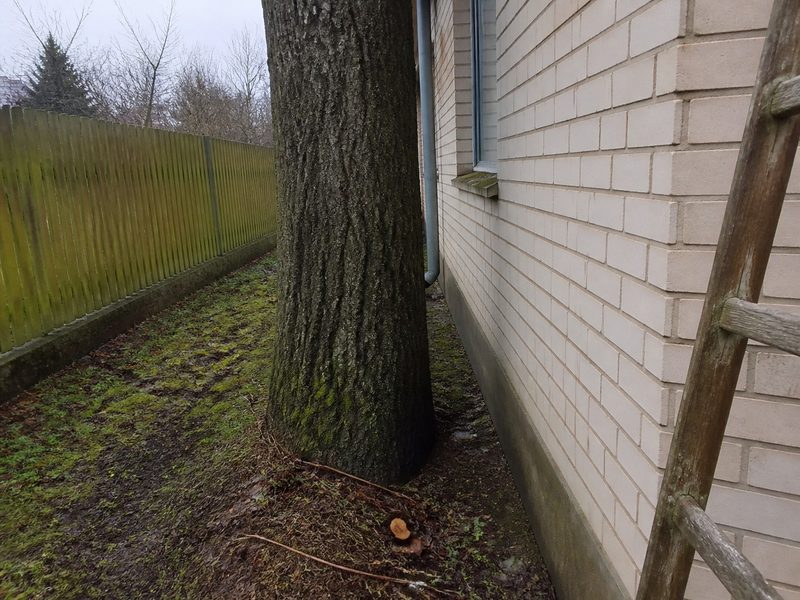
When there is no vehicle access
Typical situations in Rīga and the surrounding area:
- the tree grows behind the house and the only way in is a narrow path along the wall;
- an inner courtyard with no entrance, or gates that machinery won't pass through;
- there are steps, a wall or a steep slope between the driveway and the tree;
- the ground is so soft or so steep that taking machinery onto it isn't safe;
- the route to the tree crosses new paving, a terrace or planting that you don't want to risk.
“No vehicle access” means several rather different things in practice, so it is worth saying which of them applies in your case:
- Steps. Even a few of them rule out anything on wheels. Material goes up and down steps in people's arms.
- Terraces and levels. A garden on several levels with retaining walls — there is access, but only on foot.
- Slope. Machinery is kept off a steep bank not because it couldn't get there, but because it wouldn't be safe.
- Soft ground. A ditch, wet meadow, freshly filled ground. Here machinery would sink in or cause damage costing more to put right than the job itself.
- Gates that don't open wide enough. The most common and the most unexpected obstacle. There is a driveway and there is a route, but machinery won't go through the gateway.
- No route at all. The tree grows in an inner courtyard with no entrance whatsoever. Then everything goes through the building's stairwell or the long way round along the fence.
First we walk the route out
Before we start cutting, we walk the route out exactly as it will be with a load in our arms — from the tree to wherever the vehicle will stand. That isn't a formality: on nearly every site like this, something turns up along the route that wasn't visible in a photograph. A low gate rail. A rut where the paving has settled. A tight turn between the greenhouse and the fence where a four-metre load simply won't go round.
Walking the route, we decide three things: how long the pieces can be cut in the first place, where the route has to be covered with sheets, and whether anything along the way needs taking off temporarily — usually a gate leaf or a section of fence, which we put back after the work. Those three things together determine the rest of the plan.
How we work
Everything normally done with machinery is done here by people and ropes.
- Rope access. An arborist climbs the tree and takes it down in sections.
- Small sections. We cut pieces to a size that can be carried out by hand along the route that exists.
- Carrying out. We carry the brash and timber to the nearest point where a vehicle can stand.
- Protecting the route. Where we have to cross lawn or paving, we use ground protection sheets.
Working in stages, so the route never gets blocked
This is what sets a job like this apart from ordinary tree work. On a site with vehicle access you can happily fell the whole tree, pile the material up and then cart it away. Here you can't, because the pile occupies precisely the same narrow space the material has to be carried out through.
So we work in stages: we cut as much as the team can carry out, carry it out, and only then cut the next part. The lower branches come off last, because those are the ones screening the way out. We keep the landing zone clear at all times — the moment it is full, work above has to stop and the arborist waits in the tree. That is the most expensive thing that can happen on a job like this, and the point of good planning is that it doesn't.
In practice that means the work looks slower than you might expect — the saw isn't running continuously. That is normal and it is intended.
What this means for the price
It should be said honestly: this kind of work takes more time and more people than the same tree on a site with good access. Most of the extra time goes not on cutting but on carrying the material out. If it matters to you to understand the price in advance, tell us how far away the nearest spot a vehicle can stand is, and whether there are steps or gates on the way — from that we can assess the job fairly accurately.
How much of the time goes on carrying? On sites like these, the cutting itself is usually only a small part of the day — often a third or less. The rest is cutting material down to a carryable size and walking back and forth. A medium-sized tree yields a surprising number of loads, and each one is a journey in both directions. So the distance to the vehicle affects the price more than the height of the tree, which is why access is one of the main factors on the prices page too.
And that is the honest answer to the question of why the quote came out higher than you expected. Not because the tree is large or complicated, but because there are twenty metres of narrow path and five steps between the tree and the road. Your neighbour's identical tree, with a driveway right up to the spot, genuinely did cost less, and that is the only reason. Better to say so up front than after the work.
If you can keep some of the material on site — firewood, say, or brash you will take away yourself later — the amount to be carried out drops, and so does the time on the job. We always offer that as an option.