
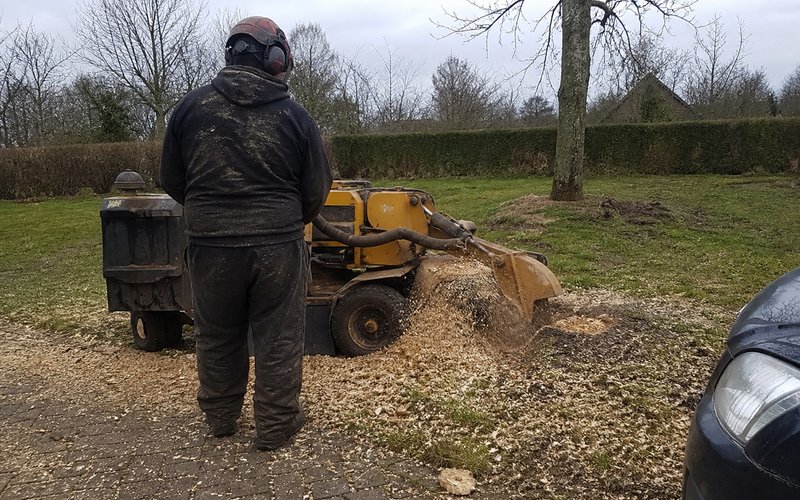
What the grinder actually does
A grinder has a cutting wheel with hardened teeth that spins fast. The wheel is swept back and forth across the stump, taking the wood off in layers — a little on each pass. The stump is not levered out of the ground and it is not cut through at one point; it is progressively levelled and then taken down below ground level.
That is the essential difference between grinding and digging out. An excavator tears the stump out along with its roots — which is why it leaves a hole. A grinder works from above and doesn't disturb the ground around the stump. Along with the stump it also takes out the root flare at the base, that is, the thick roots spreading out around the trunk.
The finer roots running further out stay in the ground. They are not a problem. Without a crown the tree no longer grows, and those roots gradually break down of their own accord. In a lawn or a flower bed they cause no trouble, and for the years they are still in the ground you will never notice them.
Grinding or digging out
There are two ways to get a stump out, and they differ far more than people usually think.
| Grinding | Digging out | |
|---|---|---|
| Surrounding lawn | Left almost untouched | Wrecked |
| Hole | None — a shallow hollow with chip in it | A large hole; soil has to be brought in |
| Machinery | Compact, fits through a gateway | An excavator; needs vehicle access |
| When it's used | In gardens, lawns, close to buildings | When the ground is being dug for other reasons anyway |
In a domestic garden grinding is almost always the right option. Digging out only makes sense when earthworks are going on across the site anyway.
What is left after grinding
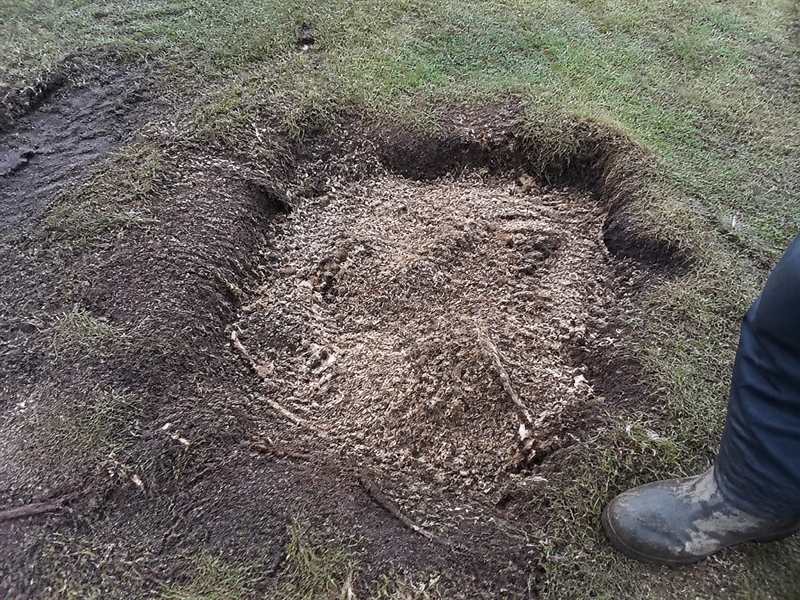
Where the stump was you are left with a shallow hollow filled with a mixture of wood chip and soil. There are two ways to deal with it:
- Leave it. Over time the chip breaks down and the spot levels itself out.
- Level it straight away. We take the chip out, fill with good topsoil, and the spot can be seeded or planted. That way the lawn recovers faster.
Surplus grindings we take away rather than leaving in a heap in the garden.
How the hollow is finished
There are two routes here, and the choice is yours. The first is to leave the hollow as it is. The chip and soil settle, break down, and the spot gradually levels itself. That happens slowly and unevenly — in the first year the spot usually sinks a little below the surrounding level, and then needs topping up once more.
The second is to finish the spot straight away. We take the chip out of the hollow and remove it, fill with good topsoil, compact it and level it with the surrounding lawn. The spot can then be seeded or planted the same day. If you want the lawn to look whole again within one season, that is the only way to achieve it.
If you are planning to plant a new tree in the spot, say so beforehand. We then change the soil over a wider area than just the hollow — more on that in the section on tree planting.
How deep we grind
We choose the depth according to what you plan to do with the spot next — and that is a question we ask before starting:
- Lawn. It is enough for the stump to be below the level of the lawn so you can mow over it.
- A new tree or planting. Deeper and wider is needed, because new roots need room.
- Paving, a terrace or a path. Deepest of all, because the remaining wood breaks down over time and the surface can subside.
Why shallow grinding comes back to bite you
If a stump is only taken down to lawn level, wood is left in the ground. It doesn't go anywhere — it rots. As it rots the wood becomes soft and takes up less space than it did whole. The surface above it settles.
In a lawn that doesn't matter. A settled spot shows as a shallow dip, you fill it with soil and reseed. Under paving, a terrace or a path it is another matter. Paving settles unevenly, because the wood doesn't rot everywhere at the same rate, and the result is a dip or lifted joints exactly where the stump was. A concrete path in such a spot cracks.
This cannot be put right without lifting the paving and removing the remaining wood — a more expensive job than simply grinding deeper in the first place. So we ask before starting what you plan for the spot. If the answer is "paving is going there" or "a path will run through", we grind deeper and take the chip and lumps of wood out of the spot completely rather than leaving them in the hollow.
Access
A grinder is compact and self-propelled — it can usually be taken through a garden gate and driven along a narrow path. That means no fence has to come down and no heavy machinery has to be driven across the lawn. If the only access is through the house or up steps, we need to know beforehand — the solution may then be a different one.
Several stumps
If there are several stumps to grind, it works out better to do them in one visit. Most of the cost is getting the machine to the site, so the second and third stumps cost less than the first.
The reason is where the time goes on the job. The grinder has to be loaded, driven out, unloaded from the trailer, walked to the stump, and after the work the whole sequence has to be repeated in reverse. That time is the same whether there is one stump on site or six. The grinding itself is only part of the visit.
So if there is another old stump in your garden that you have been putting up with, this is the moment to mention it. The same applies when more than one tree has just been felled — we grind the stumps there and then, while the machinery is on site. If branches and timber are still lying in the garden, we can combine that with site clearance, and then it all happens in one go.
What slows the work down and blunts the teeth
Grinder teeth are made for wood. Anything harder blunts them, and blunt teeth make for slower work. The things we most often find in the ground:
- Stones. Naturally occurring stones in the ground are a fact of life in Latvia, and we take the larger ones out around the stump by hand where we can reach them.
- Old bricks and lumps of concrete. Building rubble is often tipped into old gardens as hardcore, or simply buried. The teeth don't see it until they hit it.
- Buried paving and slabs. If there was once a path or a hard standing on the spot, a layer of stone often stays in the ground with turf simply grown over the top.
- Irrigation pipes and cables. Automatic watering lines, garden lighting cables, greenhouse supplies. These are usually at shallow depth, and a grinder cuts straight through them without warning.
Two of these we can only avoid with your help. If you know where irrigation or a cable runs underground, show us before we start — best of all on the spot. And if there was ever a building, a shed, a greenhouse or a driveway on the site, tell us that too, even if it was a long time ago. In a spot like that there is almost always something hard in the ground, and we work differently: we start more cautiously and establish first what is down there.
What affects the price
The diameter of the stump, how far the roots spread around it, the grinding depth required, the access, the number of stumps, and how much stone or building rubble there is in the ground. Stones are a real factor — they damage the teeth and slow the work. If you know there was paving or building work on the site, say so straight away. For the full list of factors by service, see the prices page.