
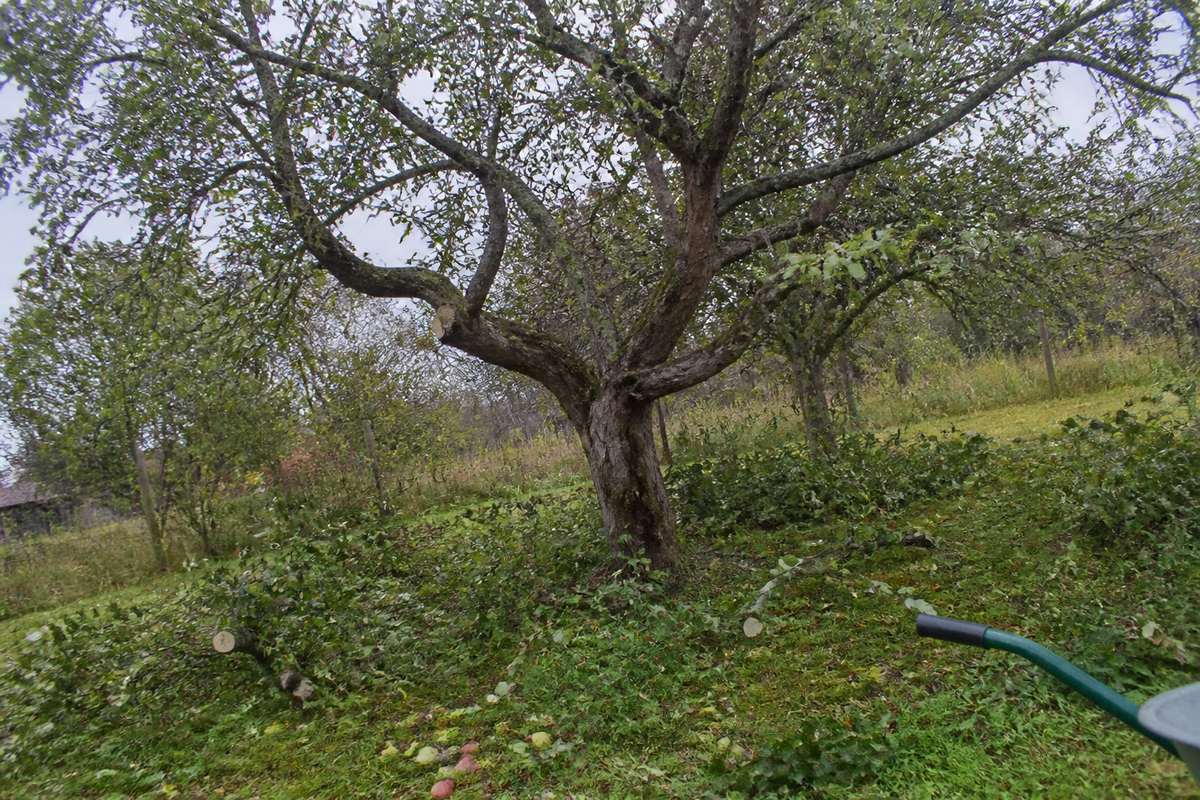
Why fruit trees are pruned differently
With an ornamental tree the aim is usually safety and size. With a fruit tree there are four aims, and all of them are practical:
- Light in the centre of the crown. Fruit ripens where the sun reaches. In a congested apple tree the crop moves further and further out to the outer shell and the top of the crown, while the inside merely grows and shades.
- Air movement. A crown that dries quickly after rain suffers less disease. Scab, mildew and fruit rot are all diseases of damp, and a thinned crown reduces them noticeably.
- A height you can manage. An apple tree that has reached ten metres drops its crop on the ground. Regular pruning keeps the fruit at a height you can reach.
- Better fruit, not more. This distinction matters. An unpruned apple tree often produces a great many small fruit. After pruning the number of fruit falls, but each one is larger, tastes better and keeps longer.
On top of that, pruning evens out cropping. Congested apple trees tend to crop in alternate years: one year full, the next almost empty. Regular attention reduces that swing.
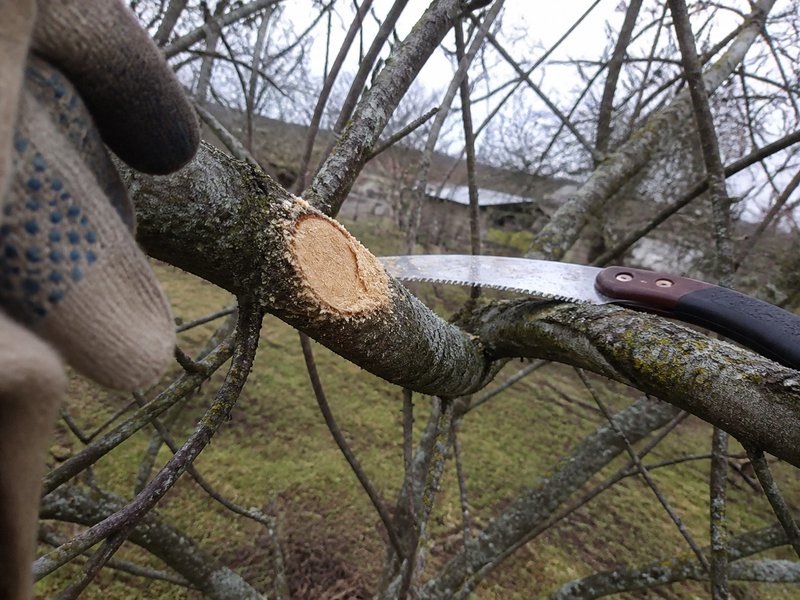
What comes out
The order of work is much the same in practically every fruit tree:
- dead, broken and diseased branches;
- branches growing inwards through the centre of the crown and crossing or rubbing against one another;
- water shoots — the vertical growths that shoot straight up, bear no fruit and only cast shade;
- suckers from the base of the trunk and from the rootstock;
- a proportion of the branches in the centre of the crown, to let light into the middle;
- last of all, height and spread, if the tree needs reducing.
Branches being shortened are cut back to a side branch thick enough to take over as the leader, rather than cut through the middle. It is the same principle that applies in any correct crown reduction, and it is the reason a properly pruned apple tree does not throw up a brush of water shoots.
When to prune what
| Species | Best time | Why |
|---|---|---|
| Apple, pear | The dormant season — from late winter until the buds break | The structure is visible, the tree loses no sap, and the cuts begin to close as soon as growth starts |
| Plum, cherry, wild cherry | In summer, after the crop has been picked | For these species winter cuts are a direct way in for fungal diseases — silver leaf and brown rot blossom wilt |
This is the commonest mistake in domestic gardens. When you are tidying the garden in spring it seems logical to prune everything at once. But stone fruit trees close their cuts very slowly in winter and in a cold, wet spring, and that is exactly when disease spores are active. A summer cut, made while the tree is growing, closes fast. So we leave plums and cherries until summer — even when that means two visits a year.
Two more points about timing. No species should be pruned in a hard frost — frozen wood splits and the edge of the cut shatters. And pruning during blossom makes no sense, because you are cutting off this year's crop. More on the seasons — when to prune trees.
Renovating an old, congested apple tree
This is the job we are asked to do most often. The typical situation: an apple tree untouched for fifteen years, grown tall, the centre an impenetrable thicket of branches, the fruit small and only at the top.
A tree like that is not pruned in one go. Take half the crown off an old apple tree and it answers the shock with hundreds of vertical water shoots, and two years later the tree is in worse condition than before. We spread renovation over two to three seasons:
First season
Out come the dead wood, the diseased and crossing branches and the suckers at the base. If the height needs reducing, we start with one or two of the largest limbs, no more. This step alone usually changes a great deal.
Second season
We thin the centre of the crown to let light in, and carry on reducing the height. We rub out the excess water shoots that have grown since the first season — which can be done in summer, by hand, while they are still green.
Third season
We settle the shape — leaving a clear branch framework with light reaching the centre. After that the tree needs attention every year, but only a very little each time.
Not every old apple tree is worth renovating. If the trunk has rotted out, if there are bracket fungi at the base or if the tree is already breaking up, the honest answer is a different one — and in that case we carry out a condition assessment first. An old cavity in an apple tree is not in itself a reason to remove it; plenty of old apple trees with cavities go on cropping for decades.
We do this work
Fruit tree pruning is part of what we do every season, both for individual trees and for whole old orchards in Rīga and within a 50 km radius — in Jūrmala, Mārupe, Ķekava, Salaspils, Olaine, Ādaži, Ogre and the surrounding areas. We chip the prunings and take them away. If you would like to keep the apple wood for smoking or firewood, we cut it up and stack it on site.
What the price depends on
The size and condition of the tree, the number of trees, whether this is annual maintenance or the renovation of a tree left untouched for years, whether we can work from the ground and a ladder or have to climb into the crown, and how much brash has to be taken away. Several trees in one visit works out better value than one, because most of the cost is the visit itself. We explain the factors on the prices page.