
The main principle in plain language
We are not lawyers, and any specific case is decided on its circumstances. But the general logic applied to these matters is reasonably consistent: liability is usually tied to whether the owner knew, or ought to have known, that the tree was dangerous.
In practice that means two completely different situations.
- A tree that was already visibly defective. Dead, without leaves in summer, with decay at the base, with a large crack in the trunk, or recently leaning. An owner ought to have noticed a tree like that. When it comes down, their position is weak.
- A healthy tree brought down by an exceptional storm. A tree with no warning signs that had stood there for thirty years. That is an event, not negligence.
Between these two extremes lies a wide grey area, and that is where all the disputes happen. Which is why the second half — the evidence — decides more in practice than the principle itself.
Storms as a circumstance
Exceptional weather can mean that nobody is at fault. If the wind really was unusually strong and healthy, stable trees came down as well, then the fall of one healthy tree hardly looks like anyone's negligence. In Latvia that is an entirely realistic scenario — after major storms, trees come down that no arborist would have flagged as dangerous.
A storm is not a universal excuse, though. If the tree was already dead and had stood that way for three years, the wind merely picked the day. The material question is not "was there a storm" but "would this tree have held if it had been in sound condition".
What the evidence decides in practice
This is the part you can control, and therefore the most important.
1. Photographs from before the tree fell
An image showing a dead crown, fungi on the trunk or a lean is worth far more after the event than before it. If you have concerns about a neighbour's tree or a local authority tree, photograph it now, not later. A dated image is the simplest piece of evidence there is.
2. A written notice to the owner
This is the single thing that changes the picture most. As long as nobody has said anything to the owner, the position "I did not know" remains open to them. After a written notice that position disappears. An email, a letter or any other means showing the content and the date of sending is sufficient — what matters is that you keep a copy. A conversation over the fence does not serve this purpose, because afterwards nobody can prove what was said.
3. An assessment of the tree's condition
After a fall the stump and the point of failure can be examined, and that usually says a great deal: whether the wood was rotten, whether the roots were damaged, whether the break runs through sound wood. So do not let the tree be cleared away before it has been photographed and examined. A tree cleared away is evidence cleared away. If the condition is in dispute, a tree health assessment can also be commissioned after the event.
Typical situations
| Situation | What it turns on in practice |
|---|---|
| Your tree on your property | The damage is covered by your property insurance, if you have it and if the case falls within it. No question of liability arises. |
| Your tree on a neighbour's property | Decided by the tree's condition before it fell and by whether anyone had warned you. A healthy tree in a storm and a dead tree on a still day are two different cases. |
| A neighbour's tree on your property | The same in the other direction. If you warned the owner in writing beforehand and can prove it, your position is considerably stronger. |
| A local authority or roadside tree | The matter goes to whoever manages the tree — the local authority or the road maintenance body. Start with a written notification including photographs and the exact location. |
| A tree on rented property | Usually decided by the contract: who is responsible for maintaining the grounds and the trees. A tenant often has a duty to report visible problems to the owner. |
None of these rows is an automatic answer — they are only a pointer to where to look. If the damage is large or the other side disputes it, that is where a lawyer belongs, and then all the material gathered beforehand becomes very useful.
Insurance
In practice, in most cases the question is not settled between neighbours but goes through the insurer. Property policies usually respond to storm damage regardless of who owned the tree — that is exactly what that part of the cover is for. If it turns out that the tree's owner was negligent, the insurer can pursue them separately, and you do not have to argue it yourself.
First — get in touch early, the same day, not after everything has been tidied up. Second — do not only ask whether it is covered, but also what they want to see and what must not be cleared away before they have recorded it. Every insurer's requirements differ slightly, and you need to know them beforehand, not afterwards.
What to do immediately, if the damage has just happened
Make sure the site is safe
A fallen tree is often under tension and can move suddenly. If there are power lines nearby, do not go near them at all and inform the network operator's emergency service first — that is not our field.
Photograph before anything is moved
The overall view, close-ups of the damage, the base of the tree and the point of failure, the stump. More images than seem necessary. This step cannot be repeated later.
Notify your insurer
The same day if possible, and establish what may be cleared away.
Do not let the tree be cleared before it is documented
The urge to tidy up is understandable, but with it goes the evidence of the tree's condition. If the dangerous part has to come off straight away, at least photograph it first.
If a neighbour is affected too — notify them in writing
Even if relations are good. A written notice protects both sides later.
The practical steps in each specific scenario are described separately: a tree has fallen on the house and a tree has fallen on a car. If the tree needs removing safely, we do that as emergency work and on storm days we try to get out the same day — we give you the realistic time when we reply to your enquiry, as it depends on the time of day and the number of call-outs.
What removal costs depend on
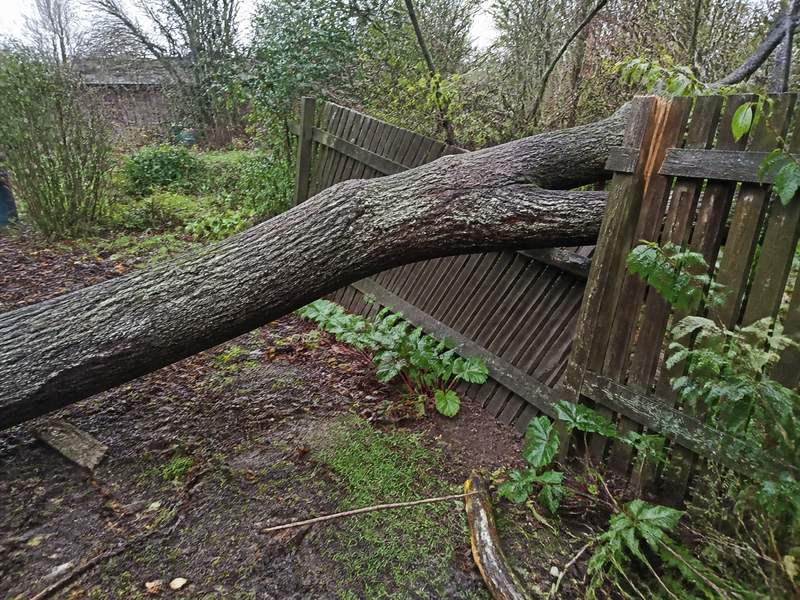
A fallen tree is not simply a tree lying on the ground. It is a tree under tension: the trunk bent, the branches compressed under the weight, part of the tree resting on a building or a fence. The price is affected by how difficult the tension is to release, what the tree is lying on, the girth of the tree, vehicle access, whether a platform is needed and how much material has to be taken away. We take the brushwood and timber away. We have explained the factors on the prices page.
The cheapest option is the one that never happens
This whole page is about a situation that has already occurred, which means the cheapest solution has already been missed. Inspecting a tree before it falls costs incomparably less than repairing a roof, and it almost always ends with a specific answer: the tree is sound, the tree can be retained with care, or the tree needs removing. If there is a tree in your yard about which you have thought "I really ought to get that looked at some time", this is the moment.