
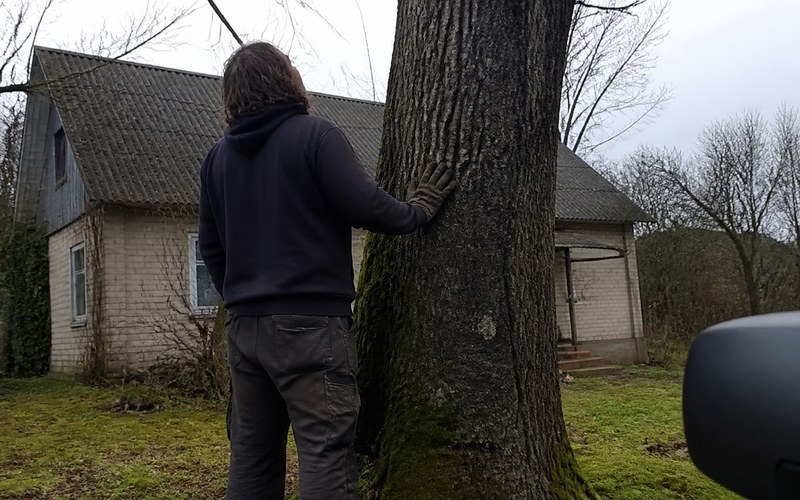
When it is worth calling an arborist
- Fungi or bracket fungi have appeared on the trunk or at the base of the tree.
- The crown has thinned, the leaves are smaller, or dead branches are showing at the top.
- After a storm the tree looks as though it is leaning, or the ground has lifted around the roots.
- There is a crack, a cavity, or an area of loosening bark on the trunk.
- There has been building work, excavation or paving nearby and the tree has looked worse ever since.
- You are buying a property and want to know what comes with it — we cover that separately: pre-purchase tree survey.
What we look at
The assessment is carried out from the ground, and where necessary the arborist climbs the tree to look at the crown more closely.
- The root zone. Whether the ground at the base is level or lifted, whether the roots have been damaged, and how badly the soil has been compacted.
- The base of the trunk. This is where most serious problems begin. We look for decay, cavities, fungi and bark damage.
- The trunk. Cracks, lean, the condition of old cuts, and whether the trunk is sound throughout.
- Branch unions. Points where two heavy stems grow from a single fork tend to be the weakest place in the whole tree.
- The crown. How much deadwood there is, the condition of the leaves, dieback at the top, and signs of pests.
- The surroundings. What sits within the tree's fall zone. A dying tree in the middle of a wood is not a problem; the same tree beside a playground is.
Why the base and the roots matter most
The entire weight of a tree — the trunk, every branch, every leaf — is carried by the base of the trunk and the roots. That is where the load is greatest, and it is also the part people look at least. Most of our time is spent looking at the lowest part of the tree and at the ground around it.
This is why identical problems at different heights are not equivalent. Decay in a branch means a branch may fall. The same decay at the base of the trunk means the whole tree may fall. A cavity high in the crown is often acceptable; the same cavity at ground level is a different conversation altogether. And a tree can live happily for years with a thinned crown, but it will not live long with damaged roots.
Root problems are also the hardest to spot, because the roots are underground. We read the indirect signs: whether the soil at the base is level or lifted, whether the turf has been torn up on one side, whether there are cracks around the trunk, whether fungi are fruiting at the base. If there has been digging, paving or heavy machinery nearby, roots may have been severed or the soil compacted — there is more on this under root and soil care and root protection during construction.
What the mallet test shows — and what it does not
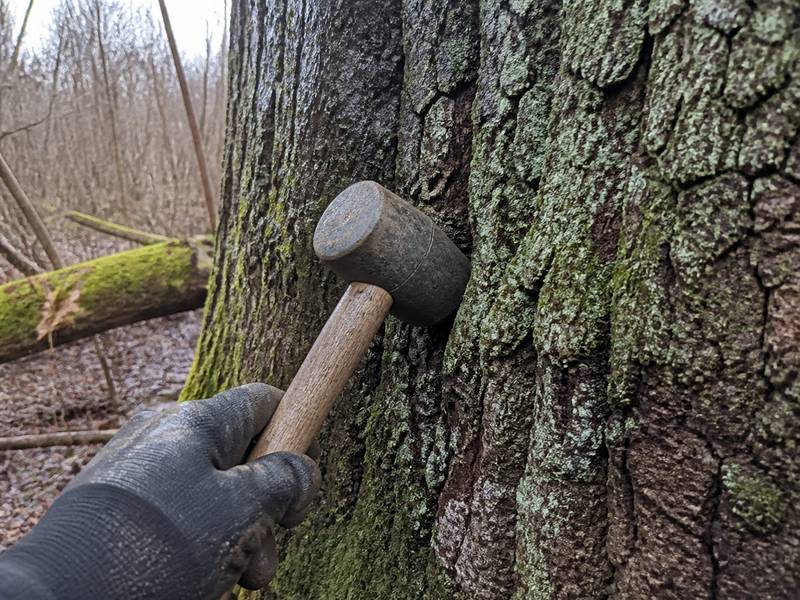
One of the first things we do is sound the trunk with a rubber mallet. Sound wood rings dense and short. A place where the wood behind the bark has decayed or separated sounds hollow. The difference is audible, and it can be traced right around the trunk to work out how widely it extends.
What the test does not tell you matters just as much. A hollow note shows there is a void or soft wood behind the bark, but it does not say how much sound wood is left or whether that is enough. A tree with a cavity in the middle can be perfectly stable if there is a strong wall of wood around it — many old trees are hollow and stand for decades. The test also says nothing about deeper damage that does not reach the outer layers, nor about what is happening underground.
So the mallet is not an answer; it is a pointer towards where to look next. We build the conclusion from everything together: the sound, the species, the condition of the crown, the fungi, the lean, and how the tree looked in previous years. If the signs contradict one another, we say so rather than pretending to be certain.
Why the surroundings decide the answer
Two identical trees with identical decay can receive completely different recommendations. The reason lies not in the tree but in what sits beneath it.
A hollow tree in the middle of a meadow, with no path, no building and no people nearby, is not dangerous. If it falls, it falls into grass. There is usually no need to touch a tree like that — its cavities are home to birds and insects, and it is worth more standing than felled. The same tree over a playground, a car park, a terrace or a neighbour's roof is a different case. There, even a small probability is unacceptable, because the consequences are severe.
So we ask how the space is used and how often anyone is there. Sometimes that points to a solution which is not removing the tree at all: move the bench, relocate the parking space, close the path and route it elsewhere. If the thing at risk can be moved, the problem disappears and the tree stays.
What you get
After the inspection we explain what we found and give a clear recommendation along one of three lines:
- The tree is fine. We tell you what to keep an eye on from here, and how often.
- The tree can be kept with some care. By removing the deadwood, for instance, or reducing the weight of the crown.
- The tree needs to come down. We explain why, and how urgently.
A fungus on the trunk or a few dead branches does not always mean a tree has to be felled. A large share of our inspections end with the tree staying — sometimes after a little care. We have no interest in recommending more work than is needed.
“Monitor it and check again” is an answer
The fourth outcome is more common than you would expect: the tree stays, and we look at it again in a year or two. That does not sound like an answer, but it is one. A tree is not a machine with a fault that is either there or not — it is a living organism that changes slowly. Sometimes a single visit cannot establish whether a problem is progressing or standing still. What tells you that is the comparison with how the tree was before.
The alternative would be to fell every tree about which there is any uncertainty. Do that, and you remove a great many trees that would have stood for decades more.
In practice, monitoring is simple, and you do it yourself:
- Photograph the tree once a year from the same spot. Mark where you stood, and next year stand in the same place. Only then are the images comparable, and only then does a thinning crown or a change in lean become visible.
- Photograph it in the same season. Midsummer is best, when the leaves are fully out — that is when the state of the crown can be compared.
- Watch the ground at the base. New cracks in the soil, lifted turf, or ground that has pulled away from the trunk on one side are signs that the tree has begun to move. This is the most important one of all.
- Take note of new fungi at the base or on the trunk, and of whether the existing ones are getting bigger.
- Walk around the tree after every major storm. Look for branches broken and hanging in the crown, and for fresh cracks.
If any of this appears sooner than the planned date, send us a photo with your enquiry and we will bring the check forward. If the tree is a heritage tree or a protected tree, monitoring matters even more, because removing such a tree is subject to stricter requirements and it is far better to spot a problem early.
How you receive the answer
We talk it through on site, at the tree, and show you what we are talking about. If there is decay at the base, you see it; if there is deadwood in the crown, we point it out. We then send you the same thing in writing, in plain language: what we found, what it means, and what we recommend.
It is not a document full of jargon that somebody then has to translate for you. There is no need to write three pages to say that a tree is fine, or to say that it has to come down. If the recommendation is to remove the tree, we also tell you how urgently and what method will be needed — whether the tree can be felled whole, or whether it will have to be dismantled in sections. That way you know in advance what will be involved and can take the decision calmly.
The price of an assessment depends on the number of trees, how large they are, whether the crown has to be climbed to inspect it, and the distance from Rīga. Inspecting a single tree is a short job; surveying an entire site with several dozen trees is a task of a different scale. We have explained the factors on our prices page.
An assessment before other work
If you already know that you want a tree removed or cared for, a separate assessment is not necessary — we do it when we arrive for the job. An assessment as a standalone service is for people who want an answer, not to book work.