
What counts as an emergency
We treat it as an emergency and aim to come out the same day if:
- the tree has already come down and is blocking access, blocking the road, or lying on a building, a fence or a car;
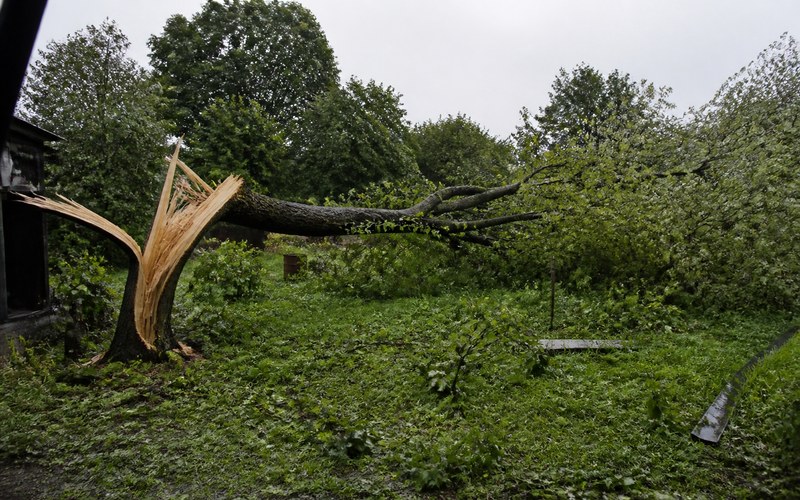
- the tree has split but has not yet fallen — this is the most dangerous scenario of all, because there is no telling when it will go;
- the tree has suddenly begun to lean after a storm and there are cracks in the ground at the roots;
- a large dead branch is hanging over a path, a doorway or a parking space;
- the tree is leaning against power lines.
A tree down on an electricity line is life-threatening, even when the cables look undamaged. Do not go near it and do not try to pull anything clear. Call the network operator's emergency service first. We work once the line has been switched off or the operator has given clearance.
How we work in an emergency
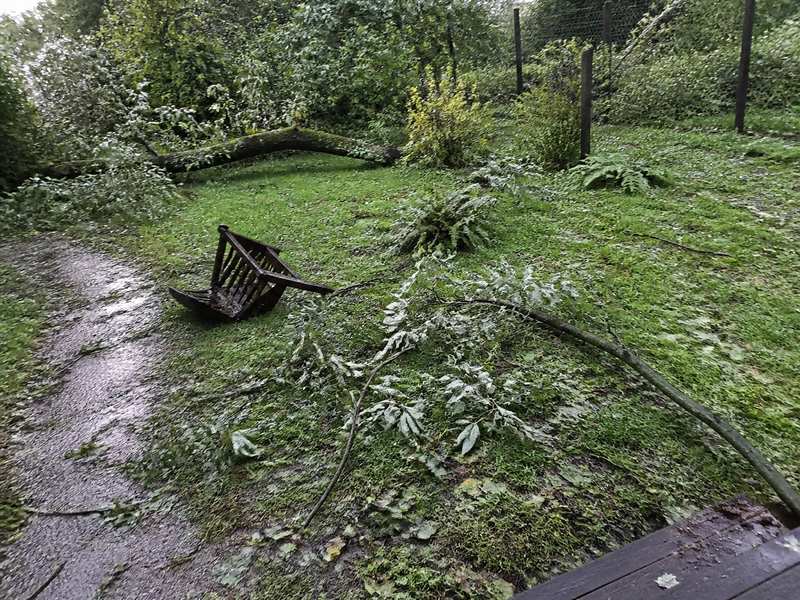
A fallen tree is usually not simply “a tree on the ground”. It is a tree under tension: the trunk is bent, the branches are compressed under the weight, and part of the tree is bearing on something else. Cut a tree like that in the wrong place and it can spring back or twist round without warning.
So the first thing we do is make the site safe — which does not always mean clearing everything away at once. If the tree is threatening a building or people, we first release the tension and take out the part that is creating the risk. The full clear-up can follow on a second visit if that makes better sense.
What to do while we're on our way
- Don't go closer to the tree than its own height if it is still partly standing.
- Don't walk under a hung-up branch, not even for a moment.
- If the tree is on the house or a car — photograph everything before anything is moved. It will help with the insurance. More on this: a tree has fallen on the house and a tree has fallen on a car.
- If the roof is damaged and it is raining, cover the spot from the inside if you can do so safely.
- Warn the neighbours if the risk extends to their property too.
“Making it safe” is not the same as “clearing it all away”
This distinction matters a great deal in emergency work, and it often catches people out. If a tree is lying on the roof of the house, the immediate task is not to remove the tree — it is to stop the tree moving any further and to make sure nobody is at risk.
In practice that means taking out the part of the tree that is creating the tension or bearing on the building, and securing the rest. Once the situation is stable, the remainder can be finished calmly — the next day, in daylight, with the right machinery and without rushing. Splitting the work this way is usually both safer and cheaper than trying to do everything in one go in the dark.
Working on a tree under tension
A fallen tree rarely lies free. Its trunk is bent, the branches are compressed under the weight, and part of the tree is bearing on something else — a fence, a roof, another tree. The energy stored in the timber is released the moment it is cut through, and at that point the tree can spring back, twist or roll.
That is why the order of work matters more than speed:
- First we establish where the tree is bearing and which way it will move once that support is taken away.
- Where necessary we secure the tree or part of it with ropes before the first cut is made.
- We release the tension gradually, with several shallower cuts rather than one.
- Branches compressed beneath the trunk come off last — they are often holding the whole structure up.
The same applies to branches that have broken but not yet fallen. A branch hung up in the crown is the most dangerous case of all, because there is no knowing what is still holding it.
When the work falls in darkness or rain
Storms have no habit of arriving at a convenient hour. Working in the evening or in the rain changes several things: visibility is poorer, timber and ropes are slippery, and climbing the tree becomes less safe. So after dark we normally do only what cannot wait — make the site safe and cordon it off. The full job we plan for daylight.
If the situation is such that the work cannot be done safely, we say so. That is more honest than putting people at risk or causing more damage than has already been done.
Why our timings on storm days are honest rather than promised
After a big storm every call-out arrives on the same day. We cannot be everywhere at once, and promising otherwise would mean lying to somebody. So when we reply to your enquiry we give you a realistic time, not a hopeful one.
We set priorities by risk: trees threatening people or living accommodation first, then those blocking access or damaging property, then the rest. If your case can wait, we'll tell you that too — and then you know we will be there the following day.
What to have ready before we arrive
- Make sure we can get in. Open the gates, move cars out of the work area, and tell us where we can park.
- Photograph the situation. Before anything is moved — it helps us and your insurer alike.
- Move whatever can be moved safely. Garden furniture, plant pots, bicycles. Anything underneath the tree, leave well alone.
- Warn the neighbours if the work will affect their side too, or if a shared entrance has to be closed.
- Keep pets indoors for the whole time we are working.
What affects the price of emergency work
Urgency, the timing (evening or weekend), the condition of the tree, and how difficult it is to release the tension in the trunk. Emergency work often demands more care than a routine removal, because the tree is in an unpredictable state. We price it individually and tell you the figure before the work starts — not after.
If the job is split into two parts — make safe first, finish afterwards — we agree that up front so there are no surprises. For the full list of factors, see the prices page.