
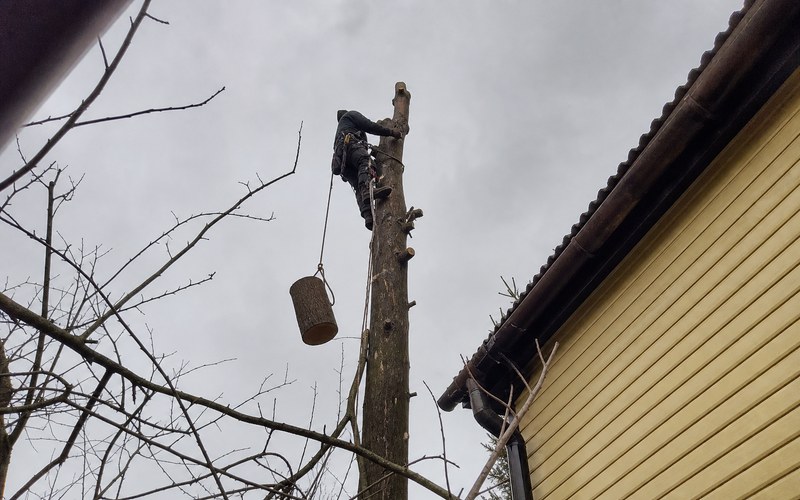
When a tree cannot be felled whole
To fell a tree whole you need clear ground around it at least as long as the tree is tall, plus a margin. In a city courtyard or a built-up garden that space usually doesn't exist. The typical cases where we work in sections:
- the tree is growing a few metres from a house wall or between two buildings;
- the branches reach out over the roof;
- underneath the tree there is a greenhouse, a terrace, a fence, block paving or planting that must not be damaged;
- electricity or telecoms cables run nearby;
- there is no vehicle access for machinery;
- the tree stands on the boundary with a neighbour and the direction of fall is unacceptable.
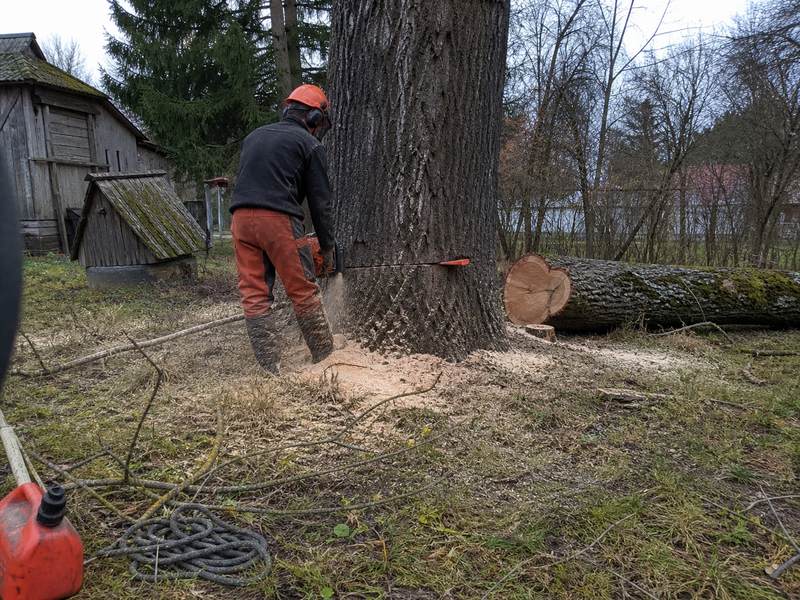
How it works
We assess the tree and the anchor points
Before anyone climbs we check whether the tree is even sound enough to be climbed, and which branches can serve as anchor points. If the tree is rotten, climbing it isn't safe and we use a platform instead.
The arborist climbs the tree
We climb on ropes and a harness system rather than on spikes — spikes damage the bark and are unacceptable on a living tree that is being kept.
The crown comes off from the top down
First we take off the branches, then the trunk in sections. Every section is attached to a rope before it is cut.
The ground team lowers each piece
The lowering is controlled by the people on the ground. For heavier sections we use a friction lowering device so the piece comes down slowly and exactly where it should.
We clear the site
The brash is chipped and taken away and the trunk is cut to length. The stump is left low and can be ground out straight away.
How the anchor point is chosen
The anchor point is the place in the tree the lowering rope is attached to. It is the first decision of the job and the one that determines everything else. A cut section hanging on a rope does not drop straight down — it swings round the anchor like a pendulum. Where it swings to is determined not by where the piece grew, but by where the anchor is.
So we put the anchor away from whatever we want to protect. If there is a greenhouse below the branch, the anchor goes on the opposite side of the trunk, or higher up on another branch further from the greenhouse. Then as the piece separates it travels away from the greenhouse rather than across it. The anchor also has to be strong enough and high enough, because a low anchor means a long pendulum swing.
Once the anchor is chosen, the rest follows from it: how big the sections can be, in what order, where the landing zone on the ground will be, and where people will stand. If the crown is all on one side and there is no usable anchor point — which happens when a tree grows against a wall — then climbing that tree is not the right method.
What the ground team does
The climber is the most visible part of the job, but the lowering is run from the ground. The people on the ground hold the rope in a friction device and pay it out in stages, so the piece descends under control rather than dropping. They also see what the arborist cannot see from above: how close the piece is to the wall, whether anyone has walked into the work area, whether the rope has snagged on a lower branch.
Their second job is keeping the landing zone clear. Each piece that comes down is cut up and moved out of the way immediately, so the next one has somewhere to land. If the zone is full, work above has to stop and the arborist waits. Communication is by short, agreed commands — before every cut both sides confirm they are ready.
What is underneath, and how we protect it
Before climbing we walk the ground beneath the tree and decide on each item separately. Light things — plant pots, furniture, bicycles — get moved out of the way, and we do that ourselves rather than leaving it to you. Anything that cannot be moved is covered or worked around.
- Greenhouses. These we don't cover — glass will not survive an impact whatever you put over it. We don't lower pieces over a greenhouse at all; the anchor goes in so that the piece travels the other way.
- Terraces and decking. We cover these with sheets and boards to spread the load. We don't put heavy trunk sections on decking — those get cut up on the ground.
- Block paving. Paving will take the weight but not the impact — a dropped section knocks a joint out or cracks a block. We cover the landing zone where it falls on paving.
- Planting and hedges. These are the ones most often overlooked. If there is a shrub you want to keep, point it out beforehand — we'll work around it differently.
Lawn is the exception: it can be walked on and it recovers. If the choice is between a rut in the lawn and a risk to the terrace, we choose the lawn.
Why bigger pieces aren't quicker
It seems logical that fewer cuts should mean a faster job. In practice the opposite is true. A piece twice as heavy means twice the force in the rope and the anchor, and far less chance of stopping it if it starts to spin. A heavy piece also has to be cut up on the ground before it can be moved, and that happens in the landing zone, where nothing else can be done meanwhile.
So the size of each section is set not by what the tree will take, but by what the ground beneath it will take. In a tight courtyard we deliberately work with smaller sections than would technically be possible.
Why it takes longer
A tree that can be felled whole is down in a few minutes. The same tree, dismantled in sections, can take several hours — which is why the price differs too. What you pay for is not the tree but the conditions around it. If you aren't sure which category your tree falls into, send photos: from an image showing the tree and its surroundings we can tell you. For the full list of factors, see the prices page.
The difference isn't a few per cent. A medium-sized tree in an open space is a short piece of work; the same tree taken down in sections in a tight courtyard tends to take a good part of the day. The reason is the number of pieces — each one needs its own anchor check, cut, lower and clearing of the zone, and those steps cannot happen at the same time. That is also why we don't promise a short job: it is more honest to say up front that the work will take a day.
Everything under the tree — greenhouse, terrace, paving, planting, fence — stays untouched. That is the whole point of the method: to get the tree out without damaging what is around it.
When we decline to climb
Climbing isn't the best answer in every case. If the tree is rotten, if its crown is very wide, or if the work has to be done quickly, we use a MEWP or a crane. We choose whichever method is safer on that particular site, not whichever looks more impressive.
Climbing a tree means the tree itself is carrying the arborist's weight. So we rule climbing out and bring in machinery when:
- the timber is decayed or soft. A trunk that sounds hollow at the base may not carry the load higher up — more on this under rotten tree removal;
- the tree is dead. Dead timber breaks with no warning sign — it doesn't flex first;
- there is no usable anchor point in the crown, because all the branches are on one side or are too slender;
- the tree has already split or is under tension. Climbing a tree like that means being exactly where it may suddenly move;
- the crown is so wide that the outer branches simply cannot be reached from any one point in the tree.
We decide this on site, before anyone starts climbing, and we tell you if the plan changes.