
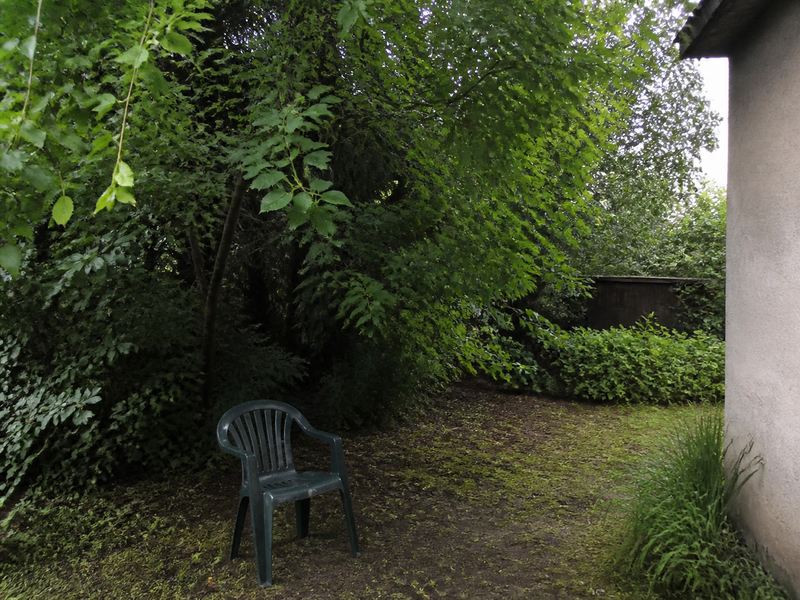
Baloži differs from Rīga's other southern suburbs in how much wooded ground has been left between the housing. Many of the houses here were built in a pine stand, and the trees were not planted in a garden but left over from the forest. That changes both how the trees behave and the way we work.
Houses surrounded by pines
A forest pine grown in a dense stand is tall and straight with a high, small crown — it has held against the wind together with its neighbours. When a space is cleared around it for a house, the tree is suddenly left alone and takes a wind load it is not used to.
That is exactly why the greatest risk is in the first years after building, and why pines like these come down in storms more often than trees that have always grown in the open. If your house stands among pines, it is worth starting with a tree health assessment — the answer is often "this one stays, those two need to come out".
Shade and light in the garden
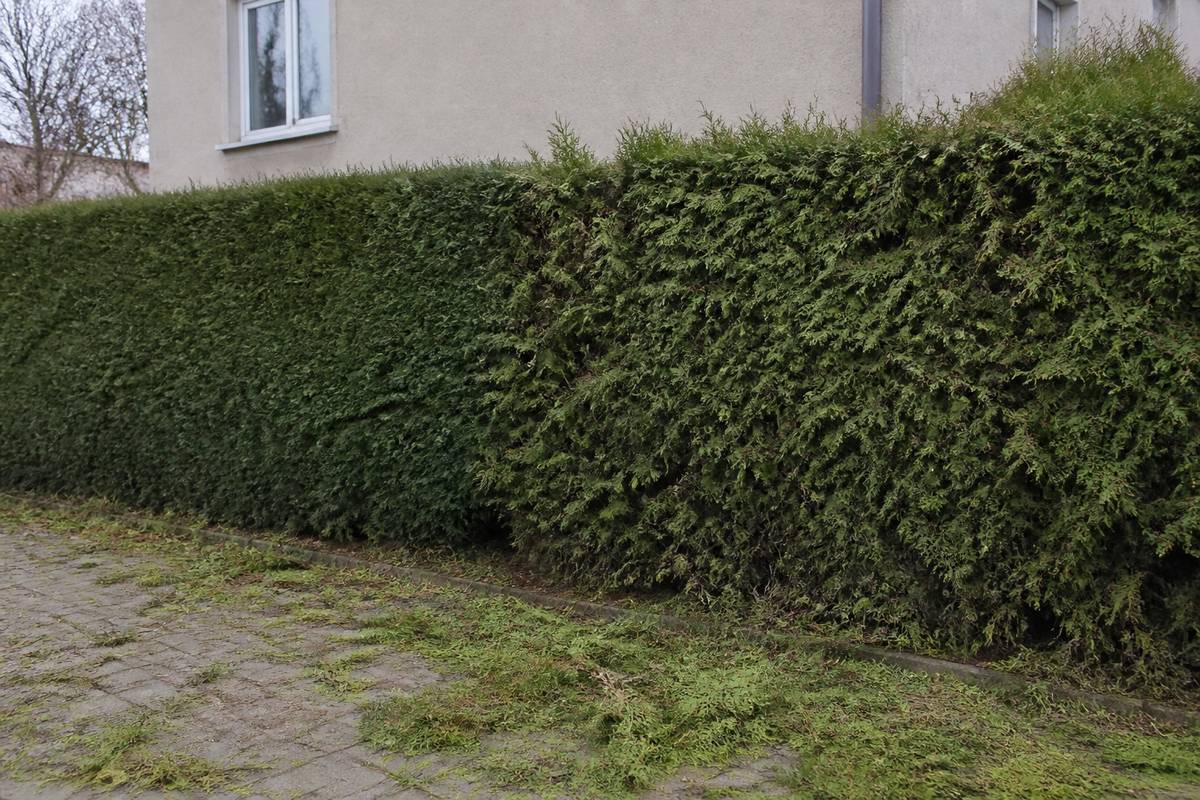
The second frequent theme in Baloži is light. Tall pines and spruces cast permanent shade in which neither lawn nor vegetables will grow, and in winter the house gets no sun at all.
Here it matters to be honest: with a pine or a spruce the crown can only be "opened" from below to a limited extent, and they do not regrow from old wood. What can realistically be achieved and what cannot is described under pruning for more light. Sometimes the honest answer is that the shade problem is solved by removing one tree rather than pruning five.
The apartment district and Titurga
In the apartment part of Baloži and the Titurga estate the situation is as in other suburbs: the courtyard trees are the same age as the buildings, have reached full size and are closing on the roofs. There is usually no drop zone in a courtyard, so the work is done in sections, lowered on a rope.
Work like this is ordered by the managing agent or the community of flat owners — we prepare a quote and a description of the work that can be submitted for approval.
Wet ground and wooded edges
Around Titurga and along the wooded edges the soil is wetter in places. The birches and aspens growing there have a weaker hold, and after stormy seasons it is these trees that come down first.
In practice: if a tree stands in a wet spot and after a storm you notice that the ground at its base has lifted or a crack has appeared — do not wait for the next storm. That is precisely the sign that brings us out ahead of the queue.
Deadwood on pines and fire safety in wooded development
A pine sheds its lower branches by itself — they die in the shade and hang on the trunk for years. In Baloži and Titurga we see it in almost every garden: the living crown is up at the top, and below it three to six metres of dry, brittle branches. In the forest that bothers nobody; among houses it is another matter. A dead pine branch snaps without warning, even on a windless day, and falls straight down — onto a car roof, onto the terrace, onto the children's play area.
The second reason is fire. If a house is surrounded by pines with a layer of dead branches starting low down, and a carpet of needles has built up beneath them over the years, a ground fire climbs those branches into the crown. That transition from ground to crown is the dangerous point, and it can be broken mechanically — by removing the dead branches and not letting combustible material accumulate right against the trunk.
- we remove the dead branches to a sensible height without touching the living crown;
- we work with ropes where there is no access, or with a platform where there is;
- we chip or take away the branches so they are not left in a heap beside the house.
More detail on the scope of the work — deadwood removal.
Where the plot ends and the forest begins
On many Baloži plots the boundary runs along the forest edge, and the tree threatening the house grows on the other side — on land belonging to the local authority, a forest owner or a neighbour. The first thing to establish is not the condition of the tree but whose land it grows on. Everything else follows from that: who orders the work, who gives permission, and who is liable if the tree comes down.
On your own land you can act yourself, observing the felling rules. If the tree grows beyond the boundary, its owner needs to know it is dangerous — that warning is best put in writing, because liability for the consequences starts from that moment. You may not fell a neighbour's tree without their consent, even if it is obviously rotten.
We can inspect the tree and write an assessment to use in discussion with the landowner or the local authority. If a permit is needed, we arrange it ourselves. It is also worth reading about neighbours' trees and liability and who is liable for a fallen tree.
What we do in Baloži
In Baloži we offer our full range of services — from a single dangerous tree to clearing an entire site. The most frequently requested:
- Dangerous tree removal — Dead, rotten, leaning and damaged trees. We assess first, then cut.
- Emergency tree removal — Fallen and broken trees after a storm — we come out the same day.
- Tree crown care — Crown shaping, thinning and deadwood removal.
- Stump grinding — Stump grinding without digging — the lawn stays almost untouched.
- Tree health assessment — Is the tree dangerous? We survey it and tell you what to do.
- Branch and timber removal — Removal of branches and timber, including where someone else did the cutting.
The full list with descriptions is in the services section.
How the work happens
- We get back to you within 5 minutes. Fill in the form and attach photos showing the tree at full height, its base and its surroundings. That is often enough for a rough quote.
- Assessment. We reply with an approximate price and method. In more complicated cases we come out to Baloži to look before the work.
- A permit, if one is needed. We check whether the Baloži local authority requires one for that particular tree, and we handle the paperwork for you.
- The work. We agree a time, arrive with everything needed and cordon off the working area.
- Clearing up. We chip or collect the branches and take them away. We don't leave wood chip in the garden. If you want the firewood, we cut it to length and stack it where you ask.
What the price depends on in Baloži
The price is set not by the size of the tree alone but by the whole context of the work. In Baloži it is made up of the height and girth of the tree, the species and condition, the distance to the house, whether there is a drop zone on a wooded plot, whether climbing or machinery is needed, and how far the material has to be carried.
In Baloži the price is often determined by how close to the tree you can drive — on wooded plots with no access track the material has to be carried out, and that takes longer than the cutting itself. We have set out the full list with explanations on the prices page.