
The signs to look for
The spruce bark beetle — Ips typographus, the eight-toothed spruce bark beetle — lives beneath the bark, so only indirect signs are visible. Look for them in a set order, from the ground upwards:
- Fine reddish-brown boring dust. The most important early sign. Look for it in the fissures of the bark, on the root flares and on the ground right at the base of the trunk. It looks like fine wood flour or coffee grounds. If it is fresh, the process is happening now.
- Small round entry holes. About the size of a match head, scattered over the trunk, often on the lower part.
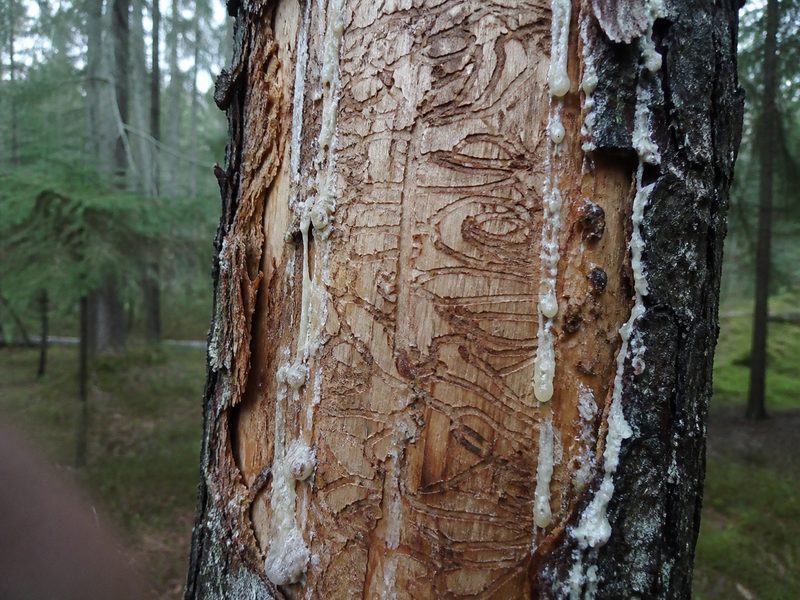
- Resin flow. Pale, hardened beads or small funnels of resin around the holes. This means the spruce is still resisting — resin is its defence.
- Bark falling away in plates. Beneath it the characteristic galleries are visible: one straight central gallery with rows of side galleries on either side. That is a definite confirmation of bark beetle.
- Needles go dull, then reddish-brown. First they lose their sheen and turn a greyish green, then reddish-brown, and then they drop.
- Woodpecker activity. If pale, flaked patches appear on the trunk and flakes of bark lie on the ground, woodpeckers are taking the larvae from beneath the bark. This is one of the most reliable signals that a tree is infested.
Put your hand on the base of the trunk and look at the ground around it. Fresh boring dust is so fine that from a few metres away you will not notice it. It is the only sign that appears before the needles change colour.
The sequence people get wrong
The typical situation: an owner notices that one spruce has turned brown, calls someone out, has it felled and considers the problem solved. The next year three are brown.
The reason is the time lag. By the time the needles are brown, the generation of beetles beneath the bark has usually completed its development and flown off to the next trees. The brown spruce is evidence, not the source. It no longer threatens anything — it merely stands there, dangerous only in that the wood and branches of a dead spruce break.
The trees that matter are the ones growing beside it. The beetles are in those now, and there something can still be done. So when we inspect bark beetle damage we never look only at the tree the enquiry came in about — always at all the spruces around it too, searching for fresh boring dust.
That is the one moment when quick action changes the outcome. An infested tree needs removing and the material taking off the property before the next generation flies — not next season.
What can and cannot be done
Honestly: an infested spruce cannot be cured. Once the beetles are under the bark, there is no treatment that reaches them there. Everything that can be done falls into two categories — removing the material in good time, and reducing stress on the remaining spruces.
- Remove the infested tree in time. If the beetles are still in the tree, removing it is worthwhile. The material must not be left lying on site — we take the brushwood and trunk away, because stacking beetle-infested wood in a woodpile beside healthy spruces means feeding the next generation.
- Remove the dead tree for safety. A spruce that has already died no longer affects the spread of bark beetle, but it becomes brittle and branches begin to fall. That is a question of dead tree removal, not of pests.
- Prevent water shortage in the others. This is the only real prevention. A spruce with healthy roots and enough water pushes the beetle out with resin. A weakened one cannot. So root zone care, mulching and loosening compacted ground are worth more than any spray.
Spruces in Latvian gardens suffer from exactly this: dry summers, lawn right up to the trunk, compacted ground, a shallow root system. The bark beetle finds a tree that is already weakened. So a bark beetle problem is almost always a stress problem, and we say so even when the client was expecting an answer about a pest.
What it can be confused with
Not every brown spruce is the work of bark beetle, and that matters, because the response differs.
- Drought. In a long dry summer a spruce's needles go dull and drop from the inside outwards, but there is no boring dust and there are no holes. That is a root question, not a pest one.
- Natural needle shed. In autumn the inner, older needles yellow and drop even on a perfectly healthy spruce. The outer, younger shoots stay green.
- Root decay. The spruce thins gradually over several years, often several neighbouring trees in one patch. There may be fungi at the base.
- Salt and imported soil. Spruces beside a road, or where a layer of soil has been spread over the roots, go brown on one side or from below.
The decisive check in every case is the same: is there boring dust at the base of the trunk and in the fissures of the bark. If there is not, look for the cause lower down, in the root zone, and see the summary of signs.
When to call an arborist
If you find fresh boring dust on a spruce that is still green, if woodpeckers are working at the trunk, or if one spruce in a group has started to go dull — it is worth having them all looked at. In an inspection we check which trees are infested, which are already empty and which are still healthy, and tell you which need removing and which can be left. Often the answer is that one or two need to go, not the whole group.
What the price depends on
The cost is set by the number and height of the spruces, whether a tree can be felled whole or has to be dismantled in sections, machinery access, the volume of timber to be taken away and the distance from Rīga. The factors are explained on the prices page. We can give an approximate quote from photographs — images showing the group of trees as a whole, and a close-up of the base of the trunk with the ground around it, are the useful ones.