
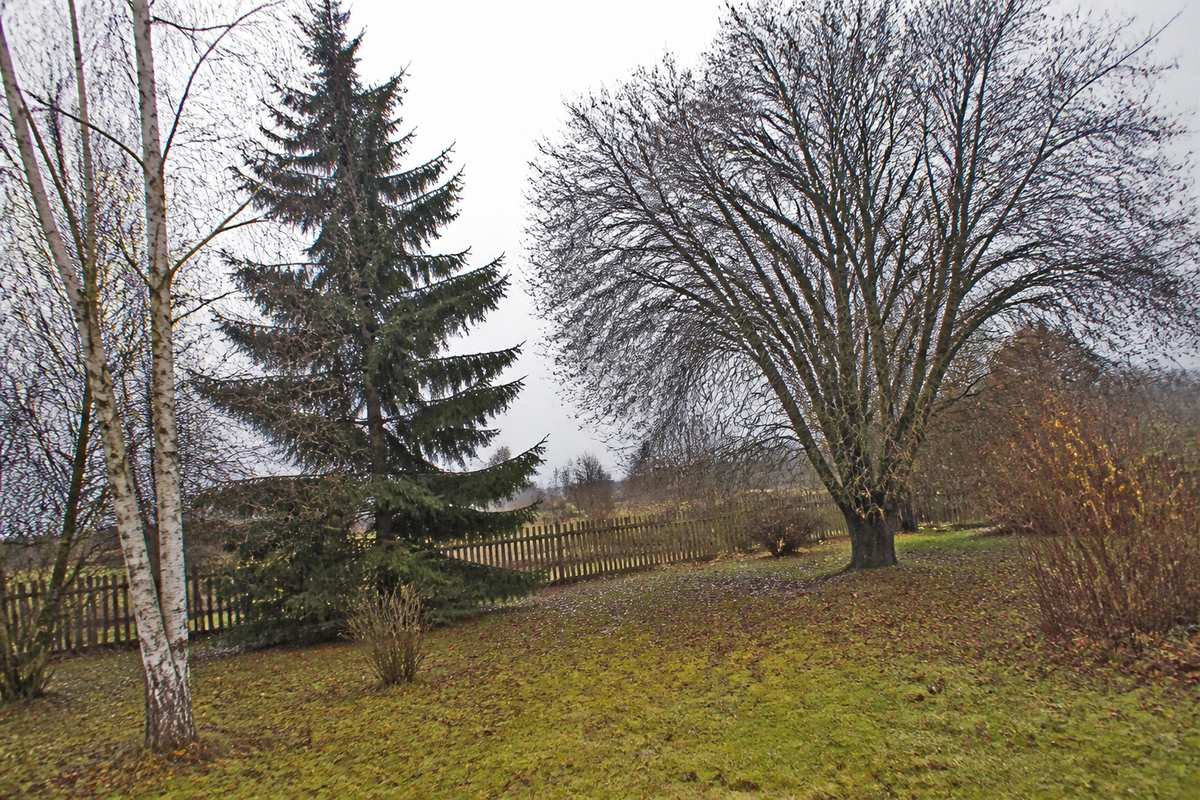
The built fabric of Mežciems is wedged between forest and trunk roads: blocks of flats, healthcare complexes, detached houses and retail units. What they have in common is that the forest starts right there, and its trees affect every property that adjoins it.
The forest edge is a risk zone
A spruce or pine that grew up inside a stand has spent its whole life taking the wind together with its neighbours. When the plot next to it is cleared for building, or the tree is left standing on an open edge, the load on it changes completely — and trees on a forest edge come down far more often than those in the middle of a stand.
The practical answer is not to clear a strip, but to survey the edge trees and work out which of them are a real risk to a building. We do that with a tree health assessment, and the result is often a shorter list than the owner expected.
The question of liability matters here too: who is responsible if a tree from the forest lands on a house. We have written about that separately — who is liable for a fallen tree.
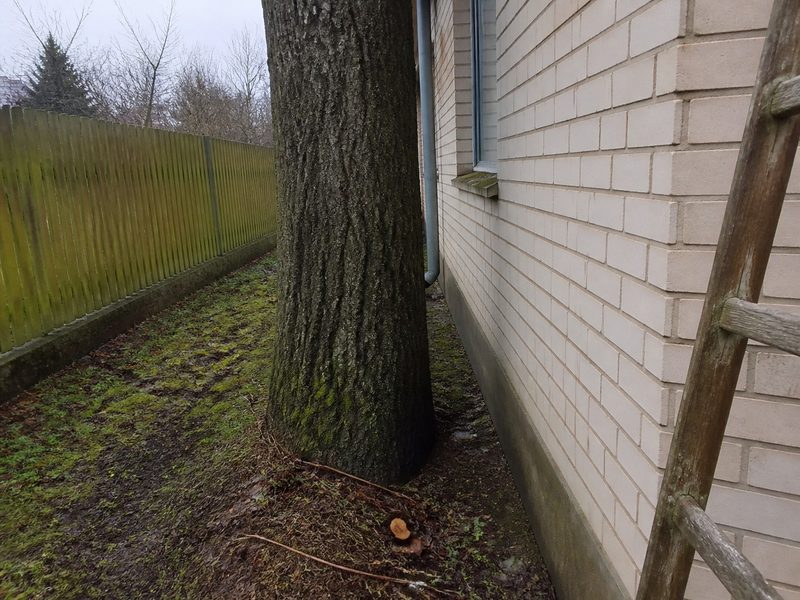
Spruce and the bark beetle
In neighbourhoods next to forest, the spruce bark beetle is a frequent problem. The signs: brown boring dust at the base of the trunk, pieces of bark coming away, and a crown that turns red-brown from the top down.
Once the bark is peeling the tree cannot be saved, and the only question left is how quickly it comes down. A dead spruce turns brittle fast, and climbing it is then no longer safe — the job needs machinery and costs more. That is why here we almost always advise against putting it off.
Courtyards and large sites
In the apartment-block part of Mežciems the most common job is deadwood removal over paths and parking bays; the client is the managing agent or the owners' association.
On the large institutional complexes and commercial sites the work usually means not one tree but a whole site: rows of trees along a fence, planting beside a car park, branches over an access road. For clients like these we start with a survey and a list of problem trees ordered by urgency — commercial tree care.
Working at hospitals and healthcare sites in Mežciems
Around Hipokrāta iela and on the other healthcare sites in Mežciems, tree care runs to different rules than in an ordinary courtyard. There must always be a clear route for ambulances, and noise under ward windows is a matter of indifference to neither patients nor staff.
In practice that means we agree the working window in advance — we settle with the site's facilities team on the specific hours in which we may work, and on which walkways and parking bays are closed at which point. What we do to keep the disruption to a minimum:
- we plan sectional dismantling so that the footpath is closed for as short a time as possible;
- we concentrate the noisiest work, branch chipping included, into a single stretch rather than spreading it across the day;
- we take branches and chip away immediately, so the site is clean and passable when we finish;
- we clear the access route without delay if emergency vehicles need it.
If there are a lot of trees on the site, it makes more sense to agree regular care than to call us out after every broken branch.
Pines on sandy soil in the detached-house part of Mežciems
The house-building part of Mežciems stands on thin, sandy soil — the same soil that continues into Biķernieki forest. Pines have grown there for decades and the ground suits them, but building changes it. Pine roots are wide and comparatively shallow, so it is the top layer of soil that decides how stable the tree will be in five years' time.
The most common reasons a pine in a garden starts to fail:
- soil compaction — a car, a path or block paving over the root zone starves the roots of air;
- soil heaped up around the trunk, smothering the root collar;
- prolonged drought in sand, where water does not linger;
- digging for foundations or services close to the trunk.
Lower branches dying back is not in itself a disease — a pine naturally sheds branches left in shade. Even so, dead branches over a path or a parking bay come down sooner or later, so we take them off under control. If building work is planned, root protection has to be thought about before the machinery comes into the garden, not afterwards.
What we do in Mežciems
Every one of our services is available in Mežciems. The ones most often requested in this neighbourhood:
- Dangerous tree removal — Dead, rotten, leaning and damaged trees. We assess first, then we cut.
- Emergency tree removal — Fallen and broken trees after a storm — we come out the same day.
- Tree crown care — Crown shaping, thinning and deadwood removal.
- Stump grinding — Stump grinding without digging — the lawn is left almost untouched.
- Tree health assessment — Is the tree dangerous? We survey it and tell you what to do.
- Branch and timber removal — Branch and timber removal, even if someone else did the cutting.
The full list with descriptions is in the services section.
How the work happens
- We get back to you within 5 min. Fill in the form and attach photos showing the whole tree, its base and the route up to it. That is often enough for a ballpark quote.
- Assessment. We reply with an approximate price and a method. If access in Mežciems is awkward, we come out and look before the job.
- Permit, if one is needed. We check whether this particular tree in Rīga requires one, and we file it on your behalf.
- The work. We agree a time, cordon off the work zone and arrive with everything needed.
- Clearing up. We chip or collect the branches and take them away. We do not leave wood chip behind. If you want firewood, we cut it to length and stack it where you tell us.
What the price depends on in Mežciems
There is no flat rate per tree. In Mežciems the quote is made up of the tree's height and girth, its species and condition, whether it stands on the forest edge or in a courtyard, whether there is a drop zone, whether climbing or machinery is needed, and how far the material has to be carried out.
In Mežciems the price is affected by access to the forest edge — if machinery cannot be brought up and the material has to be carried out, the job takes longer than the same tree beside a road would. We have set out the full list with explanations on the prices page.