The Ķekava area is a transition zone between town and country. On one side there are new detached and terraced housing schemes; on the other, old farmsteads with hundred-year-old trees that have now become a question between neighbours. The third side is commercial development and production sites along the A7.
Old farmsteads and large trees
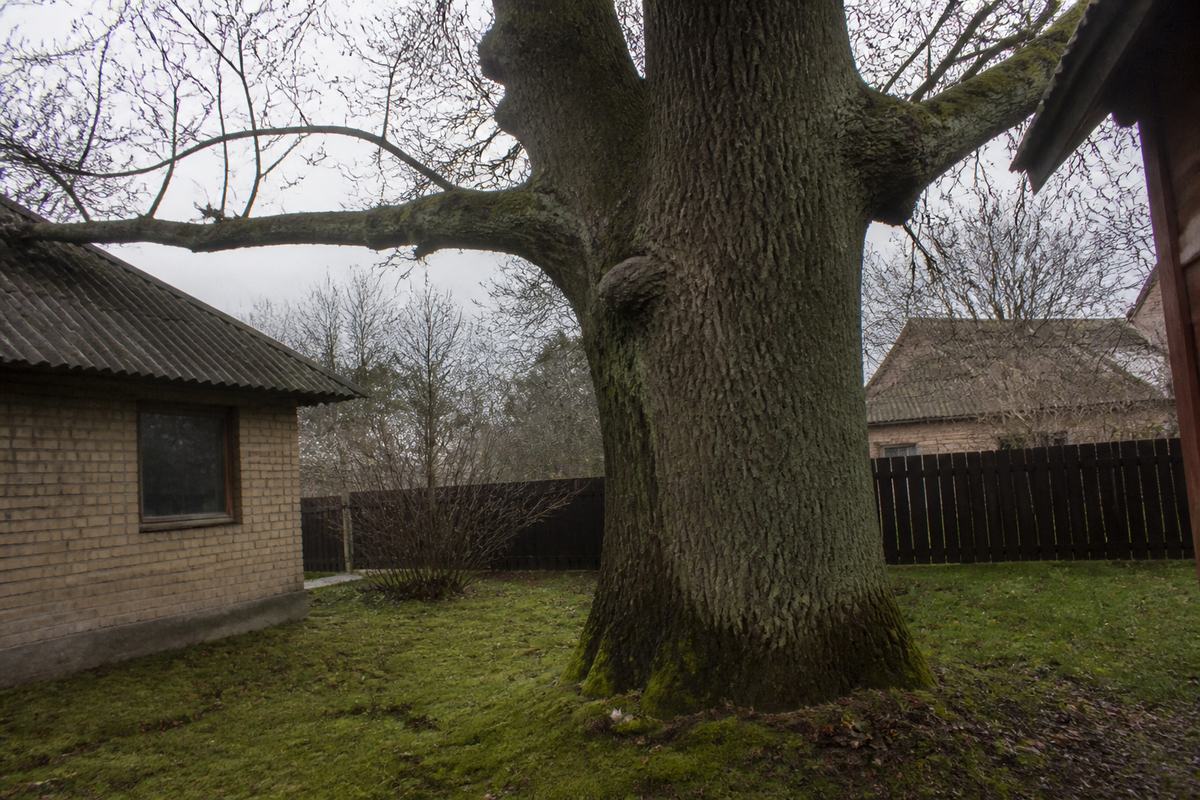
In Ķekava municipality there are many properties where the trees around the house were planted 50–80 years ago: limes, oaks, poplars, maples. They are handsome, but fully grown, and some already show signs of age — dead tops, cavities in the trunk, bracket fungi at the base.
In cases like these we almost never recommend cutting straight away. We survey the tree first and tell you whether it really is dangerous now or merely looks old. Often deadwood removal and crown reduction are enough. If we do see bracket fungi at the base of the trunk, that is a serious sign, and then it is a question of removal — technically a different job too, because climbing a rotten tree can be unsafe.
Neighbours' trees and boundaries
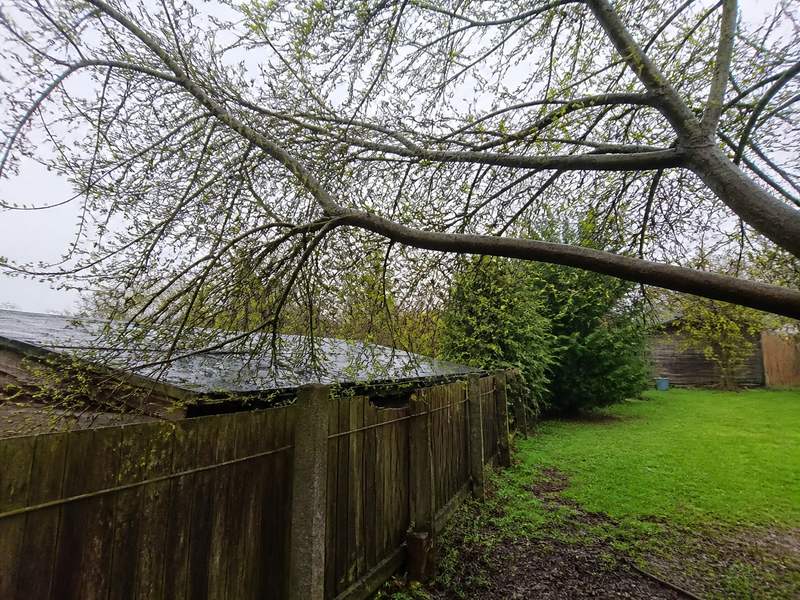
In densely built villages and the new quarters the plots are narrow, and a tree often grows right on the boundary. Branches reach over the fence, leaves fall in the neighbour's garden, shade falls across the greenhouse. That is our most frequent "not technical but human" enquiry in the Ķekava area.
Technically this is usually a straightforward job — reducing the side of the crown along the boundary line, making proper cuts so the tree stays healthy. The legal side matters more: who may cut what, and who owns the fallen fruit or branches. We have written about that separately: neighbours' trees and liability.
Access along the A7 and the bypass
Ķekava is a town on the Via Baltica corridor, and the main connections are the A7 and the new bypass infrastructure. For us that means one practical thing: travel time here is set more by the traffic peak than by distance. In the morning and evening the same road can take twice as long.
So we usually put planned work in Ķekava in the middle of the day, and that is also why we try to combine several nearby sites in one visit. If you and your neighbour need similar work, say so at once — a shared visit costs less.
Site clearance
In Ķekava municipality we regularly work on plots that have stood untended for years and grown over with aspen, willow, maple suckers and scrub — usually before building work or before a property is sold.
A job like that begins not with a saw but with deciding what to keep: a mature oak or pine is an asset to the property that you will not get back once it is cut. How we do it is described under clearing land of trees, and after the work the stumps can be ground out straight away.
Overgrown orchards at old homesteads
Around Ķekava and Katlakalns almost every older homestead still has an orchard that has not been tended for ten or twenty years. The apple trees have drawn up tall, the middle of the crown is full of crossing and dead branches, and the crop is small and sparse. New owners often think the only way out is to cut the lot down. In many cases that is not necessary.
We spread restorative pruning over several seasons. Taking half the crown off in one go means the tree answers with a thicket of water shoots and the situation ends up worse than it was. In practice it looks like this:
- in the first year — dead, broken and inward-growing branches, and reducing the crown height only as much as the tree will tolerate;
- in the following seasons — gradually opening the crown to light and thinning the new growth;
- for old, hollow apple trees — minimal safety pruning rather than shaping.
Sometimes it is too late: if the trunk is rotten, the bark is peeling and bracket fungi are growing at the root collar, we say so plainly and advise replacing the tree rather than spending years on it. More on the approach — fruit tree pruning.
Low, wet ground by the Daugava and the Ķekava river
On the stretch from Valdlauči and Katlakalns to Daugmale many properties lie in the lowland — in spring and autumn the ground is saturated with water. Fast-growing species dominate in such places: poplars, willows, grey alders, elms. They grow rapidly, but the wood is brittle and the root system stays shallow, because the water will not let it go deeper. The result is that after a summer thunderstorm large branches break out or the tree leans over with the whole root plate.
What we look at on a property like that:
- whether the turf has lifted at the base of the trunk and there are cracks in the ground — a sign that the roots are already moving;
- whether an old poplar has dead, thick branches in the crown above paths and the parking space;
- whether the tree has grown with two stems from one point — in wet ground those split particularly often.
We plan machinery access in wet weather separately. If the ground will not hold a MEWP, we work by climbing and dismantling in sections, or move the work to a drier spell or to frozen ground — that way the lawn and the drive are left unrutted. Leaning trees we look at straight away, because they generally do not wait for the next season: leaning trees.
What we do in Ķekava
In Ķekava we offer our full range of services — from a single dangerous tree to clearing an entire site. The most frequently requested:
- Dangerous tree removal — Dead, rotten, leaning and damaged trees. We assess first, then cut.
- Emergency tree removal — Fallen and broken trees after a storm — we come out the same day.
- Tree crown care — Crown shaping, thinning and deadwood removal.
- Stump grinding — Stump grinding without digging — the lawn stays almost untouched.
- Tree health assessment — Is the tree dangerous? We survey it and tell you what to do.
- Branch and timber removal — Removal of branches and timber, including where someone else did the cutting.
The full list with descriptions is in the services section.
How the work happens
- We get back to you within 5 minutes. Fill in the form and attach photos showing the tree at full height, its base and its surroundings. That is often enough for a rough quote.
- Assessment. We reply with an approximate price and method. In more complicated cases we come out to Ķekava to look before the work.
- A permit, if one is needed. We check whether the Ķekava local authority requires one for that particular tree, and we handle the paperwork for you.
- The work. We agree a time, arrive with everything needed and cordon off the working area.
- Clearing up. We chip or collect the branches and take them away. We don't leave wood chip in the garden. If you want the firewood, we cut it to length and stack it where you ask.
What the price depends on in Ķekava
The price is set by the work, not by the size of the tree in itself. In Ķekava it is affected by the height and girth of the tree, its species and condition, the distance to buildings, the fence and the neighbour's boundary, whether there is a drop zone, whether climbing or machinery is needed, and how much material has to be taken away.
In the Ķekava area the price is often influenced by the distance from Rīga and the scale of the work — several trees in one visit works out cheaper per tree than a single separate call-out. We have set out the full list with explanations on the prices page.