
Why this is a job of its own
Cemetery trees are often the oldest and largest trees in the area — and they grow directly above objects whose damage cannot simply be compensated. A memorial stone isn't a fence: it cannot be swapped for a new one, and for many people it carries real emotional weight.
So here we work on the principle that nothing falls freely. Every branch and every trunk section is tied on and lowered under control, even where that means the job takes considerably longer.
Why cemetery trees are the way they are
Cemeteries are places where the trees have gone untouched for decades. That isn't neglect — nobody prunes a tree in a cemetery because nobody is certain whose job it is or whether it is even permitted. The result is that cemetery trees are often the largest trees in the whole neighbourhood and, at the same time, the ones no hand has touched for longest.
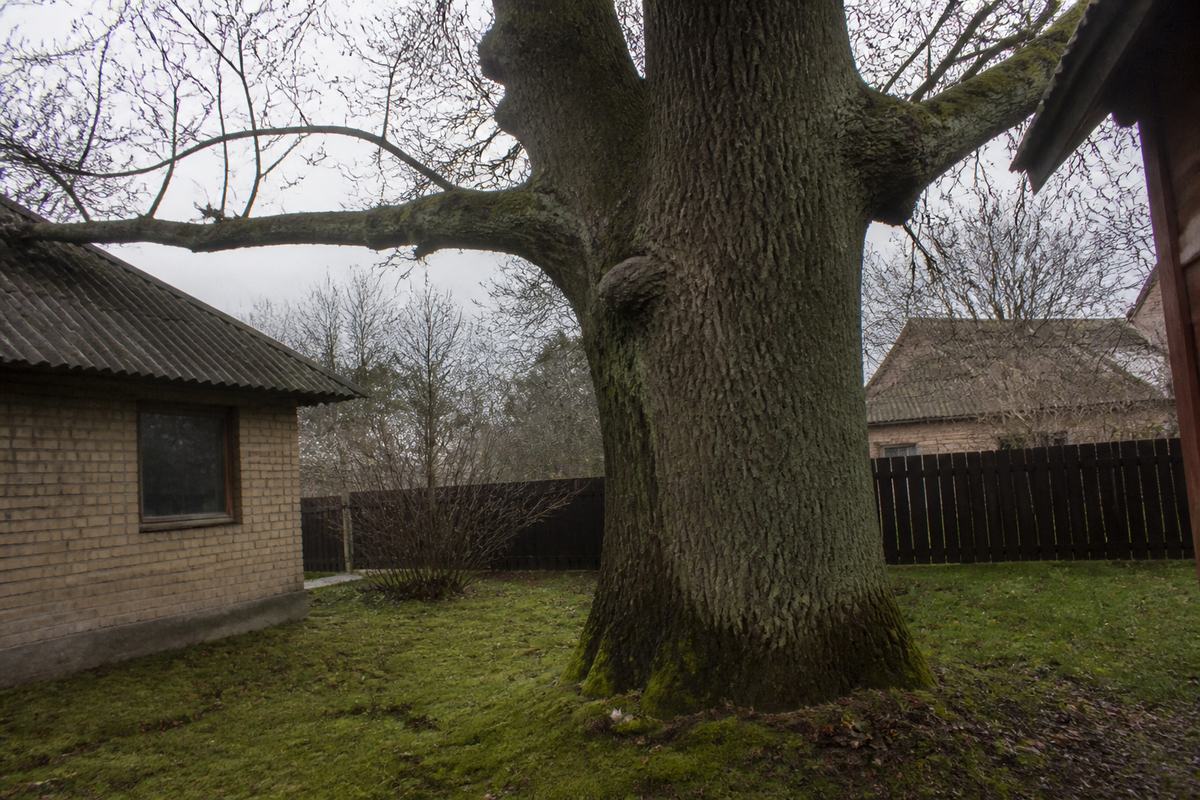
In practice that means several things in a single tree. Deadwood has accumulated in the crown that on a healthy, maintained tree would be taken out every few years. The lowest branches have sagged down to the height of the memorials. Old lime and maple trunks that were once formed have grown heavy, long limbs from the old pruning points, and those are the branches that break first. And there is often decay at the base already, hidden under decades of accumulated leaf litter.
None of that is a reason to remove them in haste. An old cemetery tree is part of the character of the place, and in most cases the right work is deadwood removal and reducing the weight in the crown, not felling. What is actually needed has to be settled by survey — see tree health assessment.
When the roots are under the memorial
This is the most common thing people tending a grave come to us about: the memorial or the kerb has tilted, and there is a large tree growing beside it. Usually it genuinely is the tree — the roots thicken over the years and lift whatever is above them.
Here we have to be honest about what can and cannot be done. Removing the tree will not put the memorial back — it doesn't correct the settlement or the tilt, and after the tree is removed the remains of the roots go on decomposing in the ground for years, so the ground there may settle further still. Restoring the memorial and the kerb is a stonemason's job, not ours. What we can do is prevent what comes next: remove the tree if it needs removing for other reasons as well, or — more often — tell you that the tree is sound and the problem needs solving from the stonework side.
We don't cut through a thick root running under a memorial simply because it is there. A root lifting a kerb is often one of the main structural roots, and severing it from a sound position turns the tree into a dangerous tree. If the tree stays, the root stays.
How the work is done
- We survey the site. We note what lies beneath the tree and what routes the material can be carried out along.
- We cover what is under the work area. Memorials and kerbs are protected with covers.
- We work on ropes. In small sections rather than large pieces — the same method as in tight spaces, only more carefully still.
- We carry the material out. Vehicle access in cemeteries is usually restricted, so we carry the material out by hand.
- We clear up completely. No brash and no sawdust may be left on the site afterwards.
How material is carried out along narrow paths
Cemetery paths are narrow, and between them are tended graves that you don't walk across. That means the material is carried along one route chosen in advance, and that route has to be worked out before the cutting starts, not afterwards. We cut the brash to a length that can be carried round a winding path without knocking it against the kerbs. If the path is sandy or soft, we use ground protection so the wheels don't cut in.
The chipper normally stays at the cemetery gates or at the nearest place a vehicle can stand, and the material is carried to it. It is the same principle as working without vehicle access: a large share of the time goes on carrying rather than cutting, and the distance from the tree to the gates is one of the biggest factors in the price.
Season and days of remembrance
In a cemetery, timing isn't only a technical question. We don't schedule work on the day of a funeral, and we also avoid the period around Kapusvētki (the cemetery festival), Svecīšu vakars (the evening of candles), Ziedu diena and All Saints', when cemeteries are busy and the plots have been tidied for the occasion. Around such days a sensible margin is at least a week either side — both so as not to spoil a freshly tended grave, and because the work is simply out of place there then.
In practical terms the best time for cemetery trees is late autumn and winter. There are no leaves, so the structure of the crown is visible and dead timber is easy to tell from live. There are few visitors. Frozen ground takes the walking and the carrying without damaging paths or turf. That is one reason we advise cemetery managers to plan this work for winter rather than spring.
A single grave or an avenue of trees
These are two different jobs, even when the trees are the same.
A single grave. The work is confined and precise. Usually it is one tree or a few branches above one particular plot, and the whole plan is about not damaging that one memorial and its neighbours. The client is a private individual, the scope is small, but the degree of care is the highest there is, because what sits beneath the work area cannot be moved out of the way.
An avenue or a whole site. Here the work is different in kind: all the trees have to be surveyed, an order of priority established for what is urgent and what can wait, and the work planned in stages across several visits. In an avenue the trees are all of the same age and so tend to start failing at the same time — knowing that, the work can be spread over several years rather than done all at once. We plan work like this together with the site manager, often as a standing arrangement rather than a single call-out.
Consents
Felling a tree in a cemetery normally requires the consent of the cemetery manager or the local authority, and the procedure varies between municipalities. We can handle that co-ordination for you — both the permit and the timing of the work, so that it doesn't clash with a funeral or a major visiting day. More on permits: the tree felling permit.
Who this service is for
We work both with private individuals looking after a particular grave and with cemetery managers and local authorities who need a larger area put in order or the condition of the old trees monitored regularly.
What the price depends on
In a cemetery the price is set not by the tree but by how carefully we have to work and how far we have to carry. It is affected by the height and condition of the tree, how densely the memorials sit beneath it, how small the sections therefore have to be, the distance to somewhere a vehicle can stand, and whether co-ordination with the site manager and a permit are needed. We have set out the full list of factors with explanations on the prices page. A photo showing the tree at full height and what lies beneath it is useful with your enquiry.