Signs worth paying attention to
A tree does not speak, but it shows. These are the signs we start an inspection with ourselves, in roughly the order they usually become visible:
- The crown is thinning. You can see more sky through the tree than you used to. There are fewer leaves, and they are unevenly distributed.
- Dieback starts at the top. This is one of the most significant signs of all. If a tree is dying back from the top down, the cause is almost always lower — in the roots or the trunk, not in the branches themselves.
- Smaller leaves, or leaves of a different colour. Small, pale or prematurely yellow leaves mean the tree is short of something — most often water, or sound roots.
- Leaves fall early. By July or August there is already a carpet of leaves under the tree.
- The trunk is weeping or bleeding. Dark, wet streaks on the bark, sometimes with a smell. They point to damage or infection beneath the bark.
- The bark is coming away in plates. The wood beneath it is dry or riddled with galleries. This sign is rarely an early one — it usually means the process has been going on for some time.
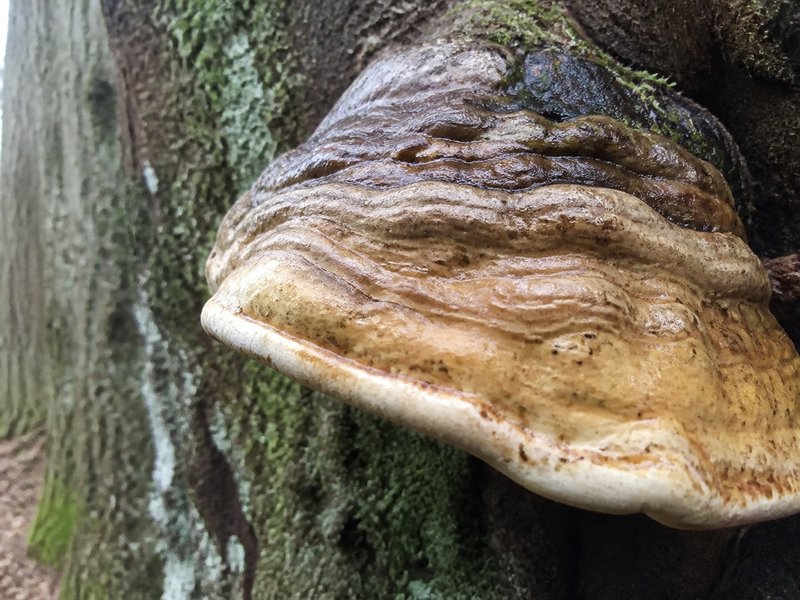
- Fungi and bracket fungi. On the trunk, at the base, or on the root flares. The location matters more than the size.
- Boring dust and rows of round holes. Fine, pale or reddish-brown wood dust in the crevices of the bark and on the ground at the base of the trunk.
Cause and symptom — why the distinction matters
This is the most important idea on the whole page. Where a problem is visible and where it begins are often two different parts of the tree.
A tree with small, brown leaves has most often not caught a leaf disease. Far more often its root system has been damaged or smothered — an area concreted or paved right up to the trunk, a trench dug, a layer of soil brought in, ground compacted over years. The leaves are simply the first place where the tree runs short of resources, so that is where we see it.
The practical consequence is direct: spraying the leaves of such a tree does no good whatsoever. It is like treating a bruise caused by a shoe that is too small. Until you know what is happening at the roots and at the base of the trunk, any treatment is guesswork. That is why a tree health assessment starts at the ground, not at the crown.
Dead branches at the top can mean root decay, a long drought, building work three years ago, or simply the tree's natural age. Meaning only emerges once several signs are put together with what has actually happened on that particular site.
The main groups of problems
Root and butt decay
The most serious group, because it affects the part of the tree that holds up everything else. Outwardly a tree can look almost normal while the roots and the base of the trunk have already decayed. The signs: a gradually thinning crown, fungi or bracket fungi low down near the ground, turf lifted on one side, a new lean. Decay cannot be halted and cannot be cured. It can be assessed — how much sound wood is left — and a decision can then be taken as to whether the tree is safe where it stands.
Trunk decay fungi
Fungi that break down the wood in the trunk or in heavy branches. The visible bracket is only the fruiting body; the part that matters is happening inside the wood. We cover this separately — bracket fungi on trees.
Bark beetles and other wood-boring pests
The culprit is most often not the insect itself but a weakened tree. Healthy spruces and pines with enough water push bark beetles out with resin. Weakened by drought, they cannot. So bark beetle damage is usually the consequence of stress, not the start of it. More on the most common case in Latvia — the spruce bark beetle.
Leaf diseases
Spots, mildew, premature leaf fall. Visually the most unpleasant group and at the same time most often the least dangerous. A healthy mature tree survives a leaf disease year after year with no consequences for its structural condition. On fruit trees it is a question of the crop, and there clearing away the fallen leaves and proper crown thinning achieve more than spraying does.
Plain stress
Neither a disease nor a pest — the tree simply has no conditions to grow in. Prolonged drought, a compacted or paved root zone, roots severed by a trench, soil brought in over the roots, salt from the road. This is the most common cause for urban trees, and it is also the case where real help is possible: root zone care — decompaction, mulching, fertilisation — often brings a tree back into shape within two or three seasons. If building work is only being planned nearby, it is worth thinking about root protection in good time, because putting the damage right after the fact is far harder.
What can be treated and what cannot
We say this plainly, because the trade often keeps quiet about it.
| Situation | The honest answer |
|---|---|
| Stress caused by drought and compacted soil | Often fixable. Root zone care, mulching, fertilisation, reducing the weight of the crown. |
| Root damage after excavation | Partly fixable, if the tree has not gone too far. Results show after a season or two. |
| Leaf diseases | Manageable. A mature tree often needs no intervention at all. |
| A pest infestation at an early stage | Sometimes it can be stopped — but only if it is caught in time and the underlying cause is addressed too. |
| Trunk and root decay | Not curable. The extent can be assessed and a decision taken on safety. |
| Ash dieback | There is no remedy. We monitor the condition and act on safety grounds. |
| The tree is already dead | Irreversible. The only question is how urgently it needs to come down. |
When something cannot be treated, that does not mean there is nothing to be done. It means the work is a different one: to establish how much strength the tree still has, how quickly its condition is changing, what lies within the fall zone, and whether it can be resolved by taking weight out of the crown rather than by removal.
What to send with your enquiry
A large share of questions can be settled from photographs alone. Three are useful: the whole tree at full height, the base of the trunk close up, and the specific spot that worries you — a fungus, a crack, a weeping streak or a hole. Write down too what has changed around the tree in recent years: digging, paving, building, a change in ground level. That information often decides the diagnosis more than the photograph itself.
What the price depends on
The cost of an inspection is set by how many trees have to be looked at, how far the property is from Rīga, whether the crown has to be climbed to examine the damage more closely, and whether a written report is required. The cost of remedial work depends on the size of the tree, the area of the root zone, and how many times a season we have to return. We have explained the factors on our prices page. We prepare a firm quote once we know what we are actually dealing with — not before.