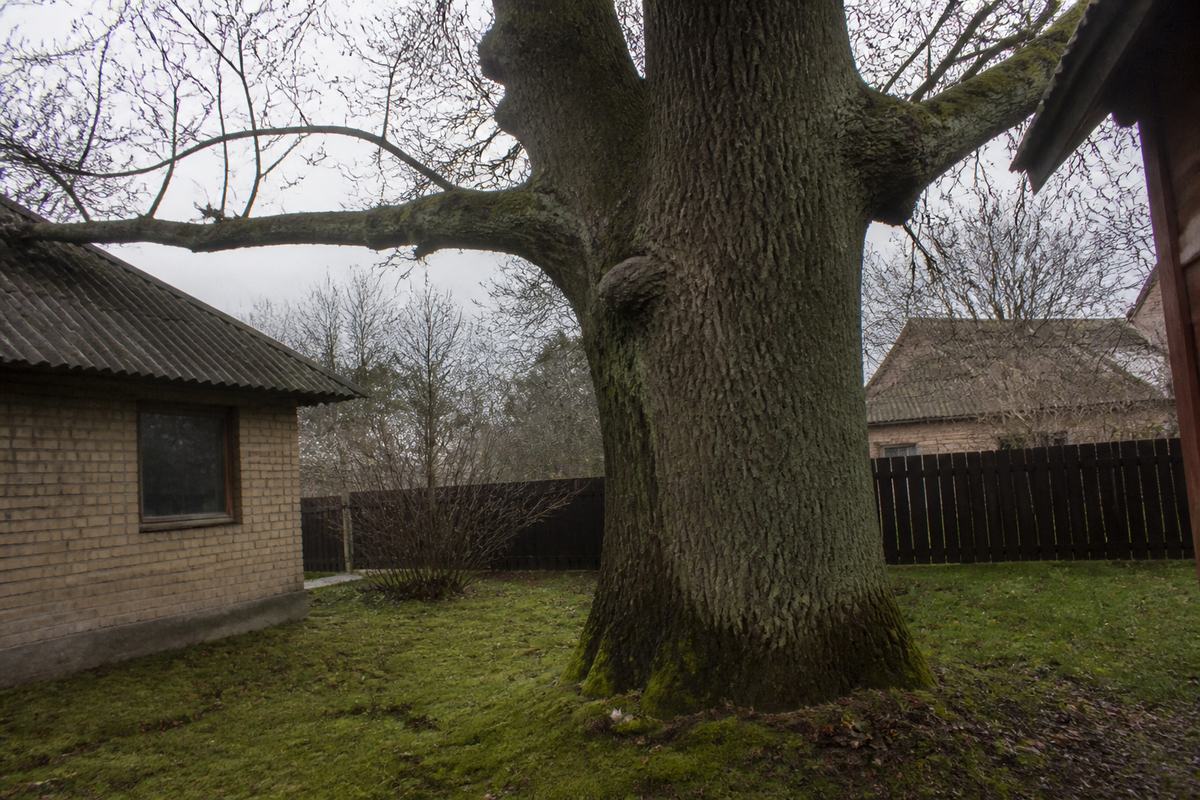
Torņakalns has historic buildings with mature garden trees, university complexes, and large development sites with construction under way. In practice that means many of our call-outs here have to do not with the age of the tree but with what is going on around it.
Construction is the biggest threat to trees
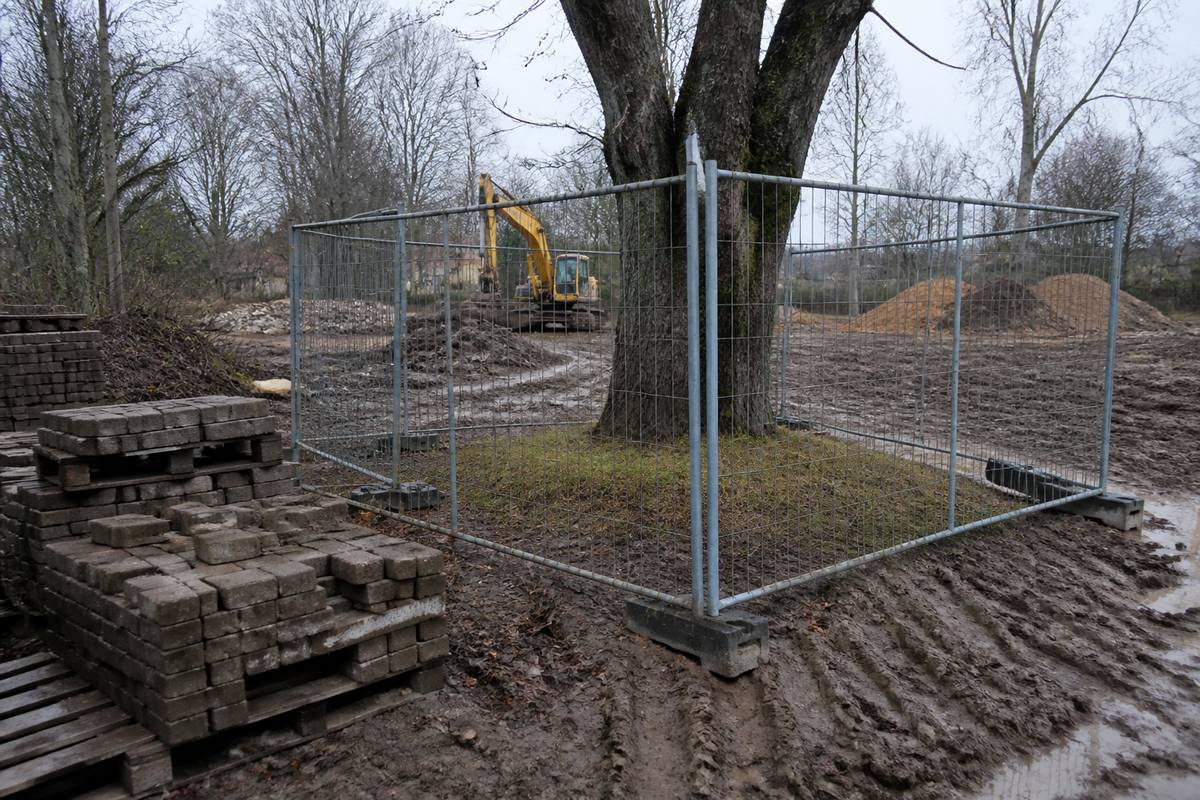
An old tree rarely dies of its own accord. Far more often it is killed by what happens around it: a trench dug for service connections, soil heaped up against the trunk, block paving laid, heavy machinery driven across the root zone.
The most important thing to know about this: the damage does not show straight away. The tree still looks normal for two or three seasons, and only then does the crown start to thin and the top to die back — by which point there is nothing left to do. So if you are planning building work, the root zone has to be fenced off beforehand: root protection during construction.
If the damage has already been done, we start with a tree health assessment and look at whether the situation can be improved with root and soil care.
Historic buildings and tight spaces
The historic wooden and masonry buildings of Torņakalns are exactly the group of structures on which a freely falling branch leaves expensive damage. So here we work on the principle that nothing falls freely to the ground — every section is lowered on a rope.
The courtyards are narrow, access is often through a gate, and the railway and the Mārupīte limit the alternative routes. If machinery cannot get to the tree, we work without it and carry the material out — tree removal without vehicle access.
Development sites and large properties
University complexes, development land and large properties mean working with a site rather than a single tree: rows of trees, avenues, planting beside roads and car parks.
For clients like these we start with a survey recording the problem trees and dividing them by urgency — what has to be done now, what next season, what merely needs watching. If building work is planned on the site, in the same survey we say which trees are worth keeping and how to protect them. More: commercial tree care.
Who orders the work in a Torņakalns courtyard where the land is in shared ownership
In the old rented buildings of Torņakalns, the tree usually grows in a courtyard belonging to all the flat owners jointly. In practice that means one neighbour's phone call is not sufficient grounds for felling — the decision to fell a tree is a decision of the co-owners, taken at a general meeting of the flat owners or by written ballot. It is more complicated still where the land under the building belongs to a different owner than the building itself; then the question has to be agreed with the landowner first.
How we work in cases like these:
- we come out to look at the tree and state in writing what is wrong with it — whether it really is dangerous, or whether deadwood removal will do;
- residents or the property manager can put that assessment on the table at the general meeting, so that the discussion is about the tree's condition rather than about taste;
- if the decision is to fell, we obtain the permit from Rīga City Council, not the client;
- on the day we cordon the courtyard off, take the branches away and do not leave chip in front of the neighbours' entrance.
More on working in apartment-block courtyards and on how a felling permit is obtained.
Trees over the neighbours' wooden houses: how we plan the work
In the streets of Torņakalns the wooden houses stand close to one another, and an old birch or ash often reaches over the neighbour's roof rather than the client's. A falling branch costs more on a wooden building than on a masonry one: a hole in the roof usually comes with wet timber in the structure below, and the repair turns out broader than it looked from the ground. So we do not take trees like these down in whole pieces.
In practice that means sectional dismantling on ropes — the arborist climbs the tree, secures each branch and lowers it under control, and nothing falls freely across the roof. Where a vehicle can get into the courtyard we use a platform; where it cannot, we work on climbing equipment alone. Before we start we arrange access with the neighbour, because the rope anchor points and the landing area for the branches are often on their side — and that conversation is easier before the work than after it.
Ash trees in Pārdaugava need their crowns watched particularly closely: ash dieback makes the branches brittle, and it is exactly those that tend to come down without any wind at all. If the tree is already leaning or splitting, in an emergency we can be there the same day.
What we do in Torņakalns
Every one of our services is available in Torņakalns. The ones most often requested in this neighbourhood:
- Dangerous tree removal — Dead, rotten, leaning and damaged trees. We assess first, then we cut.
- Emergency tree removal — Fallen and broken trees after a storm — we come out the same day.
- Tree crown care — Crown shaping, thinning and deadwood removal.
- Stump grinding — Stump grinding without digging — the lawn is left almost untouched.
- Tree health assessment — Is the tree dangerous? We survey it and tell you what to do.
- Branch and timber removal — Branch and timber removal, even if someone else did the cutting.
The full list with descriptions is in the services section.
How the work happens
- We get back to you within 5 min. Fill in the form and attach photos showing the whole tree, its base and the route up to it. That is often enough for a ballpark quote.
- Assessment. We reply with an approximate price and a method. If access in Torņakalns is awkward, we come out and look before the job.
- Permit, if one is needed. We check whether this particular tree in Rīga requires one, and we file it on your behalf.
- The work. We agree a time, cordon off the work zone and arrive with everything needed.
- Clearing up. We chip or collect the branches and take them away. We do not leave wood chip behind. If you want firewood, we cut it to length and stack it where you tell us.
What the price depends on in Torņakalns
There is no flat rate per tree. In Torņakalns the quote is set by the tree's height and girth, its species and condition, how close it is to the historic buildings, whether there is a drop zone, the amount of rope work and the vehicle access in the narrow courtyards.
In Torņakalns the price is decided mainly by access and method: in a tight historic courtyard, with rope work and the material carried out by hand, the job takes longer than the same tree on an open site. We have set out the full list with explanations on the prices page.