
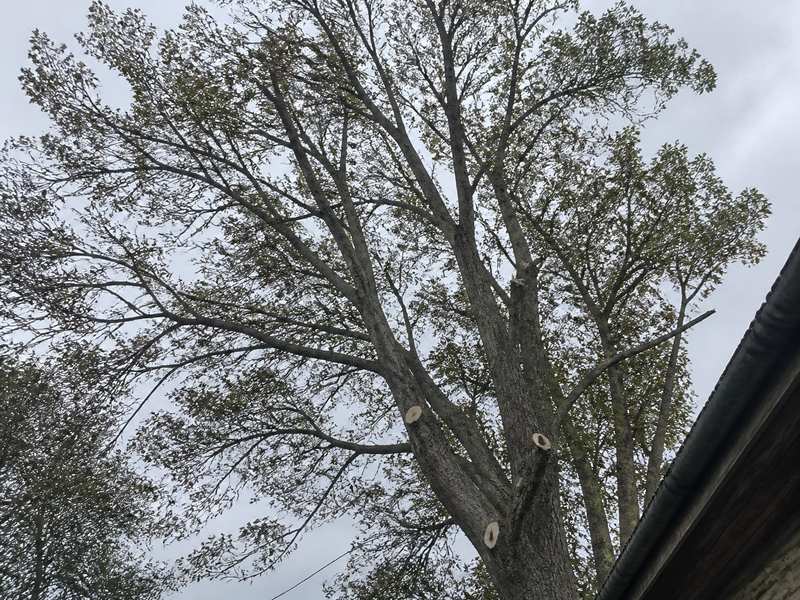
Why the choice of method matters
When someone says "prune this tree for me", they usually have a specific problem in mind: a garden that is too dark, branches over the roof, a tree that seems too big. Each of those problems has its own method, and the wrong method won't solve the problem — but it will do the tree permanent harm. So before we start we ask what you want to achieve, not how much you want cut off.
In practice there are three basic techniques. They can be combined on one tree, but they are not interchangeable.
Thinning — a lighter crown, the same size
Thinning means taking out a proportion of the branches from inside the crown and evenly throughout it. Branches are removed completely, back to their point of origin — not shortened. The result is that light and wind pass through the crown more easily, while the tree stays exactly as tall and as wide as it was.
What it gives you:
- dappled light beneath and behind the tree instead of solid shade;
- wind passing through the crown rather than pushing against it like a sail — which reduces the load on the trunk;
- the inside of the crown drying out faster, lowering the risk of fungal disease;
- the tree's natural shape preserved — after good thinning you cannot tell the tree has been pruned at all.
What it doesn't give you: thinning does not make the tree smaller. If a window has been closed in because the tree has grown bigger than its space, thinning will only help so far. And it is possible to over-thin — take too much out of the inside of the crown and all the foliage ends up at the branch tips, and branches like that break more easily.
Crown lifting — space beneath the tree
Lifting is the removal of the lowest branches to free up space under the tree. It is used where you need to walk, mow or park underneath, where branches are catching on a roof, or where they are obscuring a road sign or a street light.
There is one rule here that is often broken: the live crown must keep at least about two thirds of the tree's height. If the lowest branches are taken off too high up, the trunk is left long and spindly, it no longer thickens properly at the base, and the tree becomes less stable in wind. A long bare trunk with a small tuft on top is nothing to be proud of — it is a weaker tree than the one you started with.
Reduction — how it is done properly
Reduction is the only method that genuinely makes a tree smaller. It is also the one most often done wrong.
Done properly, it works like this: every branch we want to shorten is cut back to a side branch thick enough to take over as the new leader. A practical rule of thumb — the side branch should be at least about a third of the diameter of the branch being removed. The flow of growth then continues along that side branch, the cut grows over, and the tree does not throw up a thicket of shoots. From the ground it looks like a smaller tree with a natural shape, not like a tree that has been cut.
What is wrong is cutting a branch wherever it happens to suit us — halfway along, level with the fence, in a straight line beside the house. That leaves a stub with no live side branch on it, and from there come the problems described in the next section.
Cutting off the top of a crown and leaving thick stubs does a tree irreversible harm. There are three reasons. First, a thick cut in the middle of a branch never grows over — the tree has no mechanism for closing it, so the exposed wood begins to rot, and the decay travels down the branch into the trunk. Second, the tree answers the shock with a mass of fast shoots attached only to the outer layer of bark rather than rooted in the wood. Third — and this matters most in practice — within a few years that dense thicket of regrowth is heavy, growing on a rotting base, and breaks more easily than the original branches did. A topped tree presents a greater risk five years on than it did before, not a smaller one. We don't work that way.
How much may be taken off at one time
Leaves are a tree's food supply. Every live branch cut off is a lost piece of that supply, and the tree covers the shortfall from its reserves. On a healthy, mature tree we work to this principle: no more than about a quarter of the live crown in a single season. On an older, weaker or already stressed tree — less.
That means big changes are not a one-day job. If a tree needs reducing noticeably, we spread the work over two or three seasons. In between, the tree recovers, closes its cuts and adapts. The result is better and lasts longer than anything achieved in one crude go.
We establish the goal
Light at a window, space under the tree, branches off the roof, or simply a smaller tree — the method follows from that.
We assess the tree
Species, age, condition and old cuts. Some trees take reduction well; others answer with a flush of shoots no matter how correctly the work is done.
We tell you what can and can't be done
If the goal can't be reached without damaging the tree, we say so directly. Sometimes the honest answer is a smaller change than you were expecting.
We work on ropes or from a platform
In a living tree we climb on ropes, not spikes — spikes damage the bark. For wide crowns we use a MEWP (mobile elevating work platform).
We clear up
We chip the brash and take it away. We don't leave wood chip in your garden.
When no method is the answer
There are situations where none of the three methods helps. If a tree has grown to twice the size of the space it stands in, reducing it to the size needed would mean taking off so much that the tree would not survive in any normal form. The honest option then is to remove it and plant a species better suited to the spot, rather than fighting regrowth every other year. And if the tree's problem is decay or damaged roots, no amount of crown work will solve it — what is needed first is a tree health assessment.
Timing
For most broadleaved trees the best time is the dormant season, when the leaves are off and the structure of the tree is visible. Birch and maple are better done in late summer, because they bleed heavily in spring. Deadwood can be taken out at any time. More on the seasons — when to prune trees.
What the price depends on
The height of the tree and the size of the crown, the method chosen, whether we have to climb on ropes or can work from a platform, vehicle access, and the volume of brash to be taken away. Thinning a whole crown takes longer than reducing a few branches on one side, because the work has to cover the entire canopy. We've set out the factors on the prices page. For a more precise quote, send us a photo showing the tree at full height.