
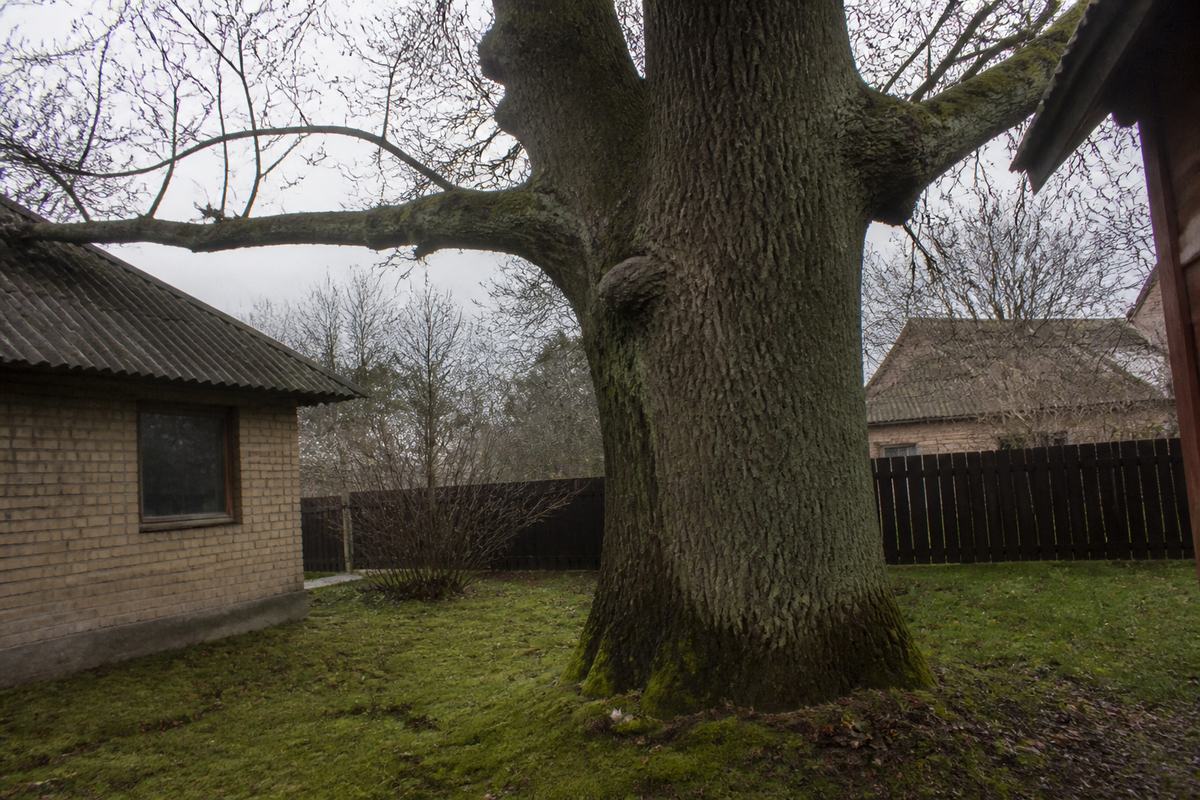
The building stock of Zasulauks is mixed and older: pre-war wooden and masonry houses, detached houses, apartment blocks, and the railway running through all of it with Zasulauks station. The trees here have grown for a long time and stand close to the buildings — but there are more open plots in places too, and that changes the price.
First we establish whether there is anywhere to fell it
The density of building in Zasulauks is uneven: on one street a tree stands wedged between two houses, on the next it is in a garden with plenty of open ground around it.
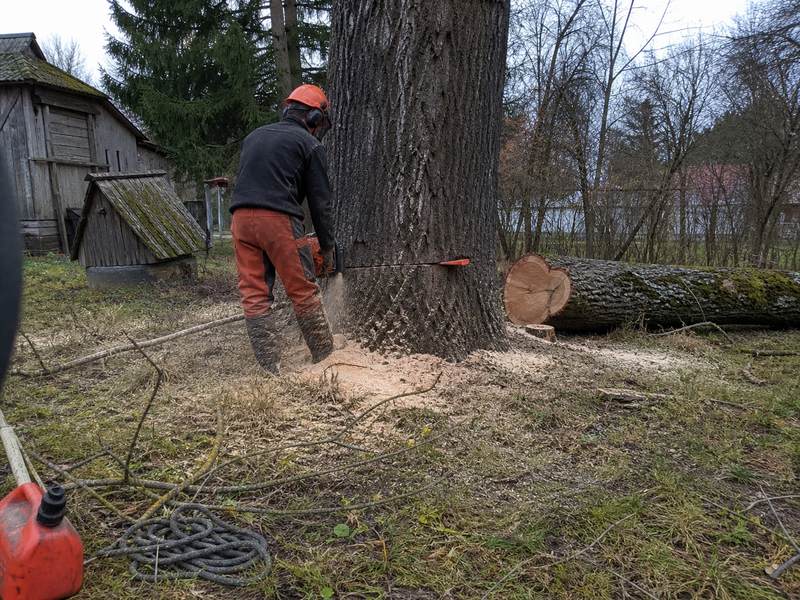
That matters, because felling a tree whole is the fastest and cheapest option. So when we assess a job, the first thing we always look at is whether there is a drop zone at all. Sectional dismantling is not a better method — it is the method for cases where there is no other. If there is room in Zasulauks, we say so and offer you the cheaper solution.
Wooden buildings call for care
Pre-war wooden houses with boarded facades, verandas and old roof coverings are expensive to restore, and even a small branch falling freely leaves damage costing more than the whole cutting job.
On properties like these we lower every section under control on a rope — tree removal over roofs. In the narrow courtyards between buildings the method is the same: removal between buildings and in courtyards.
The railway and access
The railway and Jūrmalas gatve cut the neighbourhood in two, and that affects the routes: crossing from one side to the other can take longer than it looks on a map. Narrow streets and old entrances in places mean large machinery simply will not get in.
If a tree grows in the immediate vicinity of railway infrastructure, it is no longer an ordinary garden tree — there we have to establish who owns the land and whether consent is needed. We check that before the work. A photo showing not just the tree but the route up to it is very useful with your enquiry.
Who orders the work in a shared Zasulauks courtyard and who does so on their own plot
In Zasulauks both situations occur side by side on the same street. In the garden of a detached house it is all straightforward: the owner points out the tree, we agree the scope and we carry the work out. In an apartment-block courtyard around Kalnciema iela and Jūrmalas gatve the land is more often in shared ownership or run by a property manager, and then the decision is not down to a single neighbour. In practice that means that before quoting we establish who the client is — the flat owners' association, the property manager or a particular owner — because that determines who we address the offer to and who signs the paperwork later.
We carry out the survey once, even where several trees in a courtyard need attention for different reasons. We prepare the quote in writing with the items listed separately, so that the general meeting can see what each piece of work costs. If a felling permit is needed, we handle the paperwork, but the landowner signs the application. More on working in courtyards like these under tree removal in apartment-block courtyards.
The old Pārdaugava gardens in Zasulauks: we assess trees by species
The gardens of Zasulauks were mostly planted in the pre-war and Soviet years, and we see a fairly predictable set of species in them. Each calls for a different answer:
- Poplars — tall, fast-growing, with brittle timber and a tendency to rot out in the middle of the trunk. On older specimens we check whether the trunk is still carrying the crown, and assess the direction of failure.
- Ash — affected in many places by ash dieback, which starts at the top of the crown. We write about that separately under ash dieback.
- Birch and maple — most often the problem is shade and closeness to the roof rather than the tree itself; here crown thinning or taking off individual branches helps.
- Apple, plum and cherry — neglected, with congested crowns and dead branches; we bring them back gradually rather than in a single season.
- Thujas and hedges — uncut for years, grown out over the fence and bare from below.
When we survey on site we tell you what can realistically be done with each tree and what is better left alone. The full list is in the services section.
What we do in Zasulauks
Every one of our services is available in Zasulauks. The ones most often requested in this neighbourhood:
- Dangerous tree removal — Dead, rotten, leaning and damaged trees. We assess first, then we cut.
- Emergency tree removal — Fallen and broken trees after a storm — we come out the same day.
- Tree crown care — Crown shaping, thinning and deadwood removal.
- Stump grinding — Stump grinding without digging — the lawn is left almost untouched.
- Tree health assessment — Is the tree dangerous? We survey it and tell you what to do.
- Branch and timber removal — Branch and timber removal, even if someone else did the cutting.
The full list with descriptions is in the services section.
How the work happens
- We get back to you within 5 min. Fill in the form and attach photos showing the whole tree, its base and the route up to it. That is often enough for a ballpark quote.
- Assessment. We reply with an approximate price and a method. If access in Zasulauks is awkward, we come out and look before the job.
- Permit, if one is needed. We check whether this particular tree in Rīga requires one, and we file it on your behalf.
- The work. We agree a time, cordon off the work zone and arrive with everything needed.
- Clearing up. We chip or collect the branches and take them away. We do not leave wood chip behind. If you want firewood, we cut it to length and stack it where you tell us.
What the price depends on in Zasulauks
There is no flat rate per tree. In Zasulauks the quote assesses the tree's height and girth, its species and condition, the distance to the wooden buildings, whether there is a clear drop zone, whether climbing or machinery is needed, and the volume to be taken away.
In Zasulauks the price for two trees of the same size can differ several times over — what decides it is whether the tree can be felled whole or whether every section has to be lowered on a rope over a wooden roof. We have set out the full list with explanations on the prices page.