
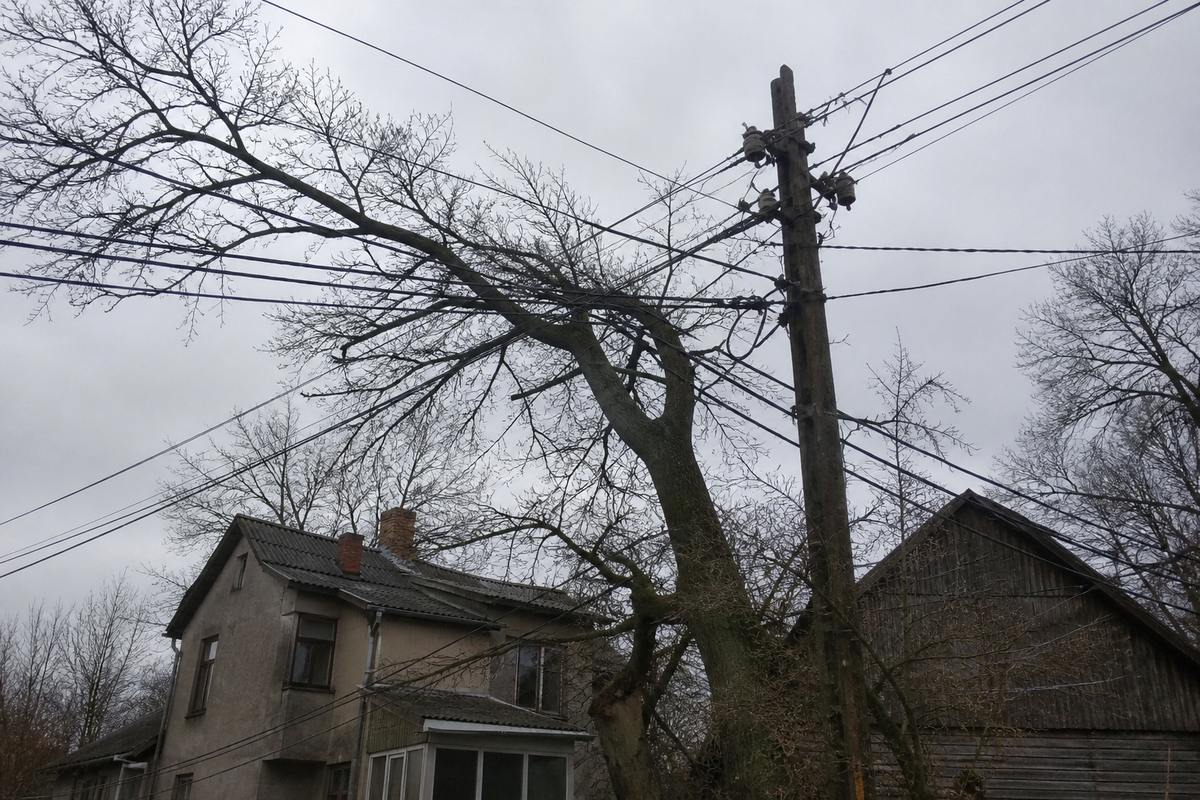
A fallen tree or branch on an electricity line is life-threatening even when the cables aren't severed and nothing is sparking. The ground around such a spot can be live. Do not go near it, do not try to pull the branch clear, and don't let children or animals near it. Contact the network operator's emergency service first. We work only once the line has been switched off or the operator has given clearance.
First establish what kind of line it is
This is the single most useful thing you can do before contacting anybody, because everything else follows from it — including who you should be talking to in the first place. In practice the cases divide in two.
The service connection to your house. This is one cable, or a twisted bundle of cables, that branches off the street line and runs to the wall of your building or the meter box. It is a low-voltage cable, it terminates at your house, and the tree growing around it is almost always on your own property. This is the situation that can most often be resolved: frequently it is enough to take the service cable down temporarily, do the work, and put it back afterwards.
The distribution line on poles. This runs along the street or across country from pole to pole, usually has several conductors at the same level, and doesn't terminate at any one house — it feeds the whole neighbourhood. This is the network operator's infrastructure, and there is a defined protection zone along it. Here the decision isn't the owner's alone, and tree work within that zone is often the operator's job entirely.
So before getting in touch it is worth establishing two things: which of these lines it is and where the boundary runs — whether the tree is on your land, the neighbour's land, or the local authority's verge along the road. The most useful thing you can describe in your enquiry is how the tree, the cables and the pole or house wall sit in relation to one another. When we speak, we can tell you which side of the line your situation falls on — including when it turns out to be the operator's job rather than ours.
Why a branch in the cables is a problem even with no visible damage
We often hear: the branches have been in the cables for years and nothing has happened, so why worry. There are several reasons, and none of them is visible from the ground.
Cables have insulation, but it isn't designed to withstand abrasion. A branch in the wind doesn't move once a year — it moves every day, and in every wind it rubs the cable in the same spot. Over the years the insulation wears through at that point, and from the outside it looks exactly as it did before. The abrasion damages the branch itself too: the bark wound that forms where it rubs is the very place decay later enters the tree.
The second factor is moisture. A dry branch and a wet branch are not the same thing — in rain or freezing drizzle wet timber conducts electricity far better, and a branch that has been harmless all summer becomes a path. The third is weight: snow and ice bend branches down far lower than in summer, so a branch sitting half a metre below a cable in summer can be pressed against it in winter.
And finally — a branch touching the service cable to a house can cause flickering or dropping voltage indoors, which people spend months hunting for in the wiring. So if you can see branches touching the cables, it is worth dealing with, even if nothing seems to be happening for now.
What we can do
- Remove trees and branches that are at a safe distance from the line, and do it so that nothing falls onto the cables — with rope access, lowering everything under control.
- Remove trees that could reach the line if they fell — before that happens.
- Prune the crown so that the branches grow away from the cables, while keeping the tree alive.
- Survey the tree and tell you whether it threatens the line and whether the matter needs to go to the operator.
What we don't do
- We don't work closer to a live line than the safety rules allow.
- We don't disconnect or touch network infrastructure — that isn't within our remit.
- We don't take on work that is the network operator's responsibility just because a client would like a quicker solution.
This boundary isn't bureaucracy. A branch touching a medium-voltage line can cause both injury and a widespread outage, and in either case the liability is real.
How the work is planned so nothing lands on the line
Once the job is on the permitted side of that boundary, the whole plan comes down to one question: where each piece will go. We send nothing towards the line — not even a small branch, not even when it looks as though it would clear it.
In practice that means three things. The anchor goes on the opposite side from the line, so that a cut piece hanging on the rope swings away from the cables rather than towards them. We work in small sections, because a small piece can be held in the hand and passed down rather than dropped. And the branches reaching over the line come off last, with everything above them removed first — so that no later piece can fall onto them and drive them, weight and all, onto the cables.
Sometimes what follows from this is that the job cannot be done the way the client had pictured at all. If the tree grows such that there is no direction in which the pieces can be taken away from the line, then the honest answer is that we must wait for a shutdown or involve the operator, not that we should work more carefully. Care is no substitute for clearance here.
Telecoms and internet cables
Low-voltage service cables, telephone and internet lines are not the same as an electricity line, but they still mustn't be broken. If branches are growing around the service cable to your house, that can usually be sorted — often it is enough to take the cable down temporarily and put it back after the work.
How to prevent it in good time
Most of these problems arise because a tree was planted too close to the line or has grown larger than anyone expected. If the crown is pruned regularly, the branches never reach the cables at all. If you are planning to plant new trees, it is worth thinking about the position — we cover that under tree planting.
This is the place to say it as plainly as possible: almost every situation where a branch is in the cables is a situation that wouldn't exist if the crown had been maintained. A tree doesn't grow into the cables in a single year. It approaches year after year, and in every one of those years it would have been easy, cheap and safe to keep it back. By the time the branch is in the cables, the choice has narrowed to a shutdown, the operator, and waiting.
Regular maintenance here means something quite simple: once every few years the branches on that side are shortened back to a point far enough from the line that a few years' growth and a winter's snow load still won't bring them into contact. It isn't an annual job and it isn't a big one — more on this under crown care. If you have several trees along the line or along the driveway, they can all be dealt with on a single visit.
What the price depends on
Here the price is set less by the size of the tree than by how freely we can work around the line. It is affected by the distance from the cables, whether the branches can be taken away from the line or everything has to come off in small sections, whether climbing or a platform is needed, whether the service cable has to be taken down or the line switched off, and how much material has to be carted away. If the work has to be co-ordinated and a shutdown awaited, that affects the timescale, not just the scope. We have set out the factors on the prices page.