
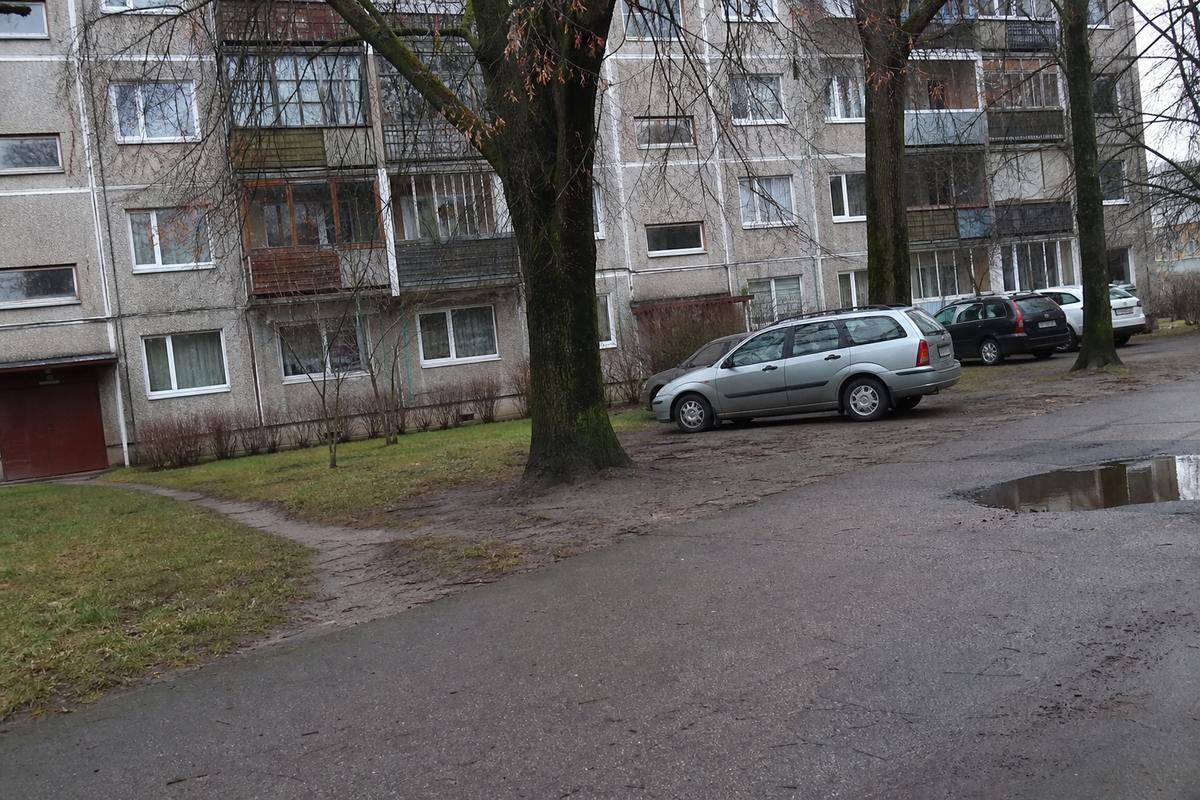
The character of Ziepniekkalns is mixed: large housing estates with generous inner courtyards, streets of detached houses, and beside them warehousing, industrial and retail premises. The first thing we establish is not the size of the tree but who owns the land and who is entitled to order the work.
Courtyards with generous inner spaces
The inner courtyards of Ziepniekkalns are spacious, and that is sometimes good news: if there is enough clear ground around a tree, it can be felled whole — the fastest and cheapest option. So when we assess a job, the first thing we look at is whether there is a drop zone.
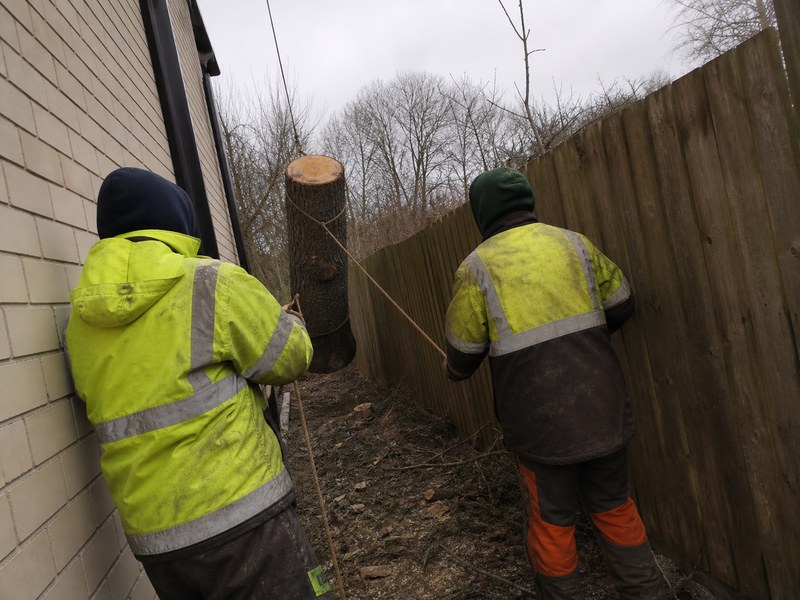
If there is not — and in a full courtyard there usually is not — we take the tree down in sections, cordoning off the zone beforehand and agreeing that a few parking bays will be cleared. The work is ordered by the managing agent or the owners' association; we prepare the quote and the description.
The detached-house part
In the streets of detached houses the client is the owner, and the questions are quite different: shade in the garden, branches over the neighbour's fence, old apple trees, hedges and thujas.
Here in most cases the answer is not removal but care — crown thinning or reduction. If light is the problem, we say honestly how much of it can realistically be recovered: on broadleaved trees thinning works well, while on conifers the options are more limited, because they do not regrow from old wood.
Commercial sites and warehousing
On the edge of the neighbourhood there are warehousing, industrial and retail premises, where tree care means a site rather than a single tree: the planting beside a car park, a row of trees along the fence, branches over an access road or over plant.
Premises like these have their own requirements — passes, safety rules, restrictions on working hours. We plan for that in advance and work outside business hours where necessary. More: commercial tree care.
Trees planted at the same time grow old at the same time
Most of the planting on the Ziepniekkalns estate went in over a short period as the buildings were handed over. That means the trees in a given courtyard reach a critical age almost simultaneously, and the problems appear in series rather than one at a time.
- Poplars — fast-growing and with brittle timber. In older specimens we often find forks with included bark in the middle; it is exactly these forks that tend to split out in wind, even when the crown looks sound from outside.
- Maples — grown from their own seed close in against the parent tree and against each other, so the crowns are drawn out to one side and climb over pavements and parking bays.
- Limes — topped back to the same points for decades. After each cut a bunch of weakly attached regrowth comes away, and the old wounds in the stub gradually decay.
- Birches — the tops die back from above, and the dead branches break directly over the paths.
In cases like these we assess each tree individually rather than the whole row by age. If there is any doubt about internal decay, we start with a tree health assessment, and only then talk about removal or crown thinning.
What to photograph so we can name a price without a visit
In apartment blocks the work usually starts with a resident's complaint to the property manager or the association's board, and what is needed next is a concrete offer. We can assess most courtyard work in Ziepniekkalns from photographs, provided they show the things that affect the price.
- The whole tree from a distance — framed so that the top and the adjacent building or parking bay are both in shot. From that we can see the height and which way the tree could fall.
- The base of the trunk and the root collar — fungi, cavities, detached bark, signs of leaning.
- The access route — whether machinery can get in between the buildings, or whether the way is blocked by parked cars, a fence, a row of garages or a playground.
- Somewhere to put the branches and the chipper, and what is underneath the tree: cables, a roof, a district heating main, kerbs.
That is enough for us to name the scope and the approach. In more difficult cases we still come and look, and only then does the offer become final. Approximate ranges can be found on the prices page, and if the tree needs a permit from the local authority, we handle the paperwork.
What we do in Ziepniekkalns
Every one of our services is available in Ziepniekkalns. The ones most often requested in this neighbourhood:
- Dangerous tree removal — Dead, rotten, leaning and damaged trees. We assess first, then we cut.
- Emergency tree removal — Fallen and broken trees after a storm — we come out the same day.
- Tree crown care — Crown shaping, thinning and deadwood removal.
- Stump grinding — Stump grinding without digging — the lawn is left almost untouched.
- Tree health assessment — Is the tree dangerous? We survey it and tell you what to do.
- Branch and timber removal — Branch and timber removal, even if someone else did the cutting.
The full list with descriptions is in the services section.
How the work happens
- We get back to you within 5 min. Fill in the form and attach photos showing the whole tree, its base and the route up to it. That is often enough for a ballpark quote.
- Assessment. We reply with an approximate price and a method. If access in Ziepniekkalns is awkward, we come out and look before the job.
- Permit, if one is needed. We check whether this particular tree in Rīga requires one, and we file it on your behalf.
- The work. We agree a time, cordon off the work zone and arrive with everything needed.
- Clearing up. We chip or collect the branches and take them away. We do not leave wood chip behind. If you want firewood, we cut it to length and stack it where you tell us.
What the price depends on in Ziepniekkalns
There is no flat rate per tree. In Ziepniekkalns the quote is influenced most by whether there is a clear drop zone inside the block, and then by the tree's height and girth, its species, its condition, the distance to the buildings and the volume of material to be taken away.
In Ziepniekkalns the price is often brought down by a clear drop zone in the more generous inner courtyards — felling a tree whole costs less than lowering it in sections, and we say so at the quoting stage. We have set out the full list with explanations on the prices page.