
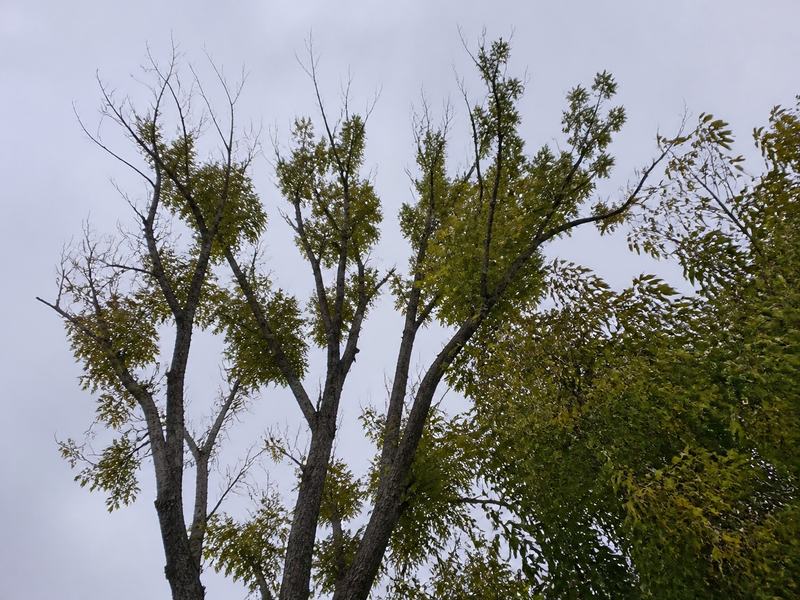
How to tell that a tree has stopped growing
- In summer there are no leaves on the tree, or only on a few branches.
- Branches snap easily and dry rather than bending.
- The bark is lifting or has already fallen away over large areas, exposing grey timber.
- There is no green layer under the bark — you can check this by nicking the bark lightly with a knife.
- The top of the crown is dead, and the dieback is working its way down.
- Fungi have appeared on the trunk, along with wood dust from insect pests.
Before you decide the tree is dead
A tree that looks bad isn't always dead — often it is under stress, and a stressed tree can recover. So before deciding, it is worth checking a few things.
- Check at the right time of year. Some species come into leaf late, and a bare tree in early spring means nothing yet. Judge it in June, when all the trees around it are in full leaf.
- Check in several places. Nick the bark on several branches and on the trunk at several heights. It often turns out that the top is dead but the trunk and lower branches are alive. That is an entirely different case.
- Look at the trunk and the base. If new shoots are coming from the trunk or at the base, the tree is still alive and fighting.
- Think about what changed. Drought, a trench dug nearby, new paving, soil piled up around the trunk, an altered water table. If the cause is known and can be put right, the tree can sometimes be recovered — see root and soil care.
- Separate illness from death. A thinning crown and dead branches at the top can be the beginning of a disease rather than the end — and then it matters to identify what it is before deciding. See tree diseases and pests.
If the tree is only partly dead, the answer is often not removal but deadwood removal — the risk goes and the tree stays. If you aren't sure, an assessment will establish it, and that costs less than felling a tree that didn't need felling.
How long a dead tree stands, and what happens to it
A dead tree doesn't fall straight away. Depending on species, size and position it may stand for anything from a few years to a decade and more — soft-timbered trees such as birch and willow collapse sooner, oak and pine stand for a long time. But standing doesn't mean staying the same. Decomposition follows a fairly predictable order:
- Year one. The leaves or needles drop and the finest tips turn brittle. The tree looks almost sound and is still reasonably firm. The bark is still holding.
- Years two and three. The bark starts lifting and falling away in pieces. Thin and medium branches begin to break and drop of their own accord. The timber dries out and becomes brittle, but the trunk is still strong. At the same time, decay is well under way beneath the bark and at the base, where it cannot be seen from outside.
- Later. The top begins to collapse — sections of the upper trunk break off and fall. The thicker branches detach at the trunk. The base goes soft, and eventually the tree either breaks at the base or goes over complete with its root plate.
The practically important point in all this is that years two and three are more dangerous than year one. That is counter-intuitive — the tree looks the same, or even calmer, because nothing visibly changes any more. But it is precisely then that the timber has dried and turned brittle, decay is already present at the base, and pieces start falling from the tree on their own, with no wind and no warning. In the first year the tree is still nearly as strong as a living one. By the third it isn't, but it looks just the same.
It also means that climbing such a tree becomes less acceptable with every year that passes, so work that would have been straightforward in the first year needs machinery after three.
Why a dead tree is more difficult
Contrary to intuition, a dead tree is often harder to remove than a living one:
- The timber isn't predictable. The felling hinge can simply break, and the tree becomes uncontrollable.
- Climbing isn't safe. A dead branch can break under load with no warning sign whatsoever.
- Debris falls. Working on a dead tree brings down a great many separate pieces, which widens the danger zone.
- There is usually decay as well. A dead tree is rarely only dead — there is normally decay at the base already.
So for dead trees we use a platform more often and plan a wider safety zone.
Permits for dead trees
The requirements for felling dead and dangerous trees are often different from those for healthy trees — in many cases the procedure is simpler. That does not mean a dead tree can always be felled without consent, particularly within the city or where the tree is large. We check which rules apply to your tree and obtain the permit if one is needed. More: the tree felling permit.
Not always. A dead tree somewhere it threatens nobody — the far corner of a garden, the middle of a field — is valuable habitat for birds and insects. Sometimes the good solution is to reduce it to a safe height and leave the standing stem. If the tree stands near a house, a path or a parking area, then yes, it needs to come out.
Reduction to a safe height
This is an option few people offer, so we'll explain it in more detail. Standing dead wood is one of the scarcest things in our gardens and at the same time one of the most valuable — woodpeckers live in it and excavate holes, and after them those holes are used by tits, flycatchers and other hole-nesting birds. Insects develop in the soft timber, and they in turn are food for the birds. None of that happens in a living tree.
The work looks like this: rather than taking the tree down to the ground, we remove the crown and the upper trunk, leaving a standing stem at a height such that even if it fell over completely it would reach nothing and nobody. In practice that means the remaining height is less than the distance to the nearest thing you don't want damaged. The branches and the upper section are carted away as usual.
What it suits: the far corner of a garden, a boundary with woodland, a meadow, a large plot. What it doesn't: a tree near the house, a path, a parking space, a neighbour's boundary, or anywhere children play. And one further practical consideration — a dead spruce left standing beside other spruces can become a bark beetle breeding site, so for spruce we don't recommend this option.
If you have several dead trees on your land, it is worth looking at them together rather than one at a time: it usually turns out that some have to be removed, some can be reduced, and some can happily be left. That is both cheaper and better for the garden.
What the price depends on
For a dead tree the price is affected by the same things as for any other — height, girth, vehicle access, the volume to be carted away — and, in addition, the condition of the timber. The longer a tree has stood dead, the more machinery has to be used and the wider the safety zone that has to be planned, and that pushes the cost up. So a dead tree removed promptly usually costs less than the same tree three years later. If you opt for reduction to a standing stem, the scope of work is smaller than for full removal. We have explained the factors on the prices page, and we can give you an approximate quote from a photo showing the tree at full height and its base.