
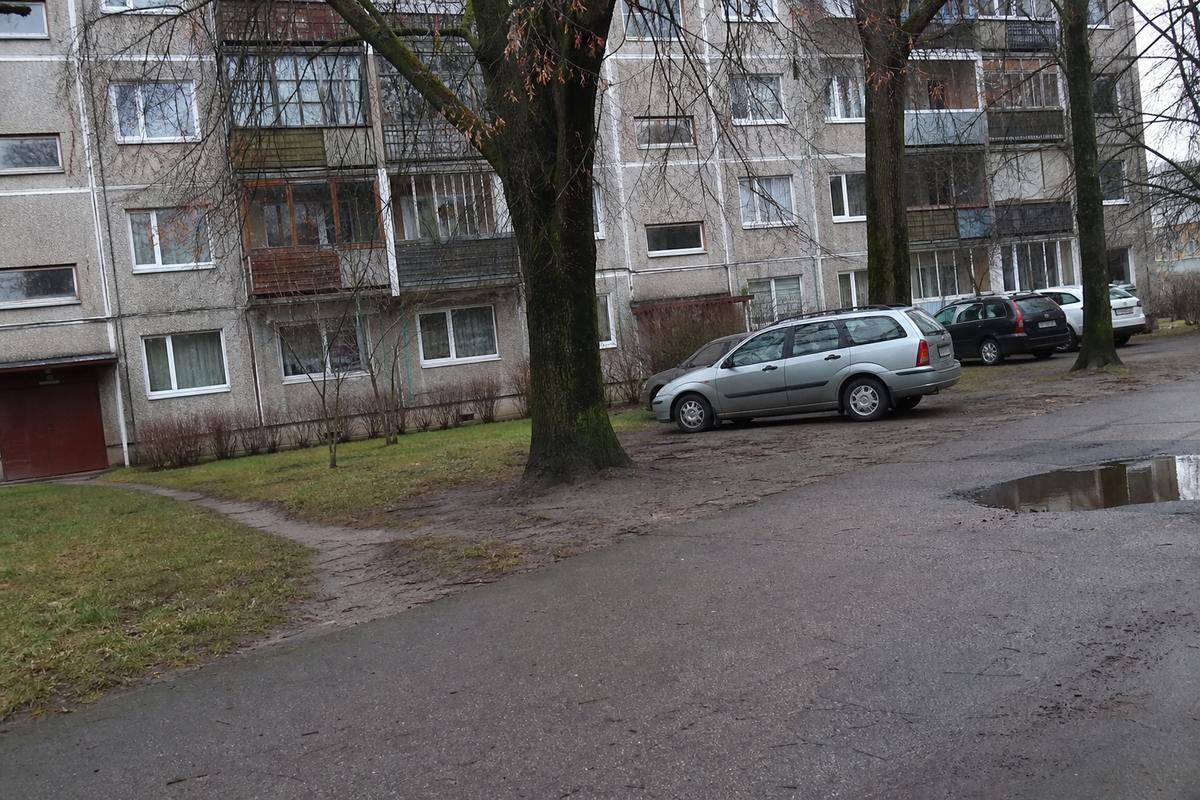
In Iļģuciems, Soviet-era housing estates stand alongside fragments of pre-war building, detached houses and industrial sites. In terms of trees that means very different conditions within a few hundred metres — and a different answer to the question of who orders the work.
The main affliction of city trees
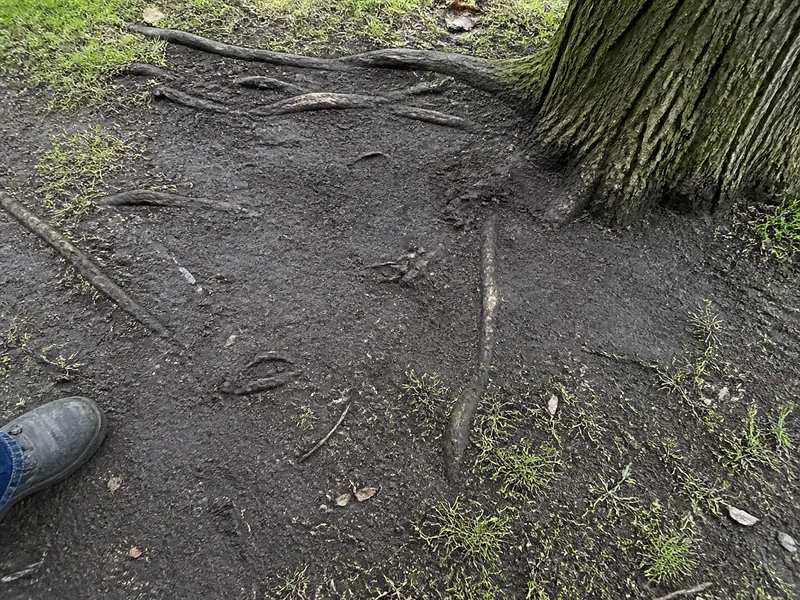
In Iļģuciems, as anywhere in a densely built urban setting, the commonest reason trees decline is not disease but compacted soil: paving, parking spaces, foot traffic and heavy machinery over the root zone.
The tree does not die from it straight away. It happens gradually — first a thinner crown, then dead branches in the top, and only after years does it become visible that the tree is failing. What can be done in this situation is described in the section on root and soil care. If work is planned nearby, the root zone is worth protecting in advance: root protection during construction.
Courtyards and old poplars
In the apartment block areas the trees are the same age as the buildings. The commonest enquiries are dead branches over a path, a crown over the roof and old poplars at the gable end.
The poplar is a story of its own: it grows fast, becomes large, and the inside of the trunk tends to rot sooner than you can see from the outside. So before any decision we look at the base of the trunk, at cavities and at bracket fungi. If there is rot, the method changes too — rotten tree removal is not the same as felling a sound tree.
Industrial sites
In the industrial part of Iļģuciems the work usually means a whole site: rows of trees along the fence, planting beside a car park, branches over an access road or a warehouse roof.
There are particular requirements here — a permit-to-enter regime, safety inductions, restrictions on where machinery may be set up, and often a time window in which the work does not disrupt operations. We agree all of that beforehand and, where needed, work outside business hours. More: commercial tree care.
The detached houses of Iļģuciems and the fragments of pre-war building
Between the apartment blocks in Iļģuciems there survive older pockets of detached houses with gardens planted well before them. There we more often work with overgrown apple and pear trees, with overgrown rows of thuja and hedging along the fence, and with limes or birches planted long ago at the corner of the house that have now grown up to the roof.
On their own plot an owner can decide a great deal for themselves. No permit is needed for fruit tree and hedge care, for deadwood removal or for crown thinning. A permit usually becomes relevant when a tree has to be felled entirely — and then we prepare the documents and settle it with the local authority on your behalf. How that works we have described in the section on the tree felling permit.
If a tree grows right on the boundary, or branches reach over onto the neighbour's side, we talk through which part belongs to whom before the work — the article neighbours' trees and liability is useful there. In old gardens fruit tree pruning is often a better fit than felling.
What happens to the timber and wood chip after a job in Iļģuciems
In the courtyards and narrow access roads of Iļģuciems there is nowhere to leave branches lying until next week, so we agree what happens to the material at the quoting stage, not on the last day.
The options are simple:
- We take everything away — branches and trunk rounds are hauled off and the site is left raked. This is what most apartment block courtyards choose.
- We leave the firewood with you — we cut the trunk to the length you need and stack it where you ask. Birch, oak and ash are worth it; poplar and willow have little value as fuel.
- We chip on site — the chip stays with you as mulch for beds and paths, or we take it away. Chipping needs somewhere the machine can be brought up to; if there is no such spot, we simply haul the branches away whole.
We do not recommend the timber of diseased trees as mulch and do not leave it in beds. More on both services — branch chipping and branch removal.
What we do in Iļģuciems
All of our services are available in Iļģuciems. The most requested in this neighbourhood:
- Dangerous tree removal — Dead, rotten, leaning and damaged trees. We assess first, then cut.
- Emergency tree removal — Fallen and broken trees after a storm — we come out the same day.
- Tree crown care — Crown shaping, thinning and deadwood removal.
- Stump grinding — Stump grinding without digging — the lawn is left almost untouched.
- Tree health assessment — Is the tree dangerous? We inspect it and tell you what to do.
- Branch and timber removal — Branch and timber removal, including where someone else did the cutting.
The full list with descriptions is in the services section.
How the work is done
- We get back to you within 5 min. Fill in the form and attach photos showing the tree at full height, its base and the route up to it. That is often enough for a rough quote.
- Assessment. We come back with an approximate price and method. If access in Iļģuciems is difficult, we come out to look before the work.
- Permit, if one is needed. We check whether the particular tree needs one in Rīga and file it on your behalf.
- The work. We agree a time, cordon off the working area and arrive with everything needed.
- Clearing up. We chip or collect the branches and take them away. We do not leave wood chip behind. If you want the firewood, we cut it to length and stack it where you ask.
What the price depends on in Iļģuciems
There is no flat rate per tree. In Iļģuciems our quote takes in the tree's height and girth, its species and condition, any rot in the trunk, the distance to buildings, the drop zone, whether climbing or machinery is needed, and the volume to be hauled away.
In Iļģuciems the price is influenced by how close machinery can be brought to the tree — in a courtyard or on an industrial site with restricted access, getting the material out takes longer than the cutting itself. We have put the full list with explanations on the prices page.