
First — which trees this page is about
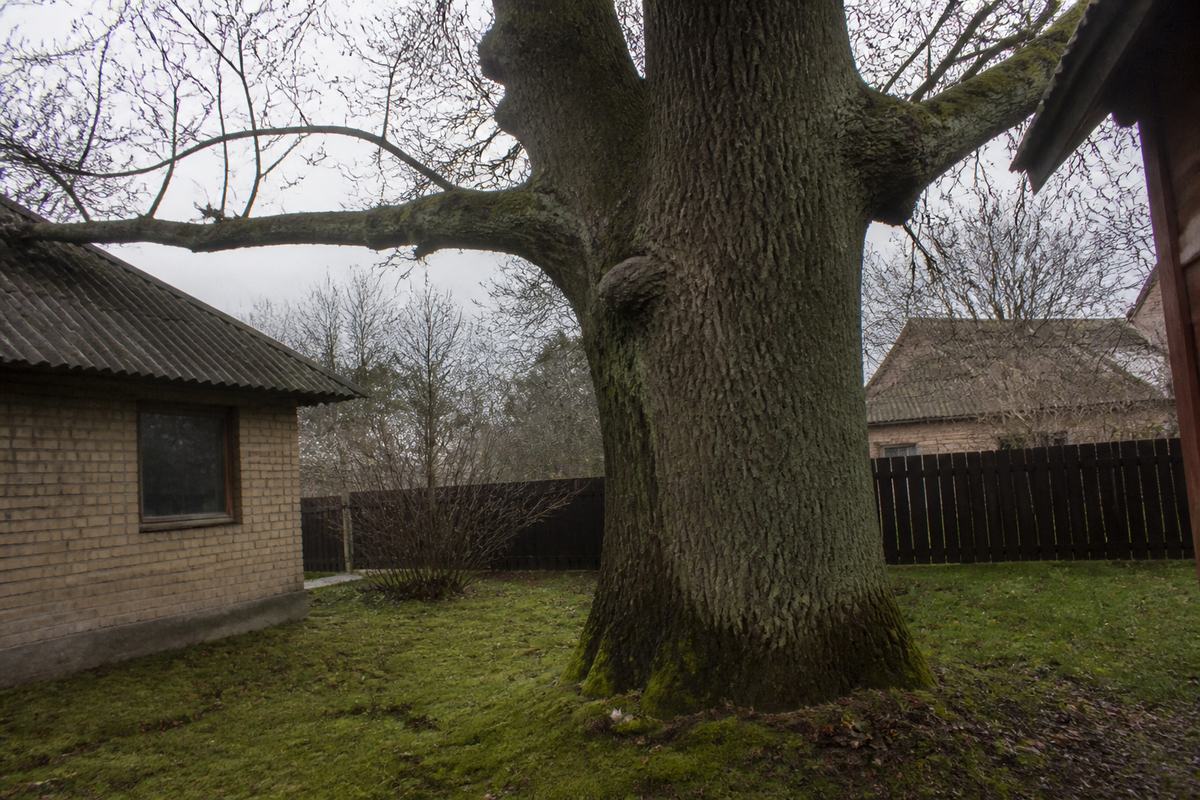
This page is about trees outside forest land: trees in a garden, in a courtyard, beside the house, on a building plot, on the grounds of an apartment block, on company land. These are the trees regulated by the local authority.
If searching for "tree felling permit" lands you on pages about felling sites, forest certificates and the State Forest Service (Valsts meža dienests), that is a different question — the management of forest land. That is about forestry operations, and the procedure is entirely different. We do not carry out forestry work. If your tree grows in a garden or a city block, read on. If your land is registered in the cadastre as forest land, this page will not help you, and you need to start with the forestry authority.
The basic principle
A tree on private property is not the same as a shrub or a flower bed. Trees outside forest land have a set procedure, because a tree affects more than your own plot — it casts shade, holds water, shapes the look of the street and is often older than the house itself. That is why the law accepts that an owner may not fell certain trees simply because they have decided to.
Whether a permit is needed is determined by several circumstances taken together:
- The size of the tree. A slender sapling and a thick old tree are not judged the same way. The threshold at which the requirement begins is set in the local authority's binding regulations.
- The species. Some species are judged more strictly; for others the procedure is relaxed.
- The location. It matters whether the tree grows in urban development, within a village, or on rural land, and whether it stands at the roadside, in a protection zone, in an area of cultural and historical value, in a specially protected nature area or in a cemetery.
- The condition of the tree. A living, healthy tree and a dead or dangerous one are usually dealt with under different procedures.
- The reason. Felling for construction, felling for safety and felling because the tree casts shade are not the same question.
So there is no single answer to "do I need a permit" that fits everyone. There is an answer for your particular tree at your particular address. The exact figures — the girth at which the requirement begins, the level of the fees — are published by each local authority itself, and it is worth checking them with your own authority rather than relying on a number read on a forum. We check this for you before we do anything.
The first question is "is one needed at all". Quite often it is not — and then there is nothing to arrange. The second most common answer is "yes, but under the simplified procedure". Only third comes the full process with valuation and payment.
The procedure differs between Rīga and the surrounding municipalities
This is the single most important fact on this page. The felling of trees outside forest land is governed by the local authority's binding regulations, and every local authority writes its own. That is why the following differ:
- the tree size at which the requirement for a permit begins;
- how compensation for the tree's value is calculated, and whether it is charged at all in a given case;
- whether the decision is taken by an officer or a committee, and how often that committee sits;
- in which cases a public consultation is held;
- what the procedure looks like for dead and dangerous trees;
- what is accepted as evidence — photographs, an inspection report, a boundary plan.
In practice this means that one and the same tree can end up in three different processes in Rīga, Mārupe and Ķekava. And that is why each local authority's website describes only its own procedure — nobody compares them.
We work in Rīga and within a 50 km radius, which includes Jūrmala, Mārupe, Ķekava, Salaspils, Ādaži, Olaine, Babīte, Piņķi, Baloži, Ikšķile, Ogre, Sigulda, Carnikava, Saulkrasti, Baldone, Stopiņi, Garkalne, Ropaži and Jelgava. That means this variation is everyday work for us, and we do not start from scratch each time.
How the process usually runs
The details differ, but the shape is mostly this:
Establish whether a permit is needed
Determine the species, size and location of the tree and compare them with your own authority's regulations. This step is often where the process also ends.
Application to the local authority
Submitted by the landowner or an authorised person. You normally state the property, the species and size of the tree and the reason for felling, and attach a site plan or photographs. In many municipalities this can be submitted electronically.
Inspection and assessment
A specialist or committee from the local authority looks at the tree and assesses whether the reason is justified and whether the tree could be retained by other means — through crown care, for example.
Public consultation, where one is required
For significant trees and trees in public space, some authorities hold a public consultation. This lengthens the process considerably, so it is worth knowing about at the planning stage.
Decision and conditions
A permit may come with conditions: a deadline, a requirement to plant replacement trees, a requirement to carry out the work outside the bird nesting season.
Compensation, where it applies
In some cases a payment for the value of the felled tree must be made into the local authority's budget. It is calculated by a formula taking in the tree's size, species, condition and location. For dead and dangerous trees it is often not applied.
Felling within the permit's validity
A permit has an expiry date. If it lapses, the process has to be started again.
What clients usually dislike in this chain is not the cutting itself but the institutional part. We handle the permit for you — we prepare the application, attach what is needed on the tree's condition and deal with the local authority. You do not have to go from office to office.
Dead, dangerous and storm-damaged trees
These situations are dealt with under a relaxed procedure almost everywhere, either because the tree is no longer a value worth retaining or because it poses an immediate risk.
- A dead tree. Compensation for value is usually not charged on a dead tree, but notification or approval is often still required — the authority needs to satisfy itself that the tree really is dead.
- A dangerous tree. If a tree has split or threatens to fall on a building, a road or people, waiting for a decision makes no sense, and the regulations normally allow immediate action with notification afterwards.
- A storm-damaged tree. After a storm local authorities usually work faster, but demand is high.
The most common mistake we see is cutting first and asking afterwards. If the tree turns out to be protected, or a permit was needed after all, the situation cannot be reversed — you cannot put the tree back. Before felling, photograph the tree from several sides, including the base and the defect. Photographs are later the only evidence of what condition the tree was in.
If you are not certain the tree really is dangerous, that can be established before you act — that is what a tree health assessment is for. Sometimes the answer is that the tree can stay and deadwood removal is enough.
Trees an owner may not fell at all
Some trees are protected in their own right — not because of where they grow, but because of how large they are. If a tree reaches a certain girth or height for its species it is a heritage tree (dižkoks), and felling it is no longer the landowner's decision. The protection applies to the tree regardless of who owns the land. There is a separate page on how this is measured and what is then possible: heritage and protected trees.
The bird nesting season
In spring and early summer birds nest in trees, and during this period tree felling and crown care are restricted. This is not a formality — destroying a nest containing chicks is an offence in itself, even if you hold a felling permit. In practice this means two things: planned work is better scheduled for autumn or winter, and applications should go in earlier than you think necessary. Winter is also the technically best time for trees — the crown is visible without leaves, and frozen ground lets vehicles get in without damaging the lawn. More on the seasons: when to prune trees. Emergency work is carried out at any time of year, but even then nests are checked for.
What happens if you fell without a permit
Felling a tree outside forest land without authorisation is an administrative offence. The penalty can be substantial, and it is often accompanied by a requirement to compensate the value of the felled tree — that is, a payment calculated from the tree's size and species, and for a large old tree that is not a small figure. We do not quote exact amounts, because they are set in legislation and change; the important point is that the sum is usually far larger than the cost of the felling work itself.
Offences are noticed more often than people expect. Most commonly they are reported by neighbours, or spotted by the local authority when something else on the property is being approved. A separate problem arises when someone fells a tree that does not belong to them or that grows on the boundary — then a civil dispute with the neighbour is added on top. We have written about that under neighbours' trees and liability.
What we do on your behalf
When we receive an enquiry we start with a check, not with an application. We establish the species, the size, the address and the procedure in the relevant municipality, and tell you one of three things: no permit is needed; a permit is needed and we will arrange it; or the tree is protected and the conversation needs to be about a different solution rather than felling. If a permit is needed, we prepare and submit the documents, and only once the decision has come through do we schedule the work.
How the permit affects the cost
Arranging the permit is part of the scope of work, and it is affected by how complicated the case is: whether the tree is alive or dead, whether an inspection report is needed, whether the local authority requires a public consultation and whether compensation for the tree's value applies. The price of the felling work itself is set by quite different factors — the height and girth of the tree, the location, vehicle access, whether we have to climb or use a platform, and how much brushwood has to be taken away. We have set out how we calculate all of this on the prices page. In your enquiry it helps to give the address straight away and attach photographs showing the tree at full height and its base — then the answer about the permit can be more specific.