
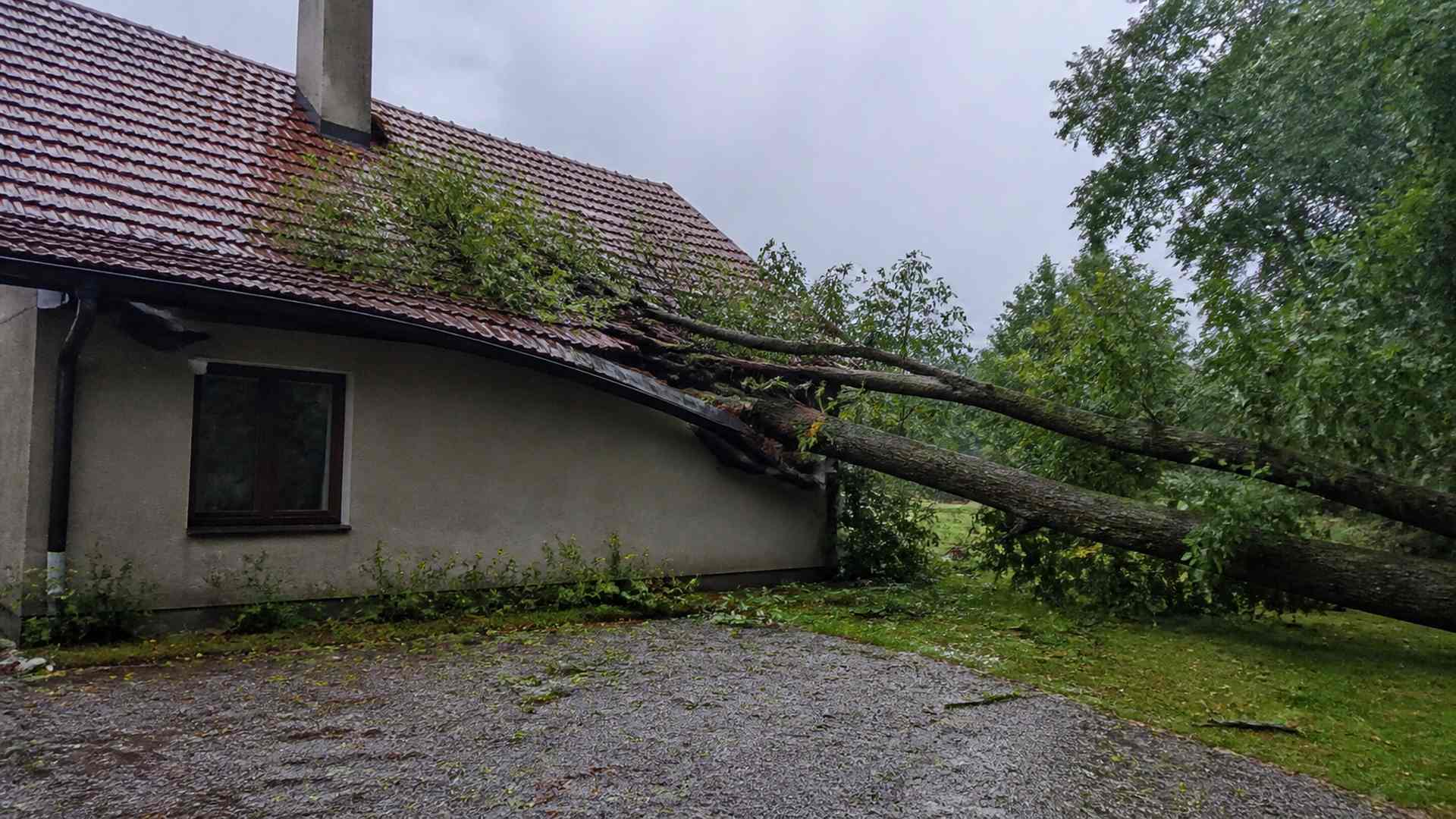
Two completely different kinds of lean
| Grown leaning | Started to lean | |
|---|---|---|
| Trunk | Often curved — the top straightens up again and reaches for the sky | Straight, but the whole tree has tipped |
| Ground at the base | Level, turf unbroken | Cracks, turf lifted on one side, a hollow on the other |
| Roots | Anchored asymmetrically, thick roots visible on the side opposite the lean | Roots torn or lifting out of the ground |
| How dangerous | Normally stable | Can become acutely dangerous |
A tree that has grown leaning — reaching for light away from a building or out from the edge of a wood, say — has compensated for its own weight by growing thicker roots and denser timber on the side where they are needed. Such a tree isn't dangerous merely because it leans.
If the tree has tipped after a storm, or if you can see fresh cracks in the ground or lifted turf at the base, it means the root system has already partly failed. A tree in that state can come down without warning and without any wind. Don't stand under it, and request an emergency call-out.
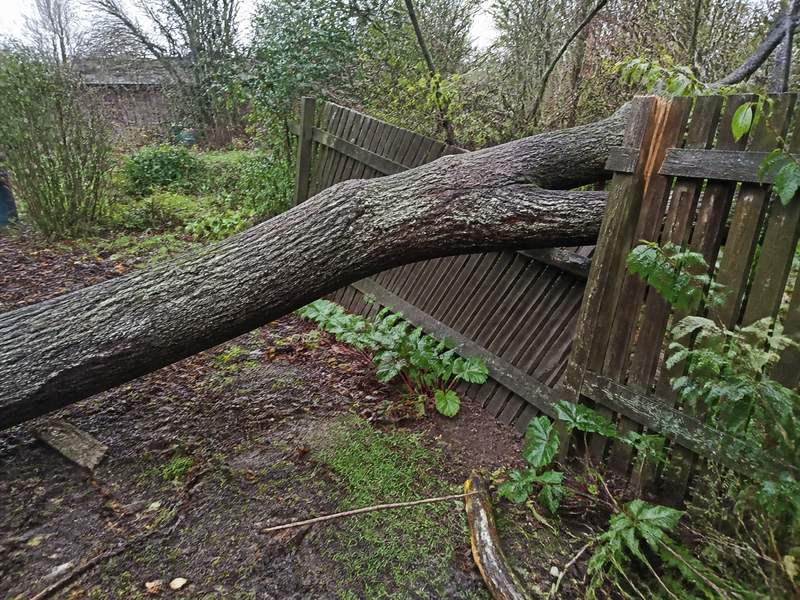
What causes a new lean
- Root failure. Decay in the root zone or at the base of the trunk — the most common cause.
- Excavation near the tree. A trench for services, foundation works, paving. Roots severed on one side take away the tree's anchorage exactly where it is needed.
- Waterlogged ground. Prolonged rain softens the soil and the tree slips.
- Wind after surrounding trees have been cleared. A tree that grew in a group is suddenly on its own and unaccustomed to the wind load.
- Compacted soil. Machinery or constant foot traffic around the tree — see root and soil care.
How to check for yourself whether the lean is increasing
You cannot judge it by eye. A lean increases by a few centimetres a year, and someone who sees the tree every day adjusts to it — after five years it looks normal. So you need a reference point that doesn't move itself.
The simplest method is a photograph. Photograph the tree once a year from exactly the same spot — mark it, at a corner post or a particular paving slab, say — and make sure a house wall, a fence or a post is in the frame. The tree itself looks different every year because the foliage changes, but the line of the trunk relative to the edge of the building is comparable. Best done in winter without leaves, in the same month each time.
The second thing, and in practice the more important: look not at the trunk but at the ground at the base. The trunk tips last. The root plate moves first, and that leaves marks in the ground. If year after year the turf at the tree is level and unbroken, the tree is standing. If something new appears there, that is a signal even when the photographs show no change at all.
What to look for at the base and in the root plate
The root plate is the slab formed by the thick roots with the soil between them. If a tree starts to lean, that slab rotates, and it does so visibly. These are the signs to look for:
- Cracks in the ground in an arc. Not a single straight crack but several short ones together forming an arc around the trunk — and they appear on the side opposite the lean, where the ground is being pulled upwards. This is the most telling sign there is.
- Lifted turf on one side. The soil or turf on the side against the lean has risen, sometimes as a low ridge. Occasionally you can get a hand underneath it.
- A hollow on the leaning side. On the opposite side the ground has settled and the trunk seems to have pressed into the earth. Water often stands there.
- Roots that are moving or torn. A visible root arched up out of the ground, or a fresh break showing pale timber.
- A gap between the trunk and the ground. The point where the trunk enters the ground is no longer closed tight.
These signs are often hidden by grass, leaves or mulch, so when we survey we check the turf around the base by hand, not only by eye. Decay at the root collar produces these same signs with no wind involved at all — see rotten tree removal.
What can be done
If the lean is natural and the tree is healthy, usually nothing needs doing at all. If the crown has grown heavy, reducing the weight of the crown sometimes helps — less leverage, less load on the roots.
It is worth being precise about what crown reduction does and doesn't achieve, because this is often taken too broadly. What it does: a smaller, thinner crown catches less wind and weighs less, so the turning force on the roots is lower. For a tree that is still standing firm, that is useful — the load comes down and the tree stays. What it doesn't do: it does not restore anchorage that has already been lost. If the roots are torn or decayed, shortening the crown will not grow those roots back. Such a tree goes on leaning, only more slowly. So reducing the weight is a solution for a stable tree, not a way of keeping a tree whose root plate is already moving.
If the root system has already failed, putting the tree back is not possible. Then the only safe answer is removal, and it should be borne in mind that a leaning tree is harder to fell — it already has a set direction of fall, and that isn't always where the clear space happens to be.
Why a leaning tree isn't easier to fell
Logic would suggest the opposite: the tree is halfway there already, so surely you just make the cut. In practice that is exactly what makes the job difficult.
With a straight tree the feller chooses the direction of fall — the weight is centred, and with a face cut and wedges the tree can be turned towards wherever there is space. With a leaning tree the direction has already been decided, and the tree decided it. It will fall the way it has tipped, and it cannot be felled against that without additional equipment. Often that side is precisely where the house, the fence or the street is — because otherwise this tree wouldn't be a problem in the first place.
The second difficulty is that the trunk of a leaning tree is under tension. The underside is in compression, the upper side in tension, and cutting releases it. A cut made in the wrong order means the trunk splits lengthways or kicks sideways — and that happens faster than a person can step back.
So leaning trees near buildings are almost always lowered in sections: the crown comes off from the top piece by piece, and the trunk is shortened in stages until what remains can no longer reach anything. If the tree is so unsound that climbing it isn't acceptable, we work from a platform, where the tree doesn't have to serve as a support. Either way the work takes longer than a simple felling, and that is one of the factors affecting the price — we have explained the rest on the prices page. For an assessment, two photos are most useful: the tree at full height from the side, and the base with the ground around it.