
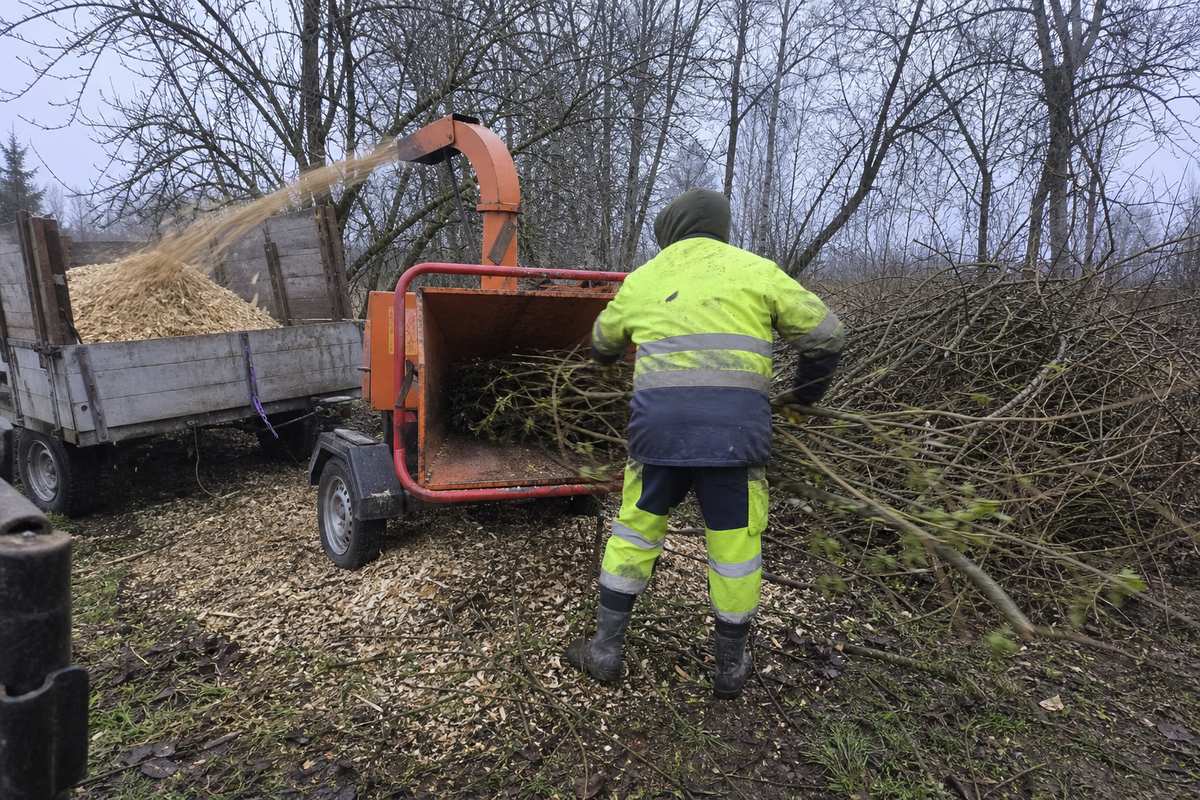
How it works on site
We position the chipper as close as possible to where we are working and turn the discharge chute straight into the trailer. The cut branches travel by the shortest possible route: from the ground into our hands, from our hands into the machine, from the machine into the trailer. When the job is finished the trailer leaves full, and there is neither a pile of brash nor a mountain of wood chip left in the garden.
That is worth stating plainly, because it isn't a given. We take the chip away. We don't leave it in the garden, we don't spread it on the beds, and we don't offer it to you as material that "might come in handy". If the job ends with a heap you have to deal with yourself, the job isn't finished.
Why chip rather than cart branches away whole
A pile of branches is almost entirely air. A crown that fills three full trailer loads as whole branches fits into one once it is chipped. Everything else follows from that:
- Fewer trips. One trailer load instead of three means less time and a smaller haulage element in the quote.
- No branches dragged across the lawn. Whole branches have to be pushed and dragged to the trailer, which leaves ruts in the lawn and scratches on the paving. The chipper works right where the branches land.
- Less space taken up during the work. If branches are stockpiled and only cleared afterwards, the garden is full for half the day. Chipping makes them disappear as fast as they are cut.
- Tight gardens. In places without proper vehicle access, carrying branches out by hand through a side gate is an hour's work. Chip goes out along the same route far faster.
What goes through a chipper and what doesn't
A chipper is a machine with blades, and the blades are its weak point. So we sort the material rather than throwing everything in.
| Material | Into the chipper | Why |
|---|---|---|
| Branches with leaves and needles | Yes | Ideal material. Foliage takes up a great deal of space and is what shrinks most in chipping. |
| Moderately thick timber | Yes | Branches and thinner sections of trunk go through without trouble. |
| Freshly cut branches | Yes | Green wood cuts more easily than dry, brittle wood. |
| Thick trunk sections | No | We cut these into firewood or take them away whole. They are too thick for a chipper. |
| Roots and stumps with soil on | No | Soil, gravel and stones among the roots destroy the blades within seconds. |
| Stones, metal, wire | No | In old gardens branches often have wire or nails grown into them. That is why we look the material over. |
| Building rubble, boards with nails | No | It isn't tree material and we don't take it at all. |
If you already have a pile in the garden where branches have got mixed up with soil, stones or an old fence, say so in your enquiry. A pile like that is usually better taken away whole than put through a chipper.
A chipper at work makes the same sort of noise as construction plant. The good news is that it is short: even after taking down a large tree, chipping usually lasts under an hour, not all day. If you live in a terrace or in an apartment block courtyard, it is worth warning the neighbours beforehand — and telling them it is for an hour, not for a day. Children and dogs should be kept indoors while we work, not because there is any danger in watching from a distance, but because nobody who isn't operating the chipper should be anywhere near it.
Can chipping be booked on its own?
Yes. If you have cut down a hedge, thinned shrubs or taken out a few trees yourself and there is a pile of brash in the garden, we will come and chip it. In that case it is worth describing the pile in your enquiry: how big it is, how thick the branches are, how long it has been standing there, and whether soil has got in among the branches. A year-old pile that has grown into the grass chips less well than a fresh one.
If you are planning a larger job — clearing a whole site or removing several trees — chipping is part of the work there and doesn't need booking separately.
What the price depends on
The chipping element of a quote is set by the volume of material, its type and the access. What matters is how far the branches have to be carried to the machine, whether the trailer can stand at the work site or has to be left on the road, how thick the material is, and whether there is anything in the pile that has to be sorted out. If the work is part of a tree removal, disposal is already included in the quote. The factors affecting the overall price are set out on the prices page, and we can give a more accurate estimate from a few photos — send us an image showing the whole pile and the route to it.