
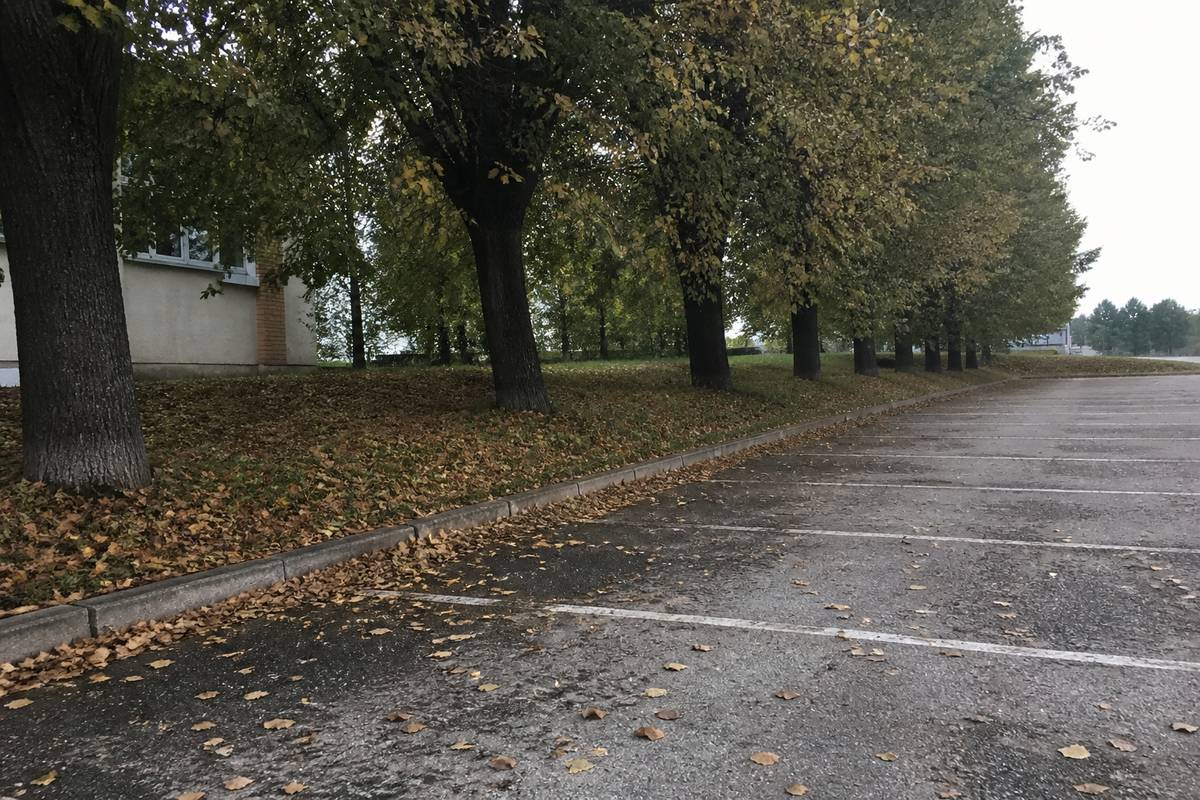
How working for a business differs from working at a private house
The kit is the same — saw, ropes, platform. Everything else differs, and it is usually that everything else which gives a managing agent more trouble than the tree work itself.
- There are many trees, not one. At a private house the question is about one particular tree. On a commercial site the question is which of fifty trees need attention this year and which can wait.
- A written report is needed. A verbal recommendation is no use if the decision has to be taken by somebody else or the expenditure has to be justified. After the survey we prepare a schedule: the tree, its condition, the work recommended and how urgent it is.
- The working hours have to fit the site. In an office car park the work goes ahead early, before people arrive; in front of a shop, not at Friday lunchtime; at a school, in the holidays or at a weekend. We agree that in advance, not on arrival.
- We are dealing with someone who is not the owner. A managing agent, a site manager or a procurement officer — somebody who has to account for it further up. So we write our explanation in a form that can be passed on without us being there.
- An invoice to the company. We work with corporate clients and issue an invoice with payment terms.
Why it is worth knowing the condition of the trees in advance
An organisation responsible for a site is also responsible for what happens on it. If a branch or a tree comes down and damages something, the first question is always the same one: was the condition of the tree known, and was anything done about it? There are only two possible answers to that question, and only one of them is a good one.
So a survey is not a formality. It is the only practical way of turning “we've got some old trees, I think” into a schedule that shows clearly which trees are fine, which need monitoring and which have to come down in the near future. Once that is written down, the decision can be taken calmly and in your own time. Until it is written down, the timing of the decision is usually chosen by a storm.
A large share of surveys end with most of the trees staying. We have no interest in recommending more work than is needed — a healthy tree felled on a site is shade lost, an outlook lost, and an irreversible decision. More on the process: tree health assessment.
Who we work for
Managing agents and residents' associations
Courtyards with old trees, where branches reach the windows and the parking spaces. Here the main question is often not a technical one but an organisational one — who is actually entitled to order the work. We cover that separately: tree removal in apartment block courtyards.
Offices, retail and business parks
Sites with people and cars present at all times. We phase the work so that only part of the car park is closed at any one time, and we schedule the larger jobs outside business hours.
Local authorities and public institutions
Schools, nurseries, sports and recreation grounds, roadside trees and avenues. Where a site is used by children, the requirements on deadwood in the crown are stricter than in a private garden, and deadwood removal is often the only work required.
Industrial and warehouse sites
Trees along fences, access roads and lighting columns. Often a belt of scrub has grown up along the perimeter too, which in time calls for site clearance.
Cemeteries
A distinct kind of work, because there are memorials beneath the trees that must not even be touched. On the method: tree removal in cemeteries.
Construction firms
If the building consent requires trees to be retained, they have to be protected until the work is finished — and most trees damaged on a building site die not from a branch being broken off but from the root zone being compacted. On that: root protection during construction.
How the work usually proceeds
1. Survey on site
We walk the grounds and inspect every tree standing near buildings, paths, car parks or play areas.
2. Report and schedule of works
You receive a written summary — the condition of the trees, the work recommended and its urgency in three groups: now, this year, later.
3. Approvals and permits
If any tree requires a felling permit from the local authority, we handle the permit for you. We agree the working hours and which areas will be closed temporarily.
4. The work and the clear-up
We chip or collect the branches and take the wood chip and branches away — we do not leave them on site. When the work is done we hand the area back in a state where it can be used straight away.
5. Ongoing monitoring
If there are a lot of trees on the site, it makes more sense to agree a regular survey and a plan spanning several years — a tree care contract.
The work we carry out on commercial sites
- Removal of dangerous, dead and decayed trees — in confined spaces, in sections using rope access.
- Crown care and thinning, and deadwood removal from rows of trees and avenues.
- Clearing branches away from roofs, light fittings and camera sightlines.
- Stump grinding, so the spot can be turfed over or paved.
- Root zone care where the ground has been compacted and the trees are suffering as a result.
- Storm call-outs — emergency tree removal.
After a storm we come out the same day wherever that is possible — honestly, that depends on the time of day, the weather, and how many call-outs there are at that moment. If there is a direct threat to people on the site, say so in your enquiry straight away.
What the price depends on
There is no flat price per site, because two areas of the same size can call for entirely different work. The price is affected by the number and size of the trees, how many of them need any work at all, whether they stand in the open or between buildings, whether climbing or a platform is required, what the access is like, how much brash has to be taken away, whether the work has to be done outside normal hours, and whether permits are needed. The factors are set out with explanations on our prices page.
For commercial sites we normally prepare the quote after the survey, because only then is it known what is actually needed. If you need a rough figure for budgeting sooner than that, describe the size of the site and the number of trees in your enquiry.
What we do not do, and what we do not promise
Trees near power lines remain the responsibility of the network operator — only they may work on live conductors, and we do not climb there. What to do in that case is set out under tree removal near power lines. And one more thing: we do work on business and institutional sites, but we do not name particular clients or sites. That is our clients' information, not our advertising material. If you want to understand how we work, ask about the work itself — we will explain it down to the last detail.