
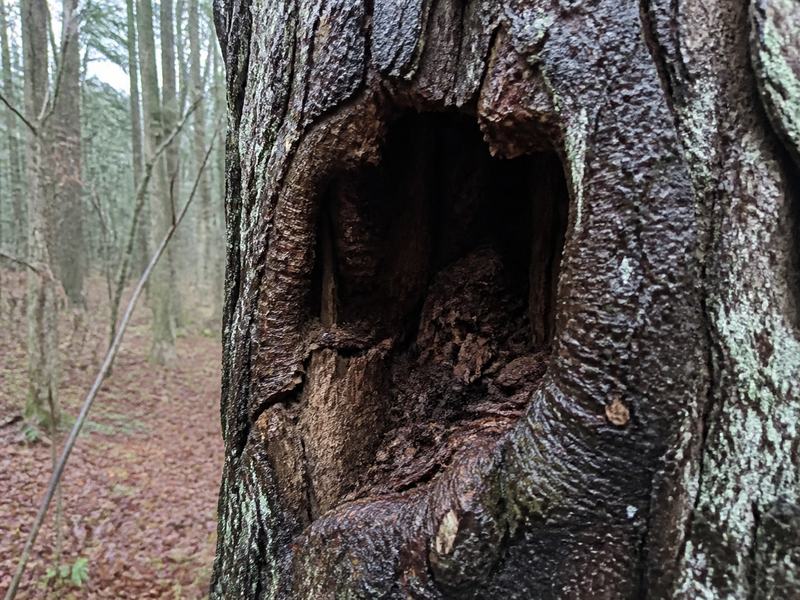
Why decay changes everything
Felling a healthy tree depends on the fact that, after the face cut, an uncut band of timber remains that acts as a hinge and determines which way the tree will fall. That hinge is all the control the feller has.
If the timber in the trunk has decayed, the hinge may not hold. The tree can:
- start to fall before the cut is finished;
- turn and fall in a different direction from the one planned;
- break somewhere up the trunk instead of falling in one piece;
- collapse on the spot as soon as it is touched.
The same applies to climbing. An arborist will not climb a tree whose timber cannot be trusted — which is why for rotten trees we often use a platform, working from which the tree doesn't have to serve as a support.
How decay starts and how it spreads
Decay doesn't begin of its own accord. The timber of a healthy tree is covered by bark and, behind it, living tissue, and fungi cannot get in through them. Decay almost always starts where that protection has been breached:
- A broken branch left exposed after it snapped. The most common way in.
- A badly made pruning cut — too close to the trunk, or leaving a thick stub that never heals over.
- Bark damage from a mower, a car, building work or a strimmer at the base.
- A severed or crushed root, after which decay enters from below ground.
- A crack between two stems where water collects.
From that entry point decay travels mainly lengthways — up and down the trunk rather than outwards in a circle. So typical decay isn't a uniformly rotten trunk but a column of soft or hollow timber up the middle, around which the tree goes on adding new, sound annual rings. The tree fights back: it forms barriers around the damage that limit the decay, and it lays down extra timber on the outside where the loads are greatest. That is why an old tree with a cavity can be perfectly stable — the weight is carried by the outer shell, not by the middle.
So the critical question isn't “is there decay in the tree” but how thick the ring of sound timber around it is, and whether that ring is continuous. An even ring of adequate thickness holds. A ring that is thin on one side, or broken by a crack or an opening, is the one that fails — and it fails on exactly that weak side.
Where the decay is — that changes everything
| Location | What it threatens | How significant |
|---|---|---|
| In the root zone and root collar | The tree's anchorage — it can go over complete with the root plate | The most serious of all. Not visible and not testable from outside |
| Lower trunk | The trunk breaking at the base, where the whole weight of the tree and all the wind leverage act | Very significant |
| Mid trunk | The trunk breaking, but under less load than at the base | Significant, depending on the weight of the crown above it |
| High in the crown, in a single branch | One branch falling | Less significant to the tree, but important to whatever is below |
The reason is simple — leverage. At the base the timber carries the whole weight of the tree and all the wind pressure from the entire crown, so decay there directly reduces what holds the tree upright. Eight metres higher up, that same decay carries only what is above it. So a cavity at ground level is an entirely different question from an equally large cavity high in the trunk, even though the two look identical.
The worst case is decay in the root collar and roots, because it isn't visible. A tree with a sound, thick trunk can go over completely if the anchoring roots have rotted. That is why, when we survey, we always start at the base and the ground around it rather than at the crown — more under tree health assessment.
How we assess decay
Outwardly a tree can look entirely normal even when the inside is hollow. The signs we look for:
- Bracket fungi and other fungi on the trunk or at the base — the most telling sign. More on this: bracket fungi on trees.
- Cavities and openings, particularly near the base.
- Bark that is lifting or falling away in large pieces.
- Sound. Struck with a rubber mallet, a decayed area rings hollow.
- Soft timber that can be pressed in.
- Ants and wood dust at the base.
What sounding tells you and what it doesn't
The sounding test — striking the trunk with a rubber mallet and listening — is an old technique and still a useful one, but it is worth understanding what it actually gives you. Sound timber answers with a short, dense note. Where there is a cavity or badly decomposed timber behind the shell, the note is lower and hollow. Walking round the trunk and striking in several places and at several heights, you can establish fairly reliably where and how far the void extends.
What sounding doesn't tell you: how thick the ring of sound timber around the void is. That is precisely the figure that determines whether the tree holds, and the sound doesn't give it. It also misses early decay, where the timber is still firm but already weaker, and it gives no information at all about the roots — you cannot strike the ground. So sounding is one sign among many, not an answer. In practice we decide on the whole set of signs: what species the fungus is, where it is growing, how extensive the void is, the condition of the crown, how heavy it is, and what lies within the tree's fall zone.
What this means on the job
- We plan a wider safety zone than for a healthy tree.
- We use machinery rather than climbing more often.
- We work in smaller sections.
- We don't leave a rotten tree part-felled overnight.
The smaller sections are worth explaining, because it is counter-intuitive — a rotten tree is lighter and softer, yet it has to be cut more cautiously than a sound one.
The reason is that in a healthy tree every cut does exactly what you expect of it. In a rotten tree it doesn't. If the middle of the trunk is hollow, the face cut leaves only two narrow patches of timber at the sides, and those can break before the cut is finished — the tree goes on its own, and where it likes. Nor can you rely on a piece carrying its own weight while it hangs on the rope: a decayed section can break in the middle, and then half of it flies off uncontrolled. And what cannot be determined from the ground at all is that decay in a trunk usually extends higher than the external signs suggest.
So we work on the assumption that the decay is more extensive than what can be seen. Every section is small enough to hold even if the timber in it turns out to be worse than expected, and light enough that its weight doesn't exceed what the lowering system will safely stop. That means more cuts and a longer job, and it is one of the reasons a rotten tree costs more than a sound tree of the same size — which, along with the other factors, we have explained on the prices page.
Trees live with cavities for decades. What matters is how much sound timber is left around the cavity and where it is — a cavity at the base of the trunk is far more significant than the same cavity high in the crown. Old trees with cavities are also valuable habitat. If the tree threatens nobody, the right decision is often to leave it and monitor it — we'll tell you that at the survey.