
Let's start with what usually goes unsaid
Mature trees in ordinary garden soil usually do not need fertilising. A tree is not a flowerpot. Its roots spread over a wide area — often twice as wide as the crown — and gather nutrients from a far greater volume of soil than any fertiliser mix can reach. The leaves that fall in autumn close that circle again in nature.
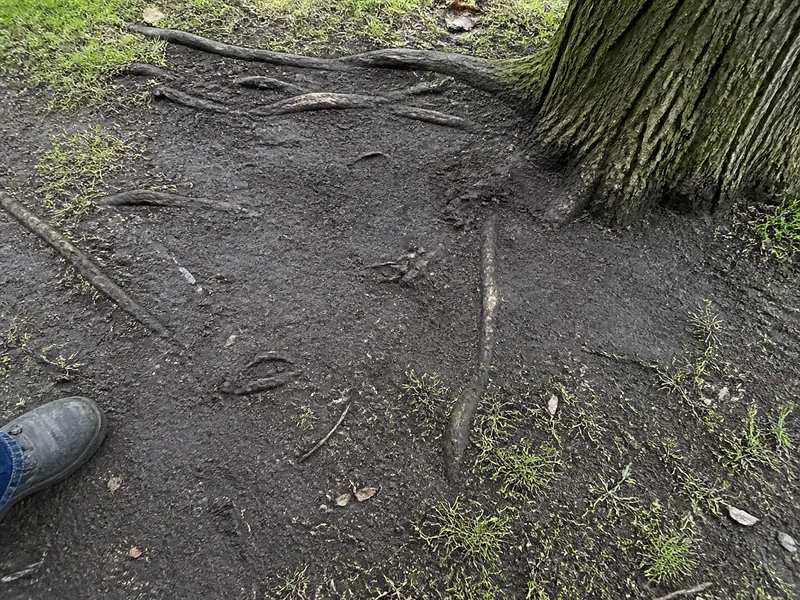
So when a tree looks unwell, fertiliser is almost never the first answer. The most common real causes are compacted soil, severed roots, a changed ground level, drought, or decay in the trunk. None of those is a nutrient problem, and none of them will be improved by feeding.
When fertilising genuinely helps
- A confirmed nutrient deficiency. Not a guess based on the look of the leaves, but a proper check on the condition of the soil. If a specific nutrient is lacking, adding it works.
- Young trees establishing. In the first years after planting or transplanting, a tree's root system is still small and does not reach far. Support is justified here.
- Very poor or disturbed urban ground. Trees in paving pits, car park islands, made ground or soil mixed with construction rubble are growing in a substrate that is not really soil. The natural cycle does not operate there.
- Trees recovering from damage. After root damage or heavy loss of crown — but only once the cause has been removed and the tree has already stabilised.
When fertilising does harm
Nitrogen pushes a tree into new leaves and shoots. A tree suffering from drought, compacted soil or lost roots has nothing with which to supply that new growth — it is already short of water. The result is that the tree spends its last reserves on tissue it cannot sustain, and becomes weaker rather than stronger. What is more, soft new shoots are exactly what pests and diseases attack first.
The second common harm is excess. Too much fertiliser damages the fine roots — it scorches them — and the surplus nitrogen leaches away into the groundwater. Another mistake is feeding the lawn beneath a tree with lawn fertiliser: it is a mix of quite different proportions, and the tree does not receive it, though it does feel the consequences.
Diagnosis before fertilising
The order is always the same. First we establish why the tree looks unwell — we do that in a health assessment: we examine the base of the trunk, the root zone, how hard the soil is, the ground level and the crown. Only then do we decide what to do.
In practice the answer is more often to improve the soil conditions than to add nutrients. If the soil is hard, the roots cannot work no matter how much nutrient is present. So the first job is usually to decompact the soil and mulch the root zone — see root and soil care. We bring the mulch with us; branches and wood chip from tree work we take away.
In many of the cases where we are called out to fertilise a tree, we advise against it. Either the tree is fine, or it has a different problem that needs solving first. Saying so is more honest than selling a bag of fertiliser that will change nothing.
When to fertilise
If fertilising is justified, the best time is spring — from the point the ground has thawed until the new shoots develop. That is when the tree genuinely uses the nutrients. Late summer and autumn also work, when the tree is no longer putting out new shoots but the roots are still active and building reserves.
Do not fertilise in midsummer during a drought — without water the nutrients are not taken up, and nitrogen at that moment does the most harm. Nor should you fertilise in the second half of summer in a way that pushes the tree into new growth: it will not survive the first frost.
What the price depends on
The price is set by the number and size of the trees, the area of the root zone, whether a check on the condition of the soil is needed, the method chosen, and whether the soil is decompacted and mulched alongside the feeding — which is most often the work that produces a real result. There is more on what makes up a quote on our prices page. In your enquiry, describe what you have noticed and how long ago — often that alone shows the problem is not one of nutrients.