
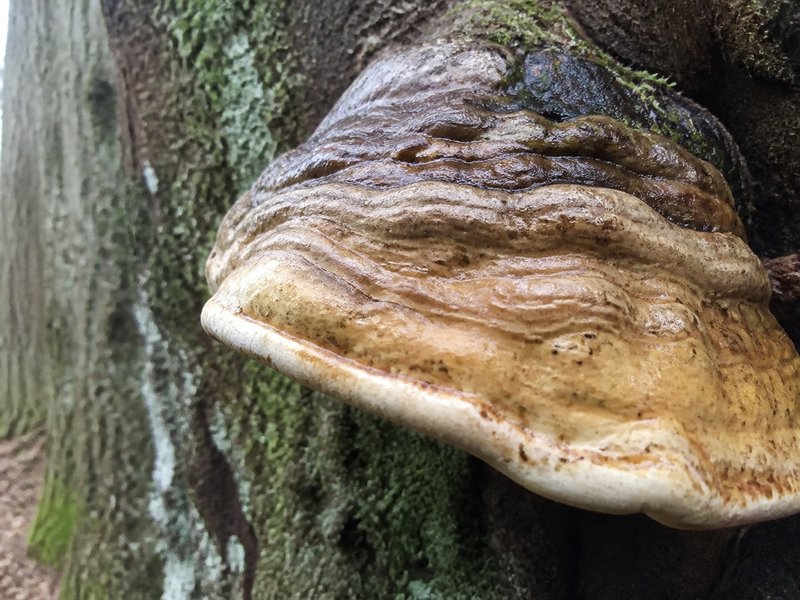
What a bracket fungus actually means
The most important thing to understand: the visible bracket is the fungus's fruiting body — the same thing as a cap on the ground in a wood. The fungus itself is inside the wood, and it has been there a long time before anything became visible on the outside. The fruiting body appears once the fungus already has enough nourishment inside.
So the question is never "how big is the bracket". The question is "how much of the wood inside has already been broken down". A small, inconspicuous bracket at the base can mean more than a large, obvious bracket on a dead branch ten metres up.
And one more thing, which reassures more often than people expect: the fungus in itself does not kill a tree quickly. It breaks down the wood, and meanwhile the tree carries on growing. The problem is not disease — the problem is strength. A tree with a decayed base can look perfectly green and healthy right up to the day it fails.
Position decides almost everything
| Where the fungus grows | What that usually means |
|---|---|
| On the root flares or in the ground at the base | The most serious position. The part that holds the tree upright and carries the wind load is affected. Calls for inspection. |
| On the base of the trunk, up to about knee height | Serious. This is where the whole load of the tree is concentrated. |
| On the middle part of the trunk | Significant, but less critical. How extensive and how deep it is matters. |
| In a branch fork or on an old pruning cut | Often indicates decay in that particular union. May mean losing the branch, not the tree. |
| On an already dead branch in the crown | Most often not a concern. The fungus is doing what it is meant to — breaking down dead wood. |
| On a stump or near fallen timber | Not connected with the living tree. No cause for concern. |
The reason is mechanical, not biological. In wind a tree works like a lever: the greatest load is where the trunk enters the ground. If the wood is broken down at precisely that point, the tree can fail completely unexpectedly. Decay in a branch that is dead and ought to be removed anyway, by contrast, does not affect the tree's strength.
Fungi on dead wood, and fungi that break down a living tree
This distinction determines how much to worry.
Fungi on dead wood
These grow on stumps, fallen trunks, dead branches and dead patches of bark. They cannot attack living wood and do not affect the tree's strength. If a bracket is growing on a stump beside a tree, or on a dead branch in the crown, it is not a sign about the tree itself.
Fungi that break down living, load-bearing wood
These get in through an injury — an old cut, a torn-out branch, a bark wound, a severed root — and break down wood that is still performing a load-bearing function. These are the ones that matter. Outwardly the tree may be in full leaf and handsome, while the inside of the trunk is already hollow.
In practice there are intermediate cases between these groups, which is why identifying a fungus from a description does not work. A bracket of the same shape on two different species means two different things.
It cannot be assessed without an inspection
Identifying a fungus requires seeing the particular tree. The species matters, as do the shape and surface of the fruiting body, whether it is fresh or several years old, how it is joined to the wood, and what is happening at the base of the tree around it. None of this can be described in words reliably enough to be depended on.
What to photograph
The fungus close up
From a few tens of centimetres away, so that the upper surface, the underside and the point where it joins the tree are all visible. You can put something familiar beside it — keys, for instance — so the scale is clear.
The position on the tree
A step back: at what height it grows, how close to the ground, whether on the trunk or on a branch. If there are several fungi, photograph each one.
The whole tree
At full height, from a distance, so that the crown, any lean and what stands around the tree are visible. This image often decides more than the picture of the fungus itself.
The base and the ground around it
Whether the turf has lifted, whether there are cracks in the ground, whether the bark at the base is sound.
These images can be attached to the enquiry form. From them we can usually tell you whether the matter is urgent, and whether a site visit is worth making at all.
A fungus does not mean automatic felling
Decay in trees is natural. In old park and woodland-edge trees it is almost always present, and they stand for decades. A bracket fungus in itself is not grounds for felling — nor do we recommend it merely because a fungus is visible.
One thing changes the decision: what lies in the tree's fall zone. The same bracket on the same tree means entirely different things depending on the location. A tree at the edge of a field with a decayed base can stand for as long as it holds — if it fails it endangers nobody, and the wood of a dying tree is valuable habitat. The same tree two metres from a child's bedroom window or over a parking space is a different conversation.
In practice our recommendation is usually one of three: leave it and check again in a year; reduce the weight of the crown and the wind load by thinning, so the tree can be kept longer; or remove it, if there is no longer enough sound wood left and there is something important beneath the tree. We have described the full course of an inspection on the page about tree health assessments.
What not to do
- Do not knock the bracket off. It does not eliminate the fungus — that is inside the wood — and it merely removes the most important sign by which the condition can be assessed. If you have already broken it off, keep it and photograph it.
- Do not fill cavities. Cement or foam in a cavity does not stop decay, holds moisture in and makes inspection impossible.
- Do not drill the trunk to check. Every new hole is a new route for the fungus to get in.
What the price depends on
The cost of an inspection is set by the number of trees, the distance from Rīga, whether we have to climb into the crown and whether a written report is required. If work follows the inspection, the price is affected by the height and condition of the tree, its proximity to buildings and cables, and how much timber has to be taken away. The factors are explained on the prices page. If it is clear from your photographs that there is no cause for concern, we say so and do not propose a visit.