
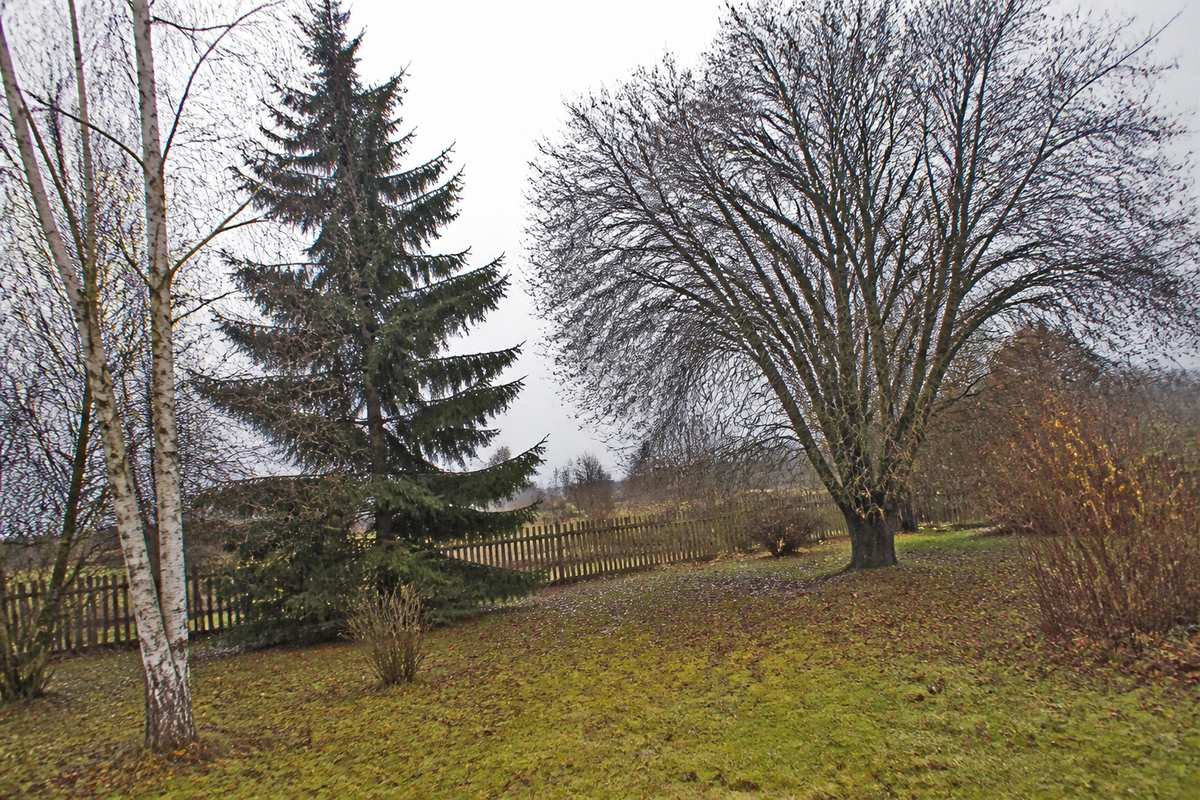
The building pattern in Berģi is scattered and green: detached houses on larger plots, newer developments and roadside premises along Brīvības gatve, and around all of it forest and the country near Lake Jugla. In practice that means that on many properties the tree was never planted in a garden — it is left over from the forest.
Forest trees in a private garden
When a plot for a house is cleared out of woodland, the remaining trees are left exposed. A pine or a spruce that used to hold against the wind together with the whole stand now takes the load alone — and it is precisely these trees that blow over most often in the first years after building.
Spruce is the riskiest here: shallow roots, sensitivity to drought and to the bark beetle. If a few tall spruces have been left on your property, they are worth inspecting — it usually turns out that some are safe and only a few need to come down. The starting point is a tree health assessment.
Storms and hung-up branches
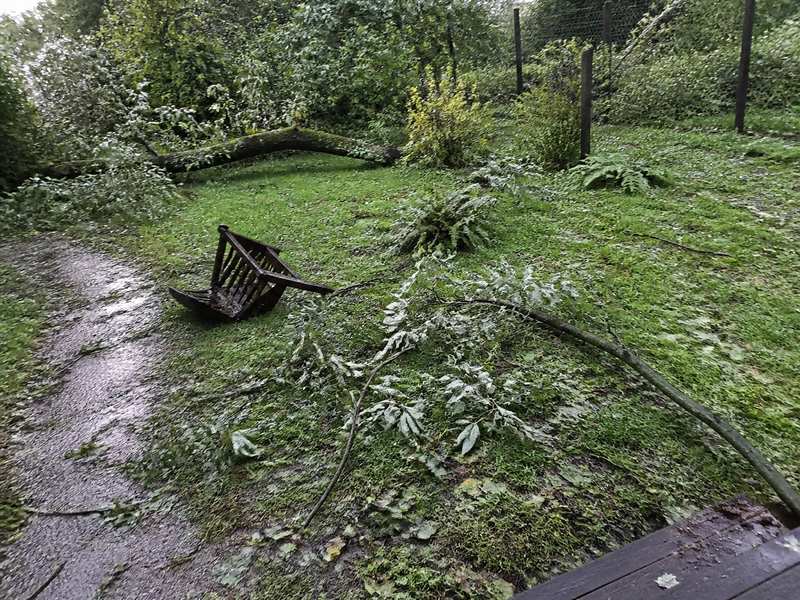
On a city edge with tall trees we get a wave of enquiries after every big storm. There are three typical cases: a branch that has broken but is hung up in the crown; a snapped top; and a tree that has leaned towards the house or the fence.
The hung-up branch is the most dangerous — it can stay put for weeks and then come down without warning, and it cannot be moved safely from the ground. That is emergency work, and we take it outside the normal queue, aiming to come out the same day.
Large plots and overgrown edges
Plots in Berģi are often larger than in the city centre, and some of them have not been managed for years. The typical task is tidying the edge of the plot: aspens, willows and maple regrowth along the boundary, branches over the drive, an overgrown fence line.
On jobs like this we start by walking the plot with you and deciding what to keep — a mature pine or oak is an asset to the property, and once it is cut you will not get it back. The rest we take out, chip and haul away; the stumps can then be ground out. More on this: clearing land of trees.
The spruce bark beetle in the forests around Berģi and what follows from it on private land
Berģi borders the forest, and that is exactly why the spruce bark beetle matters more here than in the city centre. If there is a group of dead spruces in the neighbouring woodland, the insects look for the next trees, and the spruces in your garden — with a thinned crown or damaged roots — are an easier target than those growing in the forest.
What we suggest you look for yourself:
- fine brown sawdust on the base of the trunk or in the cracks of the bark;
- fallen bark at the foot of the tree, with galleries visible underneath;
- the colour of the crown — a spruce often dies from the top and from the inside, rather than evenly;
- drops of resin with a small entry hole in the middle.
If the bark is already falling, the tree cannot be saved — at that point the question is how quickly to remove it so the pest does not spread on to the neighbouring spruces. A green spruce that has not yet been colonised is worth assessing and keeping. We have described the signs more fully in the section on the spruce bark beetle, and a tree health assessment helps to sort out which spruces to fell and which to leave.
Long drives and access on the large properties of Berģi
On many properties in Berģi the house stands deep in the plot, reached by a narrow, long drive between the trees. Day to day that is no trouble, but the problem shows up the moment a larger vehicle has to get in — a firewood delivery, a concrete mixer, the refuse lorry or the fire brigade.
A practical rule of thumb we suggest keeping along the drive:
- about 4 metres of clear height above the carriageway — anything lower and the drooping branches are the first thing to scrape the roof of a lorry;
- clear width across the whole width of the drive, including shrub regrowth from the sides;
- somewhere a vehicle can turn or reverse out without getting stuck in soft grass;
- dead and part-broken branches over the drive — these fall straight onto the carriageway and are the first to damage a car.
This is not work worth putting off until the drive has already grown over — by then it is no longer branch removal but several days of clearing. Usually deadwood removal and lifting the crown along the edge of the drive once every few years is enough. The material we cut we can chip on site and leave the chip with you for paths and beds, or take it away — whichever suits you.
What we do in Berģi
All of our services are available in Berģi. The most requested in this neighbourhood:
- Dangerous tree removal — Dead, rotten, leaning and damaged trees. We assess first, then cut.
- Emergency tree removal — Fallen and broken trees after a storm — we come out the same day.
- Tree crown care — Crown shaping, thinning and deadwood removal.
- Stump grinding — Stump grinding without digging — the lawn is left almost untouched.
- Tree health assessment — Is the tree dangerous? We inspect it and tell you what to do.
- Branch and timber removal — Branch and timber removal, including where someone else did the cutting.
The full list with descriptions is in the services section.
How the work is done
- We get back to you within 5 min. Fill in the form and attach photos showing the tree at full height, its base and the route up to it. That is often enough for a rough quote.
- Assessment. We come back with an approximate price and method. If access in Berģi is difficult, we come out to look before the work.
- Permit, if one is needed. We check whether the particular tree needs one in Rīga and file it on your behalf.
- The work. We agree a time, cordon off the working area and arrive with everything needed.
- Clearing up. We chip or collect the branches and take them away. We do not leave wood chip behind. If you want the firewood, we cut it to length and stack it where you ask.
What the price depends on in Berģi
There is no flat rate per tree. In Berģi our quote takes in the tree's height and girth, its species and condition, the distance to buildings, whether there is a drop zone on a larger plot, whether climbing or machinery is needed, and the volume of material to be hauled away.
In Berģi the price is influenced by the size of the plot and by vehicle access — several trees in one visit works out noticeably cheaper per tree than a single call-out on the city edge. We have put the full list with explanations on the prices page.