
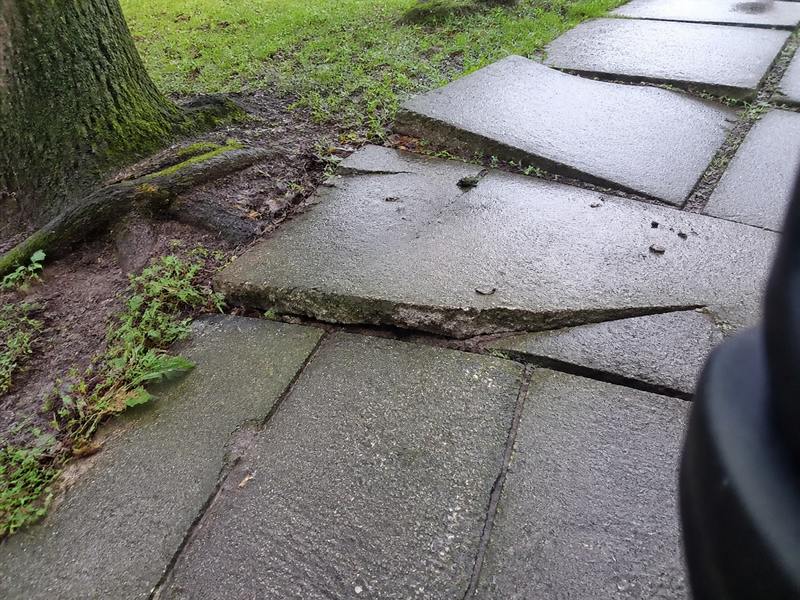
What roots can and cannot do
A root grows by seeking out air, moisture and the least resistance. It is not a drill. A root cannot break open sound, dense concrete or intact foundations — it simply has no such force, and it does not even try. What a root does is different and important to understand: it finds a crack, joint or gap that is already there, grows into it and then, thickening, widens it.
From this follows a simple conclusion that changes the whole conversation: wherever a root has caused damage, there was almost always a weak point already. The root is a consequence, not the first cause. A solid concrete slab without cracks and a sound pipe with a tight joint are simply an obstacle to a root, and it goes around them.
The second important fact: tree roots are shallow and very wide-spreading. Most of them grow in the upper layer of the soil and often extend twice as far as the crown. So roots are exactly where the paving, the paths and the shallow services are — and usually not where deep foundations are.
The real damage roots do cause
Lifted paving, paths and terraces
This one is genuine and common. A thick root growing beneath a shallow paving base lifts it over the years. The result is an uneven surface, blocks pushed proud and a place where you can trip. The same happens with thin asphalt and concrete slabs — they simply crack. It is a nuisance, sometimes a real trip hazard, but it has nothing whatever to do with structural safety.
Lifted kerbs and thin slabs
Road and path kerbs, greenhouse bases, thin concrete paths, shed floors. These elements are light and shallow, and a root moves them without difficulty.
Pipes entered or blocked
Roots really do grow into sewers and drainage — but almost always through a joint or crack that was already leaking. A leak is a signal to a root: there is water and nutrient there. It grows into the gap, and a dense plug of root matting develops inside the pipe and blocks it. The order of cause and effect matters: old ceramic pipes with clay joints leak over the decades, so the problem is the pipe, not the tree. A new, tight plastic pipe is not vulnerable to roots.
When concern about foundations is justified
Real foundation damage caused by a tree is far rarer than the talk about it suggests — and the mechanism is usually not mechanical force but soil moisture. In clay ground a large tree draws a great deal of water in summer. As clay loses water it shrinks, and the ground beneath the foundation settles slightly. In autumn it swells back. Over the years this movement can produce cracks — but that depends on the type of ground, the depth of the foundation and how old and shallow the house is. Old, shallow houses on clay are susceptible; modern foundations in dense sand or gravel usually are not.
The concern becomes justified when several things coincide: a large, thirsty tree close to the house, clay ground, shallow foundations, and new, growing cracks appearing in the wall that change with the seasons. If a crack in the house has been there for twenty years and does not change, the tree beside it is most likely not to blame.
In most cases where we are told "the roots are damaging the foundations", it turns out that what is damaged is the paving or the path, not the foundations. If cracks in the building worry you, the cause needs establishing before the tree is touched — often it is drainage, a leaking waste pipe or the foundation structure itself. Felling the tree before the diagnosis means losing the tree and keeping the crack.
Why cutting roots is the most dangerous solution
The thick roots near the trunk are not feeding roots — they are the tree's anchor. They hold a crown weighing hundreds of kilograms against the wind. If lifted paving is "solved" by severing the thick root that lifted it, the tree loses its stability on that side. Outwardly nothing changes: the tree stays green and stands. In the next strong wind from the opposite direction it can go over — root plate and all. On top of that, the cut is a route for decay, which over the years travels into the trunk.
The nearer the trunk a root is cut and the thicker it is, the greater the risk. Severing several thick roots on one side is one of the commonest reasons a tree begins to lean a few years later. If digging has already taken place near the tree, the starting point is a tree health assessment, not the next cut.
This does not mean no root may ever be cut. It means that first someone has to look at which root it is, how far from the trunk, how thick, and what is left afterwards. That decision cannot be made from the appearance of the paving.
What to do instead
- Relay the surface with room to spare. The paving is lifted, the base is levelled, the root is left in place and the surface is laid back over it, leaving room for growth. It is not a permanent solution, but it does the tree no harm and it can be repeated.
- A flexible surface. Gravel, a bark or chip path, a timber deck on point supports, or paving on sand without a concrete base accommodates root movement rather than cracking.
- Move the path. Often the cheapest and most durable solution is to shift the path a few metres rather than fight the tree every five years.
- A root barrier. In a new path or beside a new service run, a barrier can be buried that directs roots deeper or to one side. It works when installed before the problem; an already established root system cannot be corrected with a barrier, and the digging needed to install one can itself sever roots.
- Putting the pipe right. If roots have got into the drain, the roots are cut out and the damaged section of pipe is repaired or replaced. If the crack remains, the roots will come back.
- Accept a little movement. A slightly uneven path at the edge of the garden is not a problem worth a tree's life.
If a tree needs reducing in weight or lightening, that can be done through crown care — which also affects the tree's water use, but leaves its stability untouched. Conditions in the root zone can be improved with root and soil care, which sometimes removes the very reason the roots are coming to the surface — in compacted ground they have nowhere else to grow.
If the tree does have to go
Sometimes the honest answer is that the tree is growing in an entirely unsuitable place — too close to the corner of the house, over services — and the problem will recur whatever you do. Then removing the tree is justified. But that is a conclusion reached after an inspection, not before one. Some trees need a local authority permit before felling — see tree felling permits — and we arrange the permit for you.
What the price depends on
The cost of an inspection is set by the number of trees, the complexity of the situation and how much investigation is needed — whether the soil has to be opened up to look at the roots, for example. If work follows, the price is affected by its scope: relaying a surface, crown care and removing a tree are entirely different jobs. We explain how a quote is put together on the prices page. Photographs showing the tree, the distance to the building or path and the damaged area itself are useful in your enquiry.