
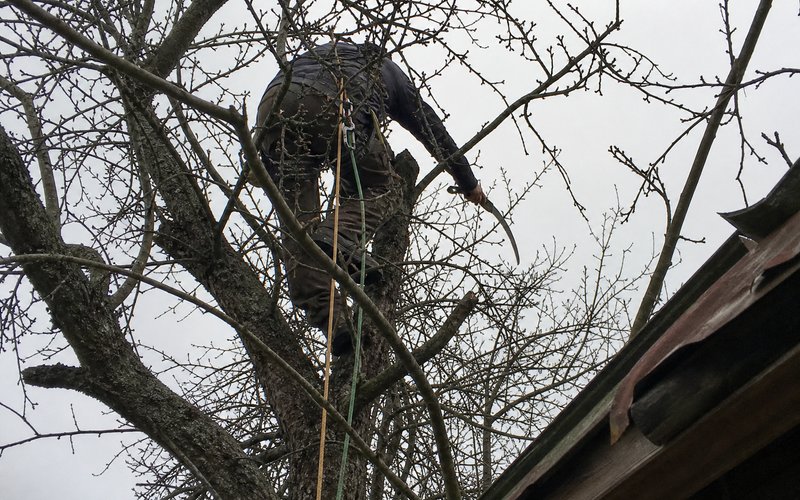
Why prune a crown at all
A tree in a city garden is not growing in the conditions it evolved for. It is surrounded by buildings, cables, paths and neighbours, and it is usually growing in a tighter space than it would choose. Crown care is the way to make it possible for that tree to stay where it is.
The most common reasons:
- deadwood that could drop onto a path, a terrace or a car;
- a crown that has become too dense and casts too much shade;
- branches reaching over a roof, a fence or a neighbour's boundary;
- branches blocking light, windows or vehicle access;
- a tree that has lost part of its crown in a storm and needs rebalancing.
What we don't do
We often see trees with the whole top of the crown cut off, leaving thick stubs. This does the tree serious harm: the cuts never close over, the wood begins to rot, and a mass of weak, congested regrowth sprouts from the stubs which, a few years later, is more dangerous than the original crown. We don't work that way, and we don't recommend it to anyone.
If a tree has outgrown the place it stands in, the honest answer is sometimes not to cut it back by half but to remove it and plant a species better suited to the spot. We will say so plainly when that is the situation.
Types of crown work
We use different techniques depending on the goal. More on the technical options — crown thinning, lifting and reduction.
- Deadwood removal. We take out only the dead branches. The live crown is left untouched. In safety terms this gives the most benefit for the least intervention.
- Thinning. We remove a proportion of the branches so more light passes through the crown and wind moves through it more easily. The tree's shape and size stay the same.
- Crown lifting. We remove the lowest branches so you can walk, mow or drive underneath.
- Reduction. We shorten individual branches back to the right point — rather than cutting the crown off.
How much can be taken off at once
This is where mistakes are made most often. A tree lives on what its leaves produce, so every live branch removed is a lost food factory. On a healthy tree you should not normally remove more than about a quarter of the live crown in a single season.
If bigger changes are needed — if a tree has to be reduced substantially, for example — we spread them over two or three seasons. The tree then has time to recover between visits, and the result is more stable. On an older or already weakened tree the limit is lower still: sometimes the right answer is to take out the dead wood and nothing more.
What happens at the cut
A tree does not heal wounds the way a human body does. It compartmentalises them — forming tissue around the cut that gradually grows over the site from the edges inwards. That is why it matters exactly where the cut is made.
- A correct cut is made right at the base of the branch, just outside the branch collar. That is where the wood holds the tissue capable of starting to grow over. A wound like this is closed within a few years.
- A left stub — a branch cut through the middle — cannot grow over, because the tissue that does the growing has been left on the piece still attached. The stub dies back, and decay enters the wood through it.
- A cut made too close takes the collar off as well and makes the wound larger than it needed to be.
The difference is not cosmetic. A badly made cut is the route by which rot and fungi get into the trunk, and the consequences show up years later.
How regrowth differs
After proper crown care a tree carries on growing normally — new shoots extend from the existing branches, and the shape of the crown is preserved. After crude cutting back the tree responds differently: many new shoots erupt from a stub at a single point, growing fast and densely but attached only weakly. Within five to ten years they are big enough to break, and they break exactly where the attachment is weak.
That is why it happens that a tree "tidied up" with the aim of making it safer is, a few years on, more dangerous than it was before.
How often crown care is needed
A mature tree in good condition does not need annual attention. Often an inspection every few years and deadwood removal as required is enough. More frequent attention is needed for:
- formally shaped trees and hedges, where the shape has to be kept up regularly;
- fruit trees, where pruning is part of getting a crop;
- fast-growing species such as willow and poplar;
- trees growing right against a building or over a path, where deadwood quickly becomes a risk.
Crown care cannot make a large tree small without damaging it. It cannot stop decay that is already in the trunk, and it cannot restore a root system that has been damaged. If a tree has outgrown the place it stands in, the honest answer is usually not annual cutting back but replacement with a species that fits the spot.
When to do the work
For most trees the best time is the dormant season — from late autumn to early spring. A few species, birch and maple among them, bleed heavily under sap pressure in spring and are better pruned in late summer. Dead and dangerous branches can be removed at any time of year. More detail on the seasons: when to prune trees.
Price
It depends on the height of the tree, the condition of the crown and how much dead wood there is, on whether we need to climb or can work from a platform, on the type of work and on the volume of brash to be taken away. Brash removal is included — how we work out the price.