
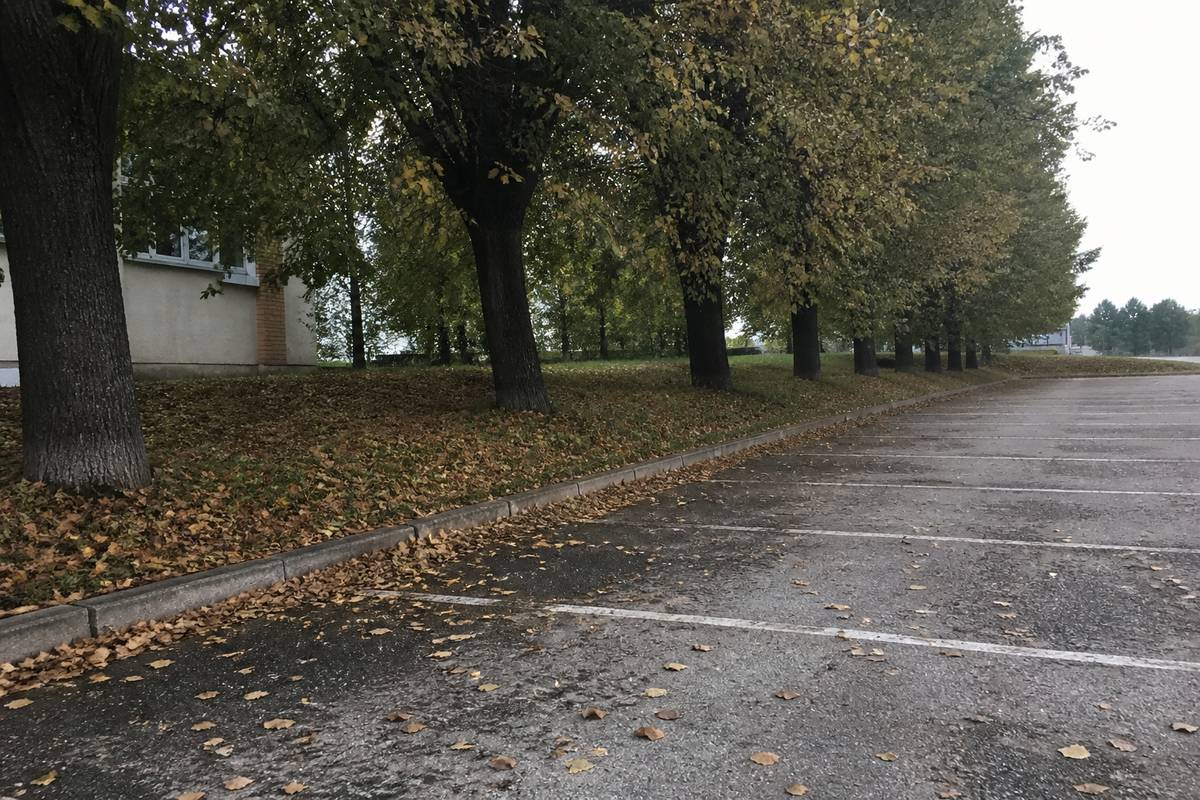
Olaine is a planned town with a clear division: a residential centre with apartment stock, districts of detached houses, and beside them the industrial, warehouse and railway areas. On the edge of the municipality the extensive forests and bogs begin. That division also determines which tree jobs are the most common here.
Business and industrial premises
In Olaine a large part of our work is not one tree in a garden but an area: car park planting, trees along the fence line, an overgrown edge of a plot, branches over the access road or over plant and machinery.
Industrial sites have their own requirements — passes, safety briefings, restrictions on working hours, warnings about where machinery must not be positioned. We plan for that in advance and adapt, including working outside normal hours or at weekends if the job would disrupt production. More: commercial tree care.
Apartment districts
In the residential part of Olaine the trees were planted at the same time as the buildings, and they have now reached full size. The commonest enquiries: poplars at the gable end, maples over the car park, and deadwood above the play area or the footpath.
The poplar is a story in itself — it grows fast, gets large and becomes brittle with age, and it is poplar branches that break most often after a storm. We have written about the peculiarities of the species under tree species and how we remove them.
Wet ground and drainage
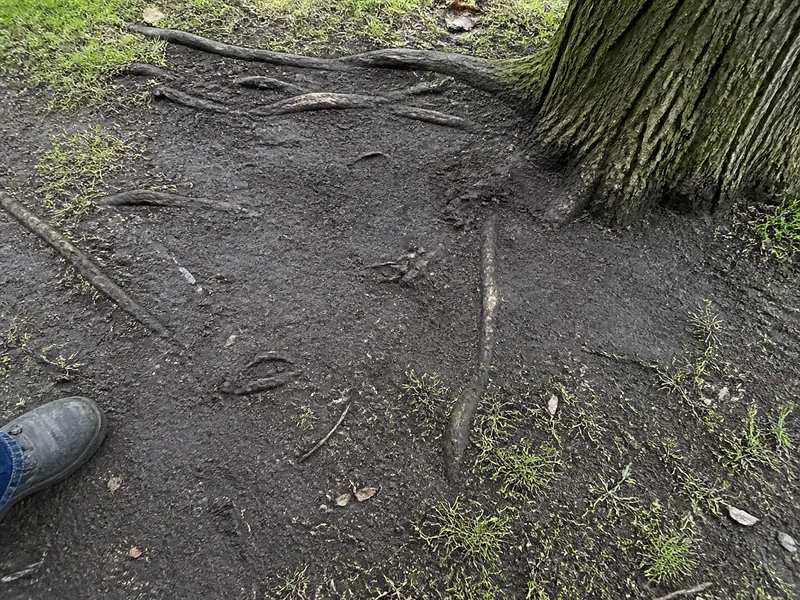
Around Olaine there are boggy areas, drainage ditches and, in places, a high water table. For trees that means the root system is shallower than it looks, and in a wet spell the tree holds less well.
For us it means planning the machinery: after prolonged rain heavy plant must not be driven over a lawn or soft ground — it will leave ruts that then have to be made good. In such cases we either wait for drier weather or work with lighter equipment and carry the material out.
Clearing plots
In Olaine municipality we regularly get enquiries about plots that have grown over with young birch and aspen, willow and scrub — usually before building work or the sale of a property.
We start by walking the plot with you and deciding what to keep. A mature pine or oak is an asset you will not get back once it is cut. The rest we remove, chip and take away; the stumps can then be ground out. In more detail: clearing land of trees.
Birches and pines in peaty soil — why they lean and break
Olaine was built in a ring of bogs and forest, and on many plots peat begins under a thin layer of sand or made ground. Trees there have no reason to send roots down — food and water are right there in the surface layer. The result is a flat, plate-like root system that holds the tree in dry weather but, in a long wet spell when the peat soaks through and softens, can no longer resist a sideways load.
In practice it looks like this: after an autumn storm a birch has not snapped but has gone over with the whole root plate, and a round roll of turf lifts out of the ground beside it. With pines the trunk more often breaks in the upper part, because the long, bare length of stem with a heavy crown at the top works as a lever. If a tree is already leaning and the root zone has begun to lift, there is not much time — in such cases we work to the leaning trees procedure and, where the danger is acute, we can be there the same day.
- A birch or pine left standing alone after the neighbouring plot has been cleared is especially vulnerable — it has grown in a group all its life and has never learned to hold the wind.
- In peaty ground the roots spread widely, so damage from digging or a road embankment is felt much further off than you would think.
- The direction of lean is not always the direction of fall — the weight of the crown and the wind exposure can change it.
Before deciding on removal we look at the root collar, the state of the soil and the load in the crown. Sometimes crown thinning is enough for the tree to last years more.
Gardens in Olaine and Jaunolaine — what to plan by season
In the private gardens of Olaine and Jaunolaine the problems repeat themselves: spruces and thujas planted too close to the house that have blocked the windows in twenty years, unpruned apple trees with congested crowns, and hedges grown wider than the plot boundary allows. In wet ground trees grow faster than the owner planned, so it is worth spreading the care across the seasons rather than putting it off into one big job.
- In winter and early spring — fruit tree pruning and crown work on larger broadleaf trees, while the ground is frozen and machinery will not rut the lawn.
- In summer — shaping hedges and thujas, removing deadwood, reducing shade over the greenhouse or the terrace.
- In autumn — assessing dangerous and leaning trees before the storm season, and tidying the grounds.
Which job is best done when is described in more detail under when to prune trees. We take the branches and chippings away ourselves, so no heap is left in the garden for the owner to deal with.
What we do in Olaine
In Olaine we offer our full range of services — from a single dangerous tree to clearing an entire site. The most frequently requested:
- Dangerous tree removal — Dead, rotten, leaning and damaged trees. We assess first, then cut.
- Emergency tree removal — Fallen and broken trees after a storm — we come out the same day.
- Tree crown care — Crown shaping, thinning and deadwood removal.
- Stump grinding — Stump grinding without digging — the lawn stays almost untouched.
- Tree health assessment — Is the tree dangerous? We survey it and tell you what to do.
- Branch and timber removal — Removal of branches and timber, including where someone else did the cutting.
The full list with descriptions is in the services section.
How the work happens
- We get back to you within 5 minutes. Fill in the form and attach photos showing the tree at full height, its base and its surroundings. That is often enough for a rough quote.
- Assessment. We reply with an approximate price and method. In more complicated cases we come out to Olaine to look before the work.
- A permit, if one is needed. We check whether the Olaine local authority requires one for that particular tree, and we handle the paperwork for you.
- The work. We agree a time, arrive with everything needed and cordon off the working area.
- Clearing up. We chip or collect the branches and take them away. We don't leave wood chip in the garden. If you want the firewood, we cut it to length and stack it where you ask.
What the price depends on in Olaine
There is no flat rate per tree. In Olaine the quote is set by the height and girth of the tree, its species and condition, the distance to buildings, cables and plant, whether there is a drop zone, whether climbing or machinery is needed, the bearing capacity of the ground and the volume of material to be taken away.
On larger sites in Olaine the price is set by volume rather than by individual trees — for work across a whole area we prepare a quote after a survey, and that usually works out better than tree by tree. We have set out the full list with explanations on the prices page.