
Saulkrasti stretches along the sea much as Jūrmala does, only in a narrower strip. Pine, sandy ground and a constant sea wind are the three factors that shape almost every job here — and they do not work the way they do inland.
The wind shapes the tree
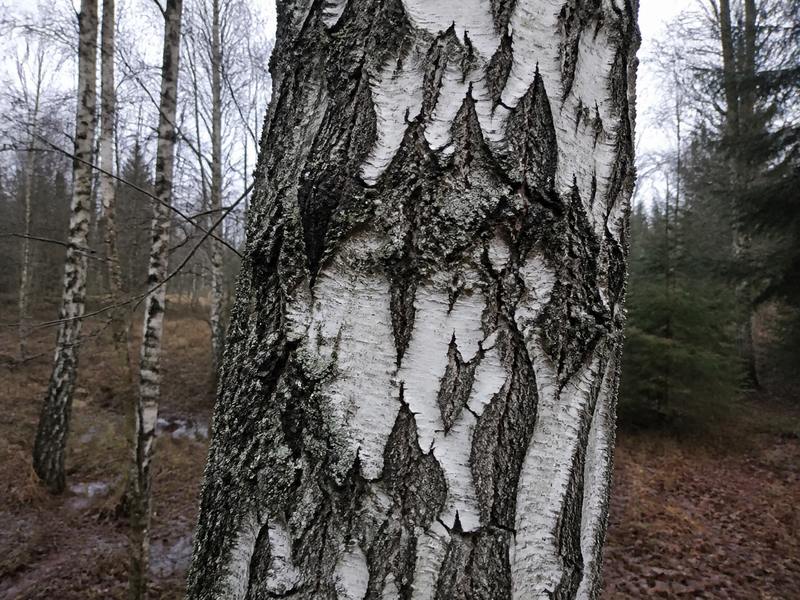
In the coastal zone the wind is not an event but a permanent condition. Pines and birches here grow with a one-sided crown — the branches on the seaward side are shorter, those on the landward side longer. That means the tree's weight is distributed unevenly, and the trunk works in one direction all its life.
In practice that changes two things: first, a tree like this must not be pruned symmetrically, because it has adapted to a particular load; second, the direction of felling has to be planned around that unbalanced crown, not just around the wind direction on the day of the work.
The dune zone and sandy ground
Sand holds less well than clay soil, and a pine's root system in it is wide but shallow. After strong storms off the sea it is here that we see trees thrown over with the whole root plate — not because the tree was diseased, but because the ground no longer held it.
Sand also means that heavy machinery must not be driven through the dune zone, and often simply cannot be. So in Saulkrasti we work a great deal with rope access, without driving up to the tree, carrying the material out to a point where a trailer can be brought up.
Summer houses and seasonal properties
A large share of Saulkrasti properties are used seasonally, and in many cases the owner is not present while the work is done. That is no obstacle for us — we agree access beforehand, where the cut firewood is to be left, and which areas machinery must not drive over. After the work we send photographs.
Seasonal properties often also mean a backlog of work: thujas untended for years, an overgrown edge of the plot, deadwood nobody has noticed. In such cases we usually walk the plot together and put the jobs into order of priority.
Saulkrasti is a long town
The town and the municipality stretch along the sea and the A1 for many kilometres — Lilaste, Saulkrasti, Zvejniekciems and Skulte are not one point. The address "Saulkrasti" tells us nothing about travel time, so the particular locality helps in your enquiry.
In the summer season access to coastal properties and parking are more difficult than in winter. If the work is not urgent, out of season it can often be done more conveniently and more cheaply.
A dead pine — why waiting costs more
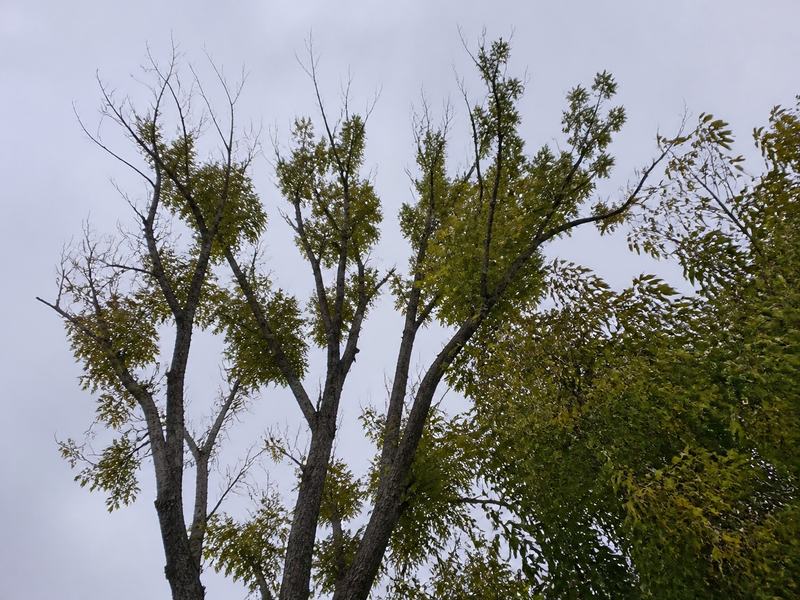
A Saulkrasti pine does not die in one night. First the upper crown thins, the needles become shorter and yellowish, then the branches die from the top downwards. Later the bark begins to flake away in plates and pale shavings collect at the base of the trunk — a sign that the bark beetle is already at work in the tree and the wood is no longer sound. If bracket fungi appear low on the trunk, the root collar has already broken down.
A dead pine is harder to cut than a living one, not easier. Living wood bends and holds; dead wood breaks without warning. A dead tree cannot be trusted either for climbing or for cutting a felling hinge — branches snap off under load, and the trunk can split earlier than the cut allows for. So with dead trees we work more cautiously and more often in sections, lowering the pieces on ropes.
That is exactly why waiting costs more. A tree that could have been cut last year takes more time this year, more rigging, and sometimes a MEWP. If you are unsure whether a pine is still alive, start with a tree health assessment.
Thujas and hedges on the seaward side
In Saulkrasti gardens a thuja hedge often looks like two different plants: on the side facing the sea the foliage is brownish and dry, on the other side green. This is not fungal damage. In winter and spring the wind carries salt and dries the foliage at a time when the frozen sandy soil can no longer supply water. The result shows in April, when the owner arrives at the summer house and assumes the hedge has been killed by frost.
- Do not rub off the brown foliage or rush to pull the plant out — many of the buds are often alive and recover by midsummer.
- When trimming, do not cut into bare wood: a thuja will not regrow from old wood, and on the seaward side such a gap stays for years.
- In the front line pine, juniper, sea buckthorn and hawthorn hold up better than thuja — a thuja needs the sheltered side.
In practice that means we shape hedges in Saulkrasti lower and denser rather than tall and narrow — a tall hedge in sand leans over and opens up in the wind. We plan thuja trimming for the summer, when it is clear what has genuinely come back, and we take the cut material away.
What we do in Saulkrasti
In Saulkrasti we offer our full range of services — from a single dangerous tree to clearing an entire site. The most frequently requested:
- Dangerous tree removal — Dead, rotten, leaning and damaged trees. We assess first, then cut.
- Emergency tree removal — Fallen and broken trees after a storm — we come out the same day.
- Tree crown care — Crown shaping, thinning and deadwood removal.
- Stump grinding — Stump grinding without digging — the lawn stays almost untouched.
- Tree health assessment — Is the tree dangerous? We survey it and tell you what to do.
- Branch and timber removal — Removal of branches and timber, including where someone else did the cutting.
The full list with descriptions is in the services section.
How the work happens
- We get back to you within 5 minutes. Fill in the form and attach photos showing the tree at full height, its base and its surroundings. That is often enough for a rough quote.
- Assessment. We reply with an approximate price and method. In more complicated cases we come out to Saulkrasti to look before the work.
- A permit, if one is needed. We check whether the Saulkrasti local authority requires one for that particular tree, and we handle the paperwork for you.
- The work. We agree a time, arrive with everything needed and cordon off the working area.
- Clearing up. We chip or collect the branches and take them away. We don't leave wood chip in the garden. If you want the firewood, we cut it to length and stack it where you ask.
What the price depends on in Saulkrasti
The price does not depend on the height of the tree alone. In Saulkrasti it is also set by the species and condition of the tree, how asymmetric the crown is, the distance to the building, whether there is a drop zone, whether climbing or machinery is needed, and how far the material has to be carried across sand.
In Saulkrasti the price is most often affected by access: if machinery cannot be brought up to the tree and the material has to be carried out over sand, the job takes considerably longer. We have set out the full list with explanations on the prices page.