
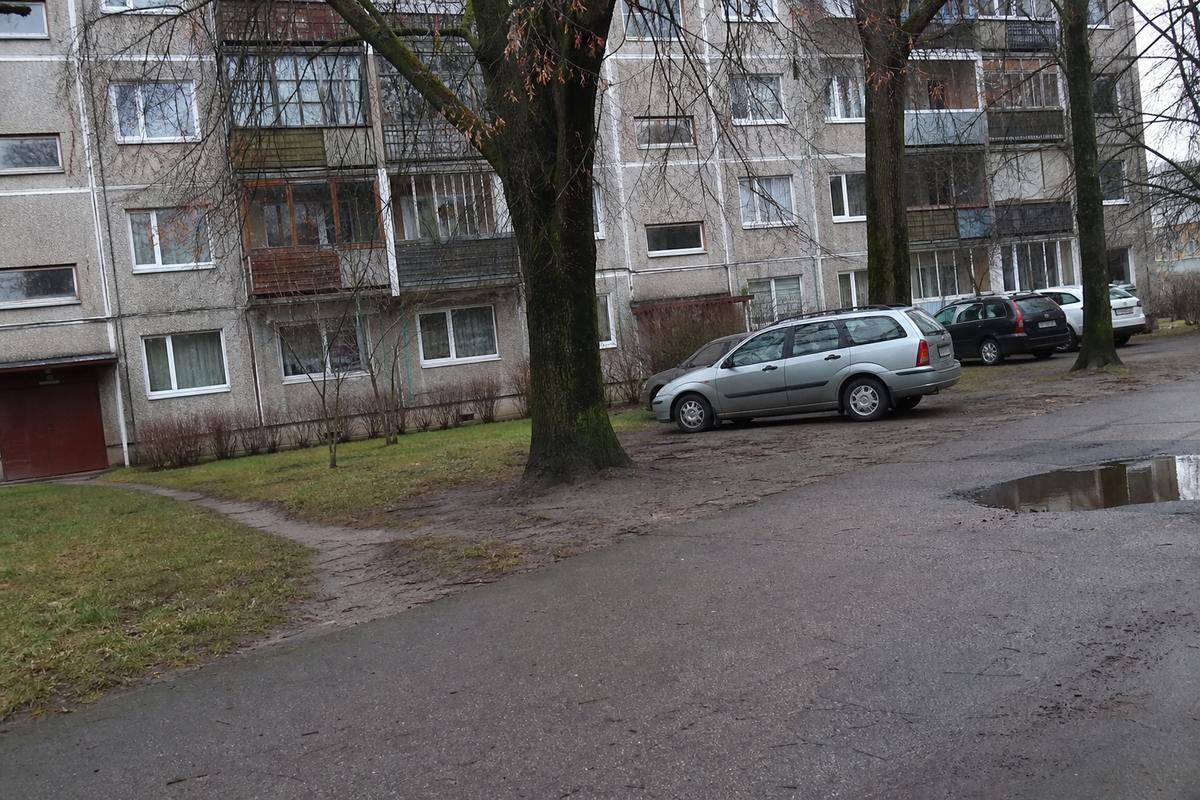
Vangaži is a small town of industrial origin where apartment stock, detached houses and wooded surroundings sit closely together. In tree terms that means a single visit can include both a courtyard job needing approvals and a completely unencumbered job in a private garden.
Courtyard trees the same age as the buildings
In the apartment part of Vangaži the trees were planted as the buildings went up. They are now full-grown: poplars, maples and limes reaching over roofs, parking areas and footpaths.
The commonest job here is not removing the whole tree but deadwood removal and crown reduction. If a tree does have to come out, there is almost never a drop zone in a courtyard, so we lower it in sections. The work is ordered by the managing agent or the owners' community — we prepare the quote and the description of the work.
Power lines and services
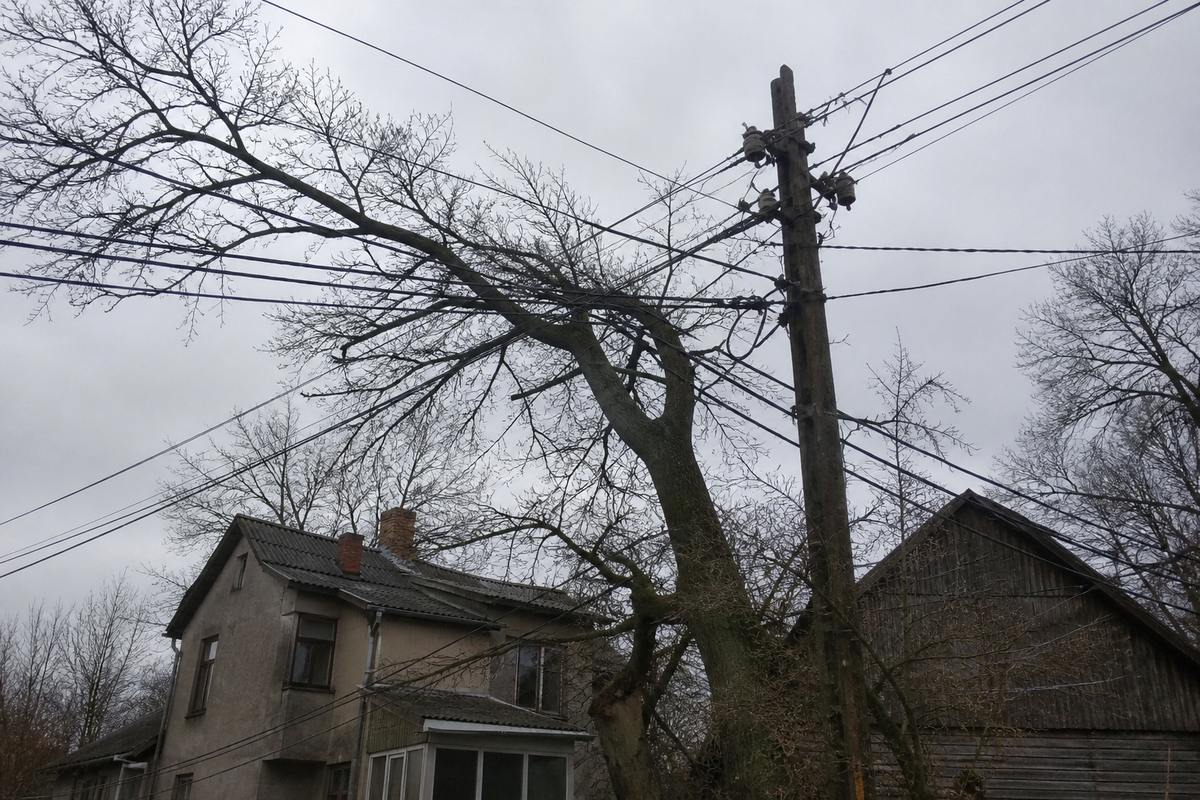
In a town of industrial origin the overhead lines and technical services run closer to the buildings than they do in newer districts. Branches growing near cables are a frequent situation — and one where it matters to know the limits.
Work near power lines requires coordination with the network operator, and some of it may only be carried out by them. We say plainly what we may do in the particular case and when the network owner has to be contacted — in more detail: removal near power lines.
Wooded edges and the Gauja basin
Around Vangaži there are wooded tracts and areas of the Gauja basin with wetter soil in places. The spruces and birches growing there come down after storms more often than trees in dry ground, and it is these trees that most often become an emergency call-out.
If a tree stands in a wet spot and you notice that the ground at its base has lifted or a crack has appeared, that is not a question to put off until spring.
Getting here on the A2
The A2 and the railway connect Vangaži with Rīga and Sigulda. In practice that means we often plan Vangaži jobs for the same day as Sigulda or the Ādaži side, which lie in the same direction.
Local access can be affected by the trunk road and railway crossings, so an exact address helps in your enquiry — we plan both the route and which machinery to bring from it.
Spruces on private properties and the bark beetle
Around Vangaži the spruce grows both along forest edges and in gardens — at many houses it was once planted as a hedge or simply left over from former forest land. It is precisely these solitary, open-grown spruces that the bark beetle finds first, because they suffer more from drought and sun in summer.
Signs worth checking yourself, without climbing anything:
- fine, pale brown boring dust at the base of the trunk, in the cracks of the bark or on the snow;
- small round holes in the bark, often with beads of resin around them;
- bark that flakes away in pieces, with winding gallery patterns underneath;
- needles turning red-brown from the top downwards in midsummer, and patches of bark stripped by woodpeckers.
If a spruce has already died, waiting improves nothing. A dead spruce loses its fine roots and the flexibility of its trunk faster than broadleaf trees — after a year it is already inclined to break in the middle, and rope work becomes more dangerous and more expensive. We have described the signs in more detail in the section on the spruce bark beetle, but if you are unsure whether the tree is still alive, we can look at it on site and carry out a tree health assessment.
Old gardens and overgrown boundaries
In the private housing part of Vangaži many gardens were laid out several decades ago, and not in all of them has the upkeep continued without a break. The typical picture: a dense strip of self-sown maple and alder along the fence, a thuja hedge grown from a metre and a half into a four-metre wall, and apple trees unpruned for ten years that no longer crop properly.
A garden like that is not recovered in one go. We usually start with whatever is most in the way — freeing the fence line and the drive, taking out dead and crossing branches — and only then turn to shaping the crowns. With self-sown trees it is important to decide which stay: an alder by the fence is, after five years, already a stem that garden shears will not cut.
- along the boundary — agree with your neighbour beforehand, because liability for boundary trees is shared;
- apples and pears do better with gradual fruit tree pruning over two or three seasons rather than one hard cut;
- stumps left after clearing scrub only stop being a nuisance once they are ground out.
We take the branches and wood chip away ourselves, so no heap is left in the garden for you to deal with.
What we do in Vangaži
In Vangaži we offer our full range of services — from a single dangerous tree to clearing an entire site. The most frequently requested:
- Dangerous tree removal — Dead, rotten, leaning and damaged trees. We assess first, then cut.
- Emergency tree removal — Fallen and broken trees after a storm — we come out the same day.
- Tree crown care — Crown shaping, thinning and deadwood removal.
- Stump grinding — Stump grinding without digging — the lawn stays almost untouched.
- Tree health assessment — Is the tree dangerous? We survey it and tell you what to do.
- Branch and timber removal — Removal of branches and timber, including where someone else did the cutting.
The full list with descriptions is in the services section.
How the work happens
- We get back to you within 5 minutes. Fill in the form and attach photos showing the tree at full height, its base and its surroundings. That is often enough for a rough quote.
- Assessment. We reply with an approximate price and method. In more complicated cases we come out to Vangaži to look before the work.
- A permit, if one is needed. We check whether the Ropaži local authority requires one for that particular tree, and we handle the paperwork for you.
- The work. We agree a time, arrive with everything needed and cordon off the working area.
- Clearing up. We chip or collect the branches and take them away. We don't leave wood chip in the garden. If you want the firewood, we cut it to length and stack it where you ask.
What the price depends on in Vangaži
There is no flat rate per tree. In Vangaži the quote is made up of the height and girth of the tree, its species and condition, the distance to buildings and power lines, whether there is a drop zone, whether climbing or machinery is needed, and the volume of material to be taken away.
In Vangaži the price is often brought down by the fact that the job can be combined with other sites in the same A2 direction — tell us if the work is not urgent and we will offer a more economical time to come out. We have set out the full list with explanations on the prices page.